
Archaeologists often seem to be obsessed with ancient wars and destruction. We can often be found eagerly sifting through the debris of ancient conflicts at long-forgotten sites, looking for hints of what happened “back then.” This is not so much because we are sadistic in nature, but rather because it is often within the debris of these ancient conflicts that we find the best-preserved material remains, which, in turn, can provide us with special windows into the past—destruction layers are almost like moments frozen in time.
However, even though archaeology turns up abundant evidence for ancient wars and destruction, occasionally it also turns up heartening evidence for peace. In the spirit of the present hope for peace that so many of us long for, let us examine some of this ancient evidence.
The Earliest Recorded Peace Treaty
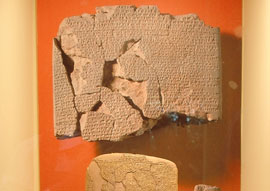
We know about this early peace treaty because, thanks to archaeology, several copies of it have been found. The Hittite version was originally found by archaeologists Theodore Makridi Bey and Dr. Hugo Winckler while excavating the ancient ruins of a village in Anatolia presently known as Bogazköy. After translating the text of the ancient tablet, Winckler, who was a cuneiform specialist from Berlin University, realized that, although written in Akkadian (the lingua franca of the time), it was the Hittite version of the peace treaty between Ramesses II of Egypt and Hattusilis III of the Hittite Empire! The Egyptian version, written in hieroglyphics on the walls of the Karnak temple (modern Luxor) in Egypt, had already been known to scholars for some time. Now Winckler held in his hands the Hittite version of this same treaty.
The text itself reads, “The Great Prince of Hatti shall not trespass against the land of Egypt forever to take anything from it. And User-maat-Re Setep-en-Re, the great ruler of Egypt, shall not trespass against the land [of Hatti, to take] from it forever... If another enemy comes against the lands of Usermaat-Re.. and he sends it to the Great Prince of Hatti, saying, ‘Come with me as reinforcement against him,’ the Great Prince of Hatti shall come to him." 1
This peace treaty between Egypt and Hatti is known among scholars as the Silver Peace because the formal version of the treaty that the Hittites presented to the Egyptians was engraved on a silver tablet. It is also, at present, one of the earliest peace treaties known in history (c. 1284 B.C.E.). However, it was not the only such treaty the ancients made.
The First Peace Treaty Between Egypt and Israel
Most of the world was surprised and thrilled to see the Palestine Liberation Organization’s Yasir Arafat and Israel’s Prime Minister Rabin standing on the same platform to sign a peace agreement. It brought back memories of a similar astonishing event just a few years earlier, when, during the administration of President Carter, Menachem Begin and Anwar Sadat signed a peace treaty between Israel and Egypt. However, as archaeologist Abraham Malamat noted at the time, this was apparently not the first time these two nations had made peace. Rather, it is likely that the original peace treaty between these two powers was made around 960 B.C.E. during the early part of the reign of King Solomon.
Unfortunately, there is no explicit mention of this treaty in either biblical or Egyptian sources. However, as Malamat shows, the existence of such a treaty can be readily inferred from certain references in the Bible as well as from knowledge of certain ancient Egyptian customs.
The key text is 1 Kings 9:16 (RSV), which reads, “Pharaoh king of Egypt had gone up and captured Gezer and burned it with fire and had slain the Canaanites who dwelt in the city, and had given it as dowry to his daughter, Solomon’s wife.”
There are two unusual occurrences in this story. Why would the pharaoh conquer a city and give it to Solomon—ancient kings were not usually so generous—and why would he allow a foreign king like Solomon to marry an Egyptian princess? While kings of other nations commonly gave their daughters in marriage in order to form key political alliances, this was not the typical Egyptian practice. Indeed, Malamat points out that for the period between 1400 B.C.E. and the 5th century B.C.E., there is explicit evidence that no daughter of a pharaoh was ever married to a foreigner. There is even an amusing story in which a Mesopotamian king asked the pharaoh for an Egyptian princess to marry, only to be turned down coldly. Not to be deterred, the Mesopotamian king asks the pharaoh to send any Egyptian girl, since his people won’t know the difference anyway! This Mesopotamian king’s eagerness illustrates how rare it was that a foreign monarch would be permitted to marry an Egyptian princess.
Returning to Solomon, Malamat has offered a plausible reconstruction of the background to these biblical passages. The reason the pharaoh attacked Gezer in the first place was probably an attempt by the Egyptian monarch to test the mettle of the new, young king of Israel, who had just recently succeeded his father David. Could he be intimidated? Would he ignore this encroachment upon the very borders of Israel? Malamat argues that somehow or other Solomon flexed his youthful muscle, and the Egyptian pharaoh, rather than entering into conflict with Israel’s king, decided to enter into a peace treaty. In fact, the pharaoh was so impressed with Solomon (whether from fear or admiration, we do not know, but Malamat suspects fear) that he took the unusual step of insuring the treaty through a marriage and thus offered his own daughter to Solomon to unite the two houses. The potential political provocation caused by taking a city on Solomon’s border was alleviated by the pharaoh’s offering the conquered city as a dowry for his daughter.
While we can’t be sure of the details of this reconstruction, the Bible does record the fact of the marriage between the house of Israel and the house of Egypt, which is, in itself, adequate testimony for the existence of a peace treaty between the two countries. Once again, just when people were on the brink of going to war, cooler, wiser heads were able to redirect the passions into a peace that would benefit all.
1 John A. Wilson, “Egyptian Treaty,” in Ancient Near Eastern Texts Relating to the Old Testament, ed. J. B. Pritchard, 3rd ed. (Princeton: Princeton University Press, 1969), 200.
Image: Istanbul - Museo archeol. - Trattato di Qadesh fra ittiti ed egizi (1269 a.C.) - Foto G. Dall'Orto 28-5-2006. Public Domain