
In the recent Christian and Jewish interchanges, a controversial issue has emerged that ignited a passionate discussion between representatives of both sides: Are the roots of the Holocaust to be found in the New Testament? Are the New Testament’s teachings and writings the very source that gave birth to Christian anti-Semitism, causing the uncountable atrocities perpetrated by the Christian Church, Christian countries, or Christian fellows against the Jews?
Is the undying and unspeakable hatred against the Jews, fostered by so many Christians throughout history, a New Testament offspring? Different and opposite answers have been given to these troubling questions.
On one side, we can find a group of Jews and Christians who see a direct line of connection between the New Testament, Christian anti-Semitism, and the Holocaust. In his book The Crucified Jew: Twenty Centuries of Christian Anti-Semitism, Rabbi Dan Cohn-Sherbok traces the history of Christian anti-Semitism from New Testament times to the present. In part two of his book, he deals with the theme of “Anti-Judaism in the New Testament,” arguing that it was the Christians and their Church who initiated and condoned anti-Semitism and that it started with the New Testament deep distrust of the tradition into which Christ himself was born.1
On this same line, a strong and direct charge is made by Shmuel Golding of the Jerusalem Institute of Biblical Polemics. For him, it is clear that the “root cause of Christian anti-Semitism... lies in the New Testament itself" and that “its fruits have been plucked and digested by Christians from the earliest times until the present day.” He continues, stating that “there are numerous verses found in the New Testament that have caused the blood of countless Jews to be shed throughout history" and that “these anti-Semitic statements were and still are the principal cause of all persecutions, oppressions, and pogroms in which Jews have suffered.” After quoting a number of New Testament texts, which in his view are anti-Semitic, Golding says that “these vicious and treacherous New Testament teachings” have given the impression of the Jews as “degenerate and cruel and that they are a deicide race.” He also quotes some "Christian'saints'' and leaders” (such as Origen, St. Jerome, St. Augustine, Luther, and others) in order to show how the New Testament teachings were perpetrated throughout history. He closes his argument by stating that “any Jew who can pay homage to the New Testament or allow himself to believe in it is, in my opinion, in the same category as a Jew who tries to justify Hitler’s Mein Kampf or as one who covers up for the deeds of the Nazis.”2
Some Christians have also adopted a similar point of view. For Elisabeth Schüssler Fiorenza and David Tracy, “Christian biblical theology must recognize that its articulation of anti-Judaism in the New Testament... generated the unspeakable sufferings of the Holocaust.” The Methodists A. Roy Eckardt and Alice Eckardt wrote that within the “New Testament... the defamation of the Jewish people... constitutes in and of itself an incitement to corporate murder.” As for the Catholic theologian David Efroymson, there is a “direct line” from the New Testament “to the Holocaust.” The British minister James Parkes stated that “it is dishonest henceforth to refuse to face the fact that the basic root of modern antisemitism lies squarely in the Gospels and the rest of the New Testament.”3
On the other side of the debate, there is a group of Jews and Christians who see no connection between the New Testament and the Holocaust. In his book Hated Without a Cause, Christian theologian Graham Keith argued against seeing the New Testament as the origin point of anti-Semitism. In the first chapter of the book, he started his argument by tracing back the origins of literary anti-Semitism to the Hellenistic literature of the third and second centuries B.C.E. that reflected the conflicts and tensions that occurred in Egypt between the Jewish and Greek populations. Hence, anti-Semitism is anterior to the New Testament and did not start with it. Further on in the book, he maintained that the New Testament passages should not be taken out of their context and that one should be careful in differentiating between anti-Semitism, which is an antipathy to a specific people based on race, and Jesus and the apostles’ opposition to Judaism, which is a religious attitude toward a reconstruction of Old Testament faith in Rabbinical Judaism. He concluded by saying that “the charge, therefore, that anti-Semitism is embedded in the New Testament is false. Certainly, if sections of the New Testament are read superficially or without due regard to the full context, they may well provide scope for those who come looking for additional fuel to fan the flames of anti-Semitic prejudice, which have already been started for very different reasons. Sadly, the church has been guilty of misreading its own Scriptures at this very point.”4
In a similar line of thought, New Testament scholar Veselin Kesich wrote that anti-Semitism had its source in the pagan and Roman worlds prior to the rise of Christianity. As an example, he mentions the well-documented riots that erupted in the city of Alexandria in the 30s C.E., when the pagan populace of the city, out of resentment for the Jewish influence in the city’s affairs, attacked its Jewish inhabitants, looting their houses and burning them out, in a form of a classic pogrom. Furthermore, for Kesich, the charge that the New Testament is anti-Semitic comes from the perspective of a reading that takes the New Testament out of its historical context. In the New Testament, one does not find tension and polemics between two religions (Judaism and Christianity), but between two Jewish groups (Pharisees and Christians mainly, and usually in the post-Jamnia era) concerning their views of Jewish truth and faithfulness to the God of Israel. When compared with the intra-Jewish polemics present in the Dead Sea Scrolls, the New Testament polemics are much more controlled and circumspect.5
For Robert Vasholz, the New Testament speaks of God’s people's problems with the same terms and language used in the Hebrew Bible by Moses and the prophets. Indeed, when compared, the writers of the Hebrew Bible have more strong and rough lines against their fellow Israelites than the New Testament writers. Vasholz asks the question why no one accuses Moses or the prophets of being “anti-Jewish.” For him, the reason is that we recognize there is “an intra-Jewish religious tension in an attempt to aid Israel toward the goal of her high calling, not to proclaim Israel as the worst people on earth.” For Vasholz, we must approach the New Testament in the same light, for the Gospels were written within the context of Judaism.6
Officially, the Catholic Church has seen the problem in a light quite different from the two positions depicted above. The Vatican document about the Holocaust, “We remember: A Reflection on the Shoah,” issued in 1998, sees the reason for the long history of anti-Semitism, not in the Church but in the Christian world, and its erroneous interpretation of the New Testament. Quoting Pope John Paul II, it states: “In the Christian world—I do not say on the part of the Church as such—erroneous and unjust interpretations of the New Testament regarding the Jewish people and their alleged culpability have circulated for too long, engendering feelings of hostility toward this people.” The document continues, stating that “such interpretations of the New Testament have been totally and definitively rejected by the Second Vatican Council.” The document further differentiates between anti-Semitism, which was characteristic of the Nazi regime, based on theories contrary to the constant teaching of the Church on the unity of the human race and the equal dignity of all races and peoples, and the long-standing sentiments of mistrust and hostility that “we call anti-Judaism, of which unfortunately, Christians also have been guilty.” So, while the Christian world and many Christians have been guilty of anti-Judaism, anti-Semitism, which culminated in the Holocaust, is a product of the National Socialist ideology. This ideology, in itself, was not a Christian phenomenon but a neo-pagan ideology of the Nazi State. This state was against the Church, did not recognize any transcendent reality as the source of life and the criterion of moral good, arrogated to itself an absolute status, and was determined to remove the very existence of the Jewish people. “The Shoah was the work of a thoroughly modern neopagan regime. Its anti-Semitism had its roots outside of Christianity, and in pursuing its aims, it did not hesitate to oppose the Church and persecute her members also.”7
Troubling as they can be, the questions posed at the beginning of this article require all of us, Jews and Christians, to face some basic issues that are essential toward the search for answers.
First of all, we need to recognize that the New Testament was written completely outside the polemics between Judaism and Christianity that emerged from the end of the second and throughout the third centuries C.E. The complete history and teachings of the New Testament occurred still inside the Judaism of the time, and their major actors never thought of themselves as being anything but Jews (see, for example, the statements of Paul at the end of his life in Acts 22:2; 23:6; 28:20; Romans 9:1–5; 11:1). The understanding of the Jewish nature of the New Testament is essential, for, as stated by the Jewish French scholar André Chouraqui, “any reading of the New Testament, including the Paulinian [sic] corpus, underlines the unity of the Hebrews’ spiritual and cultural universe and erases the barriers that religious rivalry, deepened by the great tragedies of history, have constructed between the Jewish world and the Christian world.”8
Second, we must recognize that the Christian Church and the Christian tradition, and not only some Christians or the Christian world, have profoundly projected the roots of their anti-Semitism over the New Testament and developed it into a complex system of theological interpretation, religious teaching, and preaching. This system has become an integrative part of Christian thought and life throughout the centuries and nowadays. These anti-Semitic offshoots are not natural to the New Testament; indeed, they come from another origin, but they have overtaken the New Testament so strongly that for most Christians and Jews, they are one and the same. Its offspring are the countless acts of hatred, persecution, and all kinds of evils perpetrated through these many past centuries, including, for sure, the Holocaust.
The recognition of these two fundamental and opposite realities—the Jewish intrinsic nature of the New Testament and the traditional anti-Semitic roots that have overtaken the Christian understanding of it—can only lead us, men and women of goodwill on both sides, to strive to liberate ourselves from the spiritual “prison” generated by the foreign roots and look for the life-giving sap that can flow only from the real roots of God’s given word.
1 Dan Cohm-Sherbok, The Crucified Jew: Twenty Centuries of Christian Anti- Semitism (London: HarperCollins; Grand Rapids: Eerdmans, 1997). See a brief review of this book in www.interfaithscholars. org/crucified.html, March 2003.
2 Shmuel Golding, “Antisemitism in the New Testament” [www.messianicracism. mcmail.com/ca/antisem/g2.htm], March, 2003. See similarly Gerald Sigal, “The Vatican and Two Millennia of Denial,” Jews for Judaism Library [www. j e w s f o r j u d a i s m . o r g / j 4 j - 2000/html/library/vatican.html], March 2003; and also Uri Yosef, “The Anti- Jewish New Testament,” Messiah Truth: Counter-Missionary Education [www.messiahtruth.com/anti.hmtl], March 2003.
3 See Tom Macabi, “Antisemitism in John’s Gospel” [http://www.kimel.net/ john.html], March 2003. On the same line of thought on the Christian side see also Charles W. Allen, “Lectures Notes T-500, Post-Holocaust Theology” [www.cts.edu/FacHomePages/allenc/ t500_notes/PostHolocaust.htm], March 2003.
4 Graham Keith, Hated Without a Cause? A Survey of Anti-Semitism (Carlisle, UK: Paternoster, 1997), 90. See the book review by Bassam M. Madany in the Calvin Theological Journal, vol. 33, no. 2 (1998)[www.safeplace.net/members/mer/ MER_B011.HTM], March 2003. See also Michael Bott and Jonathan Sarfati, “What’s Wrong with Bishop Spong? 8) Alleged Antisemitism in the New Testament [www.answersingenesis.org/ docs/1119.asp], March 2003.
5 Veselin Kesich, “Is the New Testament Anti-Semitic?,” Jacob’s Well [www.jacwell.org/articles/1998-SPRINGKesich. htm], March 2003.
6 Robert Vasholz, “Is the New Testament Anti-Semitic?,” Chosen People Ministries [www.chosen-people.com/docs/ Curious/AboutUs2/Articles/NTAntiSem. html], March 2003.
7 “Text of Vatican Document on the Holocaust,” New York Times, March 17, 1998 [www.mtholyoke.edu/acad/intrel/ vatican3.htm], March 2003.
8 André Chouraqui, Un Pacte neuf (Turnhout: Brepols, 1984), p. 17.
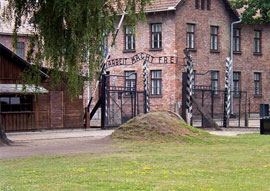
Image: Rail leading to the German Nazi death camp Auschwitz II (Birkenau). Public Domain