
In the strictest sense, archaeology can’t really say anything directly about the phenomenon of creation—that is more properly the task of the theological or biblical scholar—perhaps the biologist, palaeontologist, geologist, and physicist can contribute something from the scientific side. Archaeologists deal only with the residue of human activity in the past.
The archaeologist, therefore, does not expect to find things that directly relate to God’s activity in the creation of this earth. Nevertheless, God’s creative activity has always evoked questions in the minds of humans—they have thought about it, talked about it, and even written about it. In the case of the latter activity, archaeologists can perhaps contribute something because many ancient documents dealing with creation have been found by archaeologists. Moreover, as I will briefly explain, these extrabiblical texts are valuable in showing us both the historical and literary context of the Bible story of Creation and the theological context in which the Bible writer was working. In the case of the latter, we will see that the Bible writer was attempting to present a more enlightened and elevated perspective of the Creator and His Creation.
The First Discovery of Ancient Creation and Flood Accounts
The first extrabiblical ancient Near Eastern accounts of creation and the flood were found by Hormuzd Rassam in 1852 and 1853 while excavating the library of the Assyrian king Ashurbanipal at Nineveh. Ashurbanipal, who ruled Assyria from 668 to 626 B.C.E., desired to have copies of all the literature known to exist in his time and, therefore, had sent his scribes throughout Mesopotamia to copy and/or translate everything they could find. During this process, the king acquired a number of accounts of creation and antediluvial history, leading him to brag, “I studied inscriptions from before the flood.” Rassam found over 25,000 clay tablets from Ashurbanipal’s library; Rassam had these texts packed up and sent to England.
Nearly 20 years later, a young scholar, George Smith, was going over this large collection in the British Museum when he discovered a portion of a Babylonian flood story on a broken tablet. His publication of this tablet in 1872 caused quite a stir throughout Europe, and funds were provided for him to return to Nineveh and find the rest of the tablet. While not actually finding the missing part of the original tablet, he did find another tablet containing the missing parts of the same story, thus enabling him to fill in the gaps of the original tablet. It was discovered that Smith's flood story was part of a greater Babylonian epic, well known now as the Gilgamesh Epic. After Rassam's and Smith's initial discovery, several other renditions of the Babylonian Flood story were found on other clay tablets at numerous sites throughout Mesopotamia.
As it turned out, Ashurbanipal's library contained more than just flood stories. In 1876, George Smith published some fragments of a Babylonian creation account as well. It wasn't long before archaeologists at other Mesopotamian sites were turning up copies of what is now known as the Babylonian Genesis or the Enuma Elish (taken from the first works of the story, “When on high...").
Naturally, the discovery of both Babylonian creation and flood stories raised the question as to how these accounts were related to the biblical stories. Many conservative scholars suggested that the Babylonians borrowed from the Bible and introduced pagan elements. Most scholars, however, maintained that the Babylonian accounts antedated the Bible and that the latter's authors adapted the Babylonian accounts for their own use.
This view harmonized with the then-current view of a late date and multiauthorship of Genesis as well as with subsequent archaeological data from Mesopotamia that showed that both the Babylonian Enuma Elish creation story and the Gilgamesh epic had been a part of Mesopotamian literature for a considerable period of time. Specifically, earlier versions of the Enuma Elish creation story could be dated to ca. 1000 B.C.E., while portions of the Gilgamesh Epic were found to be dated to ca. 1700 B.C.E. (the latter, however, did not contain the flood story, as will be noted below). The various “parts” of the biblical Genesis, on the other hand, were dated to ca. 1000 B.C.E. at the very earliest, with much of it being composed during and after the Babylonian exile (6th and 5th centuries B.C.E.).
New Creation Texts
This general view of the relationship of Genesis to the Babylonian material has been maintained, with occasional variations, until recently, when the discovery of two separate second-millennium “primeval histories” raised the question as to whether the Enuma Elish and the Gilgamesh Epic really provided the best comparative material for understanding the biblical account. The two newer accounts are known as the Akkadian “Atrahasis Epic” and the Sumerian “Eridu Genesis.” Both date to about 1700 B.C.E. and may well reflect even earlier creation traditions of Mesopotamia.
The overall content of the Atrahasis Epic and the Eridu Genesis is actually quite similar to each other in that both contain a sequential description of creation, antediluvial history, and the flood. This “tripartite” literary structure is quite interesting because that is precisely how the biblical Creation story is organized in the first chapters of Genesis. The biblical account starts off with a Creation story and has a section on antediluvian history, which leads to a climatic story of the Flood. In this respect, these recently found Mesopotamian “primeval” histories are identical to the biblical account. The older Mesopotamian “primeval” histories that scholars have usually compared with the Bible are quite different. For example, the Babylonian Enuma Elish is only a creation story with no subsequent reference to the flood, while the Gilgamesh Epic, which contains a flood story, has no reference to creation.
Thus, neither the Enuma Elish creation story nor the Gilgamesh flood story are complete “primeval histories,” as are the Atrahasis Epic, the Eridu Genesis, and the biblical Genesis. The Enuma Elish, in fact, is a political document used by both the Assyrians and the Babylonians in which the creation story serves as a vehicle for establishing the priority of their respective chief gods (Assur/Assyria; Marduk/Babylon) and thus their respective nations in the greater Mesopotamian region. Both Assyrian and Babylonian scribes from later periods apparently “stripped” earlier creation accounts out of their “primeval” contexts and adapted them for later, political ends.
A similar thing can be said for the Gilgamesh Epic, in which the flood story was adapted from earlier “primeval histories” to create an additional illustration for the epic's main point, which is that death comes to all; therefore, there is nothing better than to enjoy life now. Support for the idea that the flood story was a late addition to the Gilgamesh Epic can be derived from the fact that while copies of the Gilgamesh Epic have been found that date to ca. 1700 B.C.E., none of the earlier ones (so far) have included the flood story. Indeed, the flood story occurs only in late 7th-century B.C.E. copies.
Genesis as a Second-Millennium Primeval History
The fact that the biblical account maintains the “tripartite” structure of a Creation-antediluvian historical narrative suggests that its proper historical setting is the second millennium rather than the first. Indeed, a few scholars have suggested this, such as Egyptologist Kenneth Kitchen and Old Testament scholar William H. Shea.* However, I would suggest that a closer examination of the interrelationships of the individual motifs contained within the larger structure of the biblical account supports this conclusion even more decisively.
For example, there are a number of motifs that the second-millennium primeval histories include that the first-millennium adaptation excluded or significantly altered. These motifs include the ideas of: (1) divine rest; (2) special day(s); (3) paradise; (4) kingship; (5) cities; (6) childbearing; (7) animal creation; (8) antediluvian history; (9) population; (10) flood causes; (11) flood hero's importance; (12) flood announcement; (13) animals on the ark; (14) animal sacrifice; (15) blessings for mankind; and (16) postflood commands. All of these second-millennium motifs are integral not only to the earlier, second-millennium Mesopotamian “primeval histories,” but to the biblical account as well. Indeed, the correspondence between the biblical account and the newly discovered second-millennium primeval histories is much closer than that which was earlier proposed between the Bible and the first-millennium Enuma Elish and the Gilgamesh Epic.
The Uniqueness of the Genesis Creation Account
At the same time, the polemical nature of the biblical account, in contrast with the second-millennium Mesopotamian literature, is even more specific than those proposed for the later accounts. It is as if the writer of Genesis was deliberately challenging the viewpoint of the Mesopotamian accounts point by point. For example, the idea of “nakedness” and animal clothing is mentioned in both the Mesopotamian and biblical accounts; however, their meanings are just the opposite. In Mesopotamia, “nakedness” was seen as a curse and animal skins as a blessing from the gods; in the Bible, nakedness portrayed the innocence of humans before the fall, and the animal skins were necessary only because of the loss of paradise. Again, in the Mesopotamian version, people become too numerous and noisy, necessitating floods, miscarriages, etc. to reduce the human population. In the Bible, humans are commanded to “be fruitful and multiply”; the cause of the flood is human wickedness, not noise! These differences can be seen throughout the differing accounts. Ultimately, we see that the Bible version of Creation presents us with a higher and more noble view of both God and His creation, including humans.
Thus, these new ancient creation accounts from the second millennium not only provide us with a more appropriate and meaningful historical literary context for the biblical Creation story, they also provide us with a more meaningful historical theological context, one that highlights not only the love of God in His creative acts but also His justice and mercy in dealing with His creatures after the tragic entry of sin—a justice and mercy that holds out the hope of future redemption and re-creation.
*K. A. Kitchen, The Bible in Its World (Exeter: Paternoster Press, 1977), 31-32; W. H. Shea, “A Comparison of Narrative Elements in Ancient Mesopotamian Creation-Flood Stories with Genesis 1-9,” Origins (Geoscience Research Institute) 11 (1984):9-29.
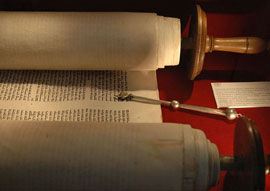
Image: A Sefer Torah opened for liturgical use in a synagogue service. Public Domain