
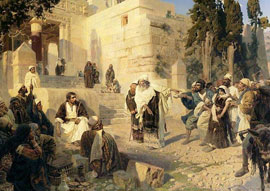
 It is usually a great surprise, for most Christians and Jews, to realize that the Jesus, the central figure of the Christian faith, never was a Christian, and never belonged to a Christian Church. On the contrary, during his entire life, Jesus was nothing but a Jew. He was born as a Jew, and he lived and died as such. Furthermore, according to the New Testament, he was resurrected as a Jew and ascended to heaven as a Jew. All the events of his life, death and resurrection, narrated in the Gospels and in the first chapter of the book of Acts, occurred well before the beginning of the church, hence, inside the Judaism of the time.
The realization of the Jewish nature of Jesus, his life and teachings, and of the New Testament proclamation about his person, has produced a profound impact on the Christian and Jewish perspectives about him and about the New Testament message. The last decades have seen a growing number of studies and works that have challenged the traditional Christian and Jewish views on the subject, and produced a growing movement, in both side, aimed at a revision of these traditional views, claiming a reshaping of our views on Jesus, his person, and his message.
Even through a cursory survey of Jesus’ life and message, one can perceive the depth of his Jewishness. Born of a Jewish mother, he is a Jew even by the most orthodox standards. Like any Jewish boy, he was circumcised when eight days old (Luke 1:21; Genesis 17:12). He received his name at his circumcision ceremony, according to the Jewish custom still common till today. As a firstborn Jewish son, he was taken to Jerusalem by his parents in order to be redeemed through the pidyon-haben ceremony, “as it is written in the Law of the Lord: ‘Every firstborn male is to be consecrated to the Lord’” (Luke 2:23; Numbers 3:12-13, 45-51; 18:16). In the Gospel report, we also find the earliest historical reference ever to the Jewish Bar-Mitzvah ceremony (the celebration of a Jewish boy’s religious majority). At the age of twelve, Jesus went to Jerusalem to take part in the religious celebration of Pessach (“Passover”) as an adult member of the community, and he engaged himself in Torah discussion with some religious leaders in Jerusalem (Luke 2:41-52). This Gospel’s report reflects a very ancient practice of this ceremony for, while the age for Bar-Mitzvah is normally 13 years old, in some ancient oriental communities, like the Jewish Syrian community of Aleppo and Damascus, if a boy is found to be very religious and advanced in his Torah studies, he performs his Bar-Mitzvah at the age of twelve instead of thirteen. As a practicing religious Jew, Jesus wore tzitzit (“fringes”) in the corners of his garment as a reminder that he has taken upon him the obligation to observe God’s Law (see Matthew 9:20; Mark 27; Luke 8:44; and Numbers 15:37-41). On the Sabbath day, it was his custom to go to the synagogue for worship, and he took an active part in it by reading from Bible scrolls and presenting the Derashah (“sermon,” cf. Luke 4:16-21). During the religious Jewish holidays, he usually went to Jerusalem and participated in their celebration in the Temple.1
The Gospels present his short ministry of three years and half as the one of an itinerant Rabbi (Matthew 4:23-25). He was recognized as a Rabbi by his contemporaries: Nicodemus, an important member of the Sanhedrin (the Jewish ruling council at the time), so called him (John 3:2); and so did many of his disciples (John 2:38; 11:28; 20:16). His teachings are aimed to help people to fulfill the Torah, and live a life of dedication to God and His Word: “Do not think that I came to abolish the Law or the Prophets; I have not come to abolish them but to fulfill them. I tell you the truth, until heaven and earth disappear, not the smallest letter, not the least stroke of a pen, will by any means disappear from the Law until everything is accomplished. Anyone who breaks one of the least of these commandments and teaches others to do the same will be called least in the kingdom of heaven, but whoever practices and teaches these commands will be called great in the kingdom of heaven” (Matthew 5:17-19).
Jesus’ way of praying was a Jewish way, as it can be seen in the Lord’s Prayer (Matthew 6:9-13). The opening words, “Our Father Who art in Heaven” (in Hebrew: Avinu she-ba-shamayim) is part of many Jewish prayers. Other elements of the Lord’s Prayer have many close parallels to two of the main Jewish prayers that have survived the ages: the Kaddish and the Amidah. As in the Kaddish and in the Amidah, in Jesus’ prayer, for example, the Name of God is sanctified and praised, there is a request for the coming of His kingdom, and that His will be done. Indeed, the same verbal form appears in the beginning of the Kaddish and the “Lord’s Prayer”: Itqaddash Shemeh/Shimcha (“hallowed be His/Your Name”).
Jesus’ death happens also well within the Jewish context of the political turmoil present in the land of Israel in the first century C.E. Like a great number of his Jewish brethren of the time, He died the violent death by crucifixion at the hands of the occupying Roman power. His growing popularity among the people of the land, his triumphal entrance in Jerusalem, when the multitudes of Jewish pilgrims hailed him with the Messianic titles of “Son of David,” and the “Blessed One who came in the Name of the Lord,” and his stern attitude toward the leadership of the Jerusalem Temple by driving away the money changers and merchants they had allowed to work inside the Temple area (Matthew 21:1-17), sealed the opposition of those who were involved with the Roman power and had no sympathy for him. They needed to stop him before this Messianic popular movement could get out of their control and become a menace to the political situation (see John 11:45-56). So he was charged of crime against the Lex Julia Laesae Majestatis, the Roman law that forbade anyone to even pretend any royal title or position within the territories of the Roman Empire. The only king of Judea was, by law, Tiberius Caesar. The penalty for such crime was death. And so Jesus was crucified, with the charge of his crime affixed upon his cross: “Jesus of Nazareth, the King of the Jews.”
Finally, the growing movement of Messianic recognition of Jesus was indeed a truly Jewish Faith phenomenon at the time. Since his birth, very pious and religious Jews recognized in him the Jewish Messiah. For Zechariah haCohen, the father of John the Baptist, the birth of Jesus was the fulfillment of God’s promises to the fathers and the proof that He remembered His holy covenant (Luke 1:68-73). Simeon, the Elder, probably one of the first rabbis who appears in the Jewish wisdom tractate Pirkei Avot (“Sayings of the Fathers”), called him God’s “salvation which You [God] have prepared in the sight of all people, a light for revelation to the gentiles and for glory of Your [God’s] people Israel” (Luke 2:30-32).2 During his life multitudes of Jews followed him (Matthew 4:25; 8:1; 9:35-38; etc.). Many influential Jews and members of the Sanhedrin admired him and some were his disciples in secret (John 3: 1-21; 7:50-52; 19:38-39). In his triumphal entrance in Jerusalem, Jesus is received by the multitudes as a prophet, and even more as the “Son of David” (Matthew 21:1-11). His arrest, judgment and condemnation needed to be done at night for fear that it would produce a revolt among the people assembled for the Passover in Jerusalem (Matthew 26:3-5; Luke 22:1-6). In the years that followed, the numbers of Jews who believed in him as the Messiah increased more and more until by the middle of the first century C.E. there were dozens of thousands of Jews who believed in him as the Messiah, just in the area of Jerusalem and vicinity (Acts 21:17-20). Indeed, prior to the destruction of Jerusalem in 70 C.E., Early Christianity became the largest religious body within Judaism. It lived and proclaimed, to Jews and Gentiles alike (Acts 1:8; Romans 1:17), its faith in Jesus as the resurrected Messiah.
Why did Christianity lose track with its religious roots and context? Why did Jesus, the Jew, become a foreigner to his own people? The history of this tragic development started in the second century C.E. and is too long and complex to be covered here. However, what we are seeing nowadays is his coming back home, and with it, there is a hope that he is paving the way so that we too, Jews and Christians, will come back to each other and live as brothers of a common faith in the God of Israel.
1 For Jesus’ participation at Pessach (“Passover”), see John 2:13-35; 6:4-71; 11:55-20:29. For Succoth (“Tabernacles”), John 7:2-8:20. In John 5:1-47, there is a reference to a religious pilgrimage festival but it is not actually identified which one it was. In John 10:22-42, a reference is made to events that occurred during Hanukkah, the feast that celebrates the “Dedication” of the Temple during the time of Judas the Maccabee in 165 B.C.E.
2 For a reference to this Rabbi Simeon, see Pirkei Avot 1: 17-18. He was apparently the son, or the grandson, of the famous Hillel and the father of the great Gamaliel II.