
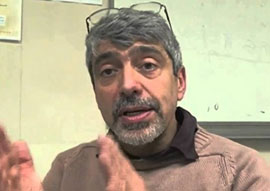
Philippe Haddad graduated from the Jewish Seminary of France and has functioned as a rabbi in Marseilles, Nîmes, and Paris. Since 1992, he has been the rabbi in charge of the youth and is the director of the youth movement Tikvaténou. Rabbi Haddad is also the author of two books: Ces Hommes qui parlaient, réflexion sur le prophétisme (These Men Who Spoke, A Reflection on Prophetism) and Yona, leprophète malgré lui, pièce de théâtre (Jonah, A Prophet in Spite of Himself, A Theater Play).
Shabbat Shalom*: What, in your view, are the right conditions for authentic dialogue?
Haddad: The God of Abraham has been recognized as the One who spoke, whatever the world may be. The Hebrew does not appreciate loneliness, not only because “it is not good that man should be alone” (Genesis 2:18), but also because his nature and subjective sensibility keep him aware of the "other." God speaks; this is the first great discovery of monotheism. To speak means to recognize others, to allow them a place, and to offer them life without imposing ours on them. A midrash tells about the feelings of God during the story of the burning bush. Will He reveal Himself with a powerful voice? This may frighten Moses, who is still young in the experience of prophecy. Will He restrain His voice and make it soft and thin? It may then be confused with a desert breeze. The solution? God will hear the voice of Amram, the father of the liberator. When the “father-son” relationship is successful, it is then possible to share ideas. Then, the "brother-brother" relationship is possible, and the “man-woman” relationship can work.
To speak also means to be an adult, to give oneself, and to recognize the duties of respect, brotherhood, and love. In fact, the history of language is the same as the history of the Bible—even the same as human history. In the beginning, Adam receives life, but it is not enough for him. He also wants the forbidden fruit; he desires totality. We must wait until Abraham sees the germination of the Hebrew, the Ivri, that is, the one who passes over to the other side, the one who recognizes the existence of a second shore. And here the Hebrew language is very expressive; in a very metaphorical way, it suggests “the lips” of the river. It is to this God, to this common memory, that a Jew, a Muslim, or a Christian should refer when they meet. It is fortunate that we share a common memory.
Shabbat Shalom: How do you perceive the progress of the Jewish-Christian dialogue?
Haddad: From the beginning of my rabbinic ministry, I have been involved in interfaith dialogue in the context of organizations such as the Jewish-Christian Friendship or the Brotherhood of Abraham. There are quite a few rabbis who are involved in this dialogue in Paris and elsewhere in France. Because this effort is consistent with the brotherly logic of the biblical message, it also allows us to explain Judaism without any distortion to Christians, who today are eager to return to their Hebrew sources. Indeed, I am struck by the progress of this dialogue. It is such that many universities and other professional associations organize these types of meetings.
Shabbat Shalom: What are the limitations of this dialogue?
Haddad: Some rabbis are reluctant to engage in this dialogue, either for theological reasons or simply because of the weight of history. In regard to the first argument, I would answer that we are not repeating the disputes of the Middle Ages, but we meet to hear each other and enrich each other. In response to the second argument, it seems to me that our look at the future for our children is more important than our stumbling blocks from the past. This does not mean that we should forget. On the contrary, “to remember” in Hebrew implies a commitment for the future. Jules Isaac has denounced anti-Semitism, and Vatican II has responded. The recent proclamations of the Pope have perplexed many of us. It is sufficient for the church to recognize its errors. But let’s not forget that we are just beginning, and the emotional weight is still heavy. But if we meet as friends, as we sing in the Haggadah of Pesach, Dayyenu, “It is enough for us.”
Shabbat Shalom: How is this dialogue understood in Jewish tradition?
Haddad: The Bible says very harsh things toward the Canaanite cults, especially because they involve ritual murder and immorality. We understand why dialogue between the prophet Elijah and the priests of Queen Jezebel was impossible. But today the world has changed; a humanitarian spirit springs from our religions when they are not embarrassed by their extremists. In many ways, this dialogue, which shows the good will of men and women of good faith, contains something of the messianic aim of the prophets.
Shabbat Shalom: What are the good things that this dialogue can do?
Haddad: To be together is actually a great achievement. This dialogue shows the secular person that we can be religious without being bigots or closed off from each other. True religion does not necessarily imply the ghetto, or the condescension and even the contempt for the other religion; on the contrary, it calls for openness, humility, and listening to each other. I also believe that we must prove to the new generations that religion should contribute to the peace of the world and not only to its destruction. In a recent colloquium, I saw a Jew, a Christian, a Muslim, and an agnostic talking to each other. This scene had something messianic about it! To talk to each other, to dialogue, is also a means to repair the first crime of history, the murder of Abel by Cain. Unfortunately, many Cains have arisen throughout the world. The greater our love, the greater the peace. Hope reminds me of one of the most beautiful messages of monotheism.
Shabbat Shalom: As a rabbi greatly responsible for the Jewish youth of Paris, what is the challenge of the Jewish-Christian dialogue for young Jews?
Haddad: My master, the late Chief Rabbi Jais, liked to refer to Abraham as a fulfilled man, faithful to particularism yet open to universalism. I would like to transmit this idea to young people. I believe that, as Jews, we should recognize the universal dimension of Abraham in the Christian mission. What was the intent of the apostles? We should be “Christians” in our Judaism, as Christians want to be “Jews” in their theology. The challenge also concerns us as citizens; as such, we must live in the city and be open and respectful to other traditions while remaining faithful to ours.
Shabbat Shalom: How do you explain this new interest in Jewish-Christian dialogue, especially after the Holocaust?
Haddad: I believe that the discovery of the horror of the camps and the works of Jules Isaac have played a great role in this awakening. Christians have begun to understand their part of the responsibility in the tragedy and feel the need for teshuvah (repentance). Consequently, after World War II, dialogue between Jews and Christians began. As long as we talk to each other, we are able to weave the material of brotherhood. Hitler has lost, and God is the winner. Fifty years after the Holocaust, we realize that this message is still valid.
Shabbat Shalom: Is it an authentic dialogue, or is it like a nice talk over a cup of tea?
Haddad: The dialogue is a particular action, an open one, and a courageous one. The Jew does not meet the Christian, and the Christian does not meet the Jew as one meets ordinary people, one’s colleague in the office, or someone at the bar. We carry the weight of our history, of our questions, of our doubts, and even of our fears. I do not feel at ease when I am invited. I feel that I carry a responsibility, and I am sure that a priest would say the same thing. But we also carry hope, and it’s this hope that brings us together.
This is why I am so sorry that there are not more rabbis or more Jews who participate in this dialogue. Of course, one can say that we Jews do not need the Christians to be Jews, whereas the Christians need their Jewish roots. To this argument, I will respond to the members of my community that the essence of the biblical message of the practice of Mitzwoth is brotherhood. As Joseph said, “These are my brothers whom I am looking for.” “Love peace and seek it,” states the Talmud. It is not enough to love values; we have to pursue them. You see, we are far from the little talk over the cup of tea.
Shabbat Shalom: What are the topics on which the dialogue should focus? Are there forbidden topics?
Haddad: In my view, there are no limits to an authentic dialogue. We can speak of our values, of our religious rituals, and we can study a text together. We can reflect on the problems of modern society. The only point that would bother me would be a theological disputation on the messiahship of Jesus with the intention of proving that one is right over the other.
I am often asked who Jesus is for a Jew and if salvation depends on obedience to the law. I answer according to my faith. The Christians will hear my answer as I hear theirs. When I respond that Israel is a people of priests, or the witness of God, I do not do any Jewish apologetic; I specify that this implies the feeling of being responsible in the name of God. In fact, every man, every religion, and every nation can play this role if they are careful enough. If there is no totalitarian attempt, we can walk together. And we know it since we want to dialogue.
Shabbat Shalom: What role does Israel play in the Jewish-Christian dialogue?
Haddad: Many Christians have understood the importance of the land of Israel for the Jews. This is the land of the fathers of the exiles, a land of refuge. As Jewish philosopher André Néher put it, “A mystical land of the absolute... the land of Israel is the living sign that hope can be realized.” This is a new picture of the Jews. They are no longer homeless; they can now settle under their fig tree or their vineyard. Of course, I do not ignore the problem of coexisting with the Palestinians. But peace will germinate. The Jewish-Christian dialogue should be accompanied by a Jewish-Muslim dialogue. The religious component of the conflict is an important element to address.
Shabbat Shalom: Do you have any suggestions for local religious leaders?
Haddad: I think that each city and each religious community should be involved in the Jewish-Christian encounter. It is the duty of the rabbi, the priest, or the pastor to take the initiative and call the other in order to set up a meeting. We should also use the mass media. Local papers, radio, and television are good means to communicate our ideals and promote Jewish-Christian friendship.
*Interview by Richard Elofer, correspondent for Shabbat Shalom in Israel.