
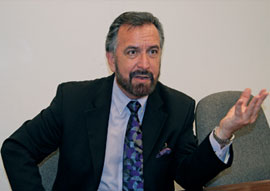
The tragedy of Jewish-Christian relations as viewed by a Rabbi of the Anti-Defamation League in Jerusalem.
Rabbi David Rosen was born and educated in Britain and continued his advanced rabbinic studies in Israel, where he received his smichah (ordination) and served as chaplain in the Western Sinai.
From 1975 to 1979, he was the Senior Rabbi of the largest Jewish congregation in South Africa, and from 1979 to 1985, Rabbi Rosen was Chief Rabbi of Ireland. He returned to Israel in 1985 and became Professor of Jewish Studies at the Jerusalem Center of Near Eastern Studies. In 1997, Rabbi Rosen was appointed director of the Anti-Defamation League’s Israel Office after serving for nine years as its director of Inter-Faith Relations.
Rabbi Rosen served on the Permanent Bilateral Commission of the State of Israel and the Holy See, which negotiated the normalization of relations between Israel and the Vatican. He serves as a member of the International Jewish Committee for Inter-Religious Consultations, which represents organized world Jewry in its relations with other world religious bodies.
Since 1995, Rabbi Rosen has served as President of the World Conference on Religion and Peace, the all-encompassing world interfaith body. In 1998, he was elected President of the International Council of Christians and Jews, the umbrella organization for some 30 national bodies devoted to promoting Jewish-Christian relations.
In March 2001, Rabbi Rosen joined the American Jewish Committee to head up its international interreligious relations activities.
Shabbat Shalom*: Rabbi Rosen, you are the director of Interfaith Relations of the Anti-Defamation League, Israel office, and we thank you very much for allowing us to interview you. We would appreciate it if you would explain to our readers exactly what the Anti-Defamation League is.
Rosen: The Anti-Defamation League was founded by the Jewish philanthropic social organization known as B’nai B’rith. B’nai B’rith itself was an organization that started in Europe to bring Jews together and unite them around common concerns despite different ideological or denominational affiliations. The Anti-Defamation League, known by its initials, ADL, started in the United States mainly to fight anti-Semitism, but if you want to fight anti-Semitism effectively, you have to fight all prejudice and bigotry. And if you really want to fight against prejudice and bigotry, then you should have prevention as well as just trying to cure. So it’s not only a question of litigation, of lobbying, of exposing, but also of education, of producing materials, of alliances, that is, of coalitions between different communities, and particularly in the field of interreligious relations, because religion can unfortunately be a source of prejudice. It can also be the greatest source of healing. And thus, there is a link for interreligious cooperation as well. What happened, then, with the ADL is that something that originally started for a specific purpose eventually covers the whole gamut of interests that affect the contemporary Jew, and not only with regards to Judaism and the Jewish community, but it becomes a human-relations agency for all different minority groups. For example, some of the best materials on minority groups in the United States have been produced by the ADL. During the Gulf War, much of the legal activity of the ADL was on behalf of Arab-Americans, who were the victims of prejudice in America. So this is a very wide-ranging organization today, and this organization, especially in America, has, like other American international Jewish organizations, offices here in Jerusalem. The main purpose of this office is to be a conduit of information between Israel and diaspora Jewry. So there, you have more or less an overview.
Shabbat Shalom: As we all know, the history between the Christian Church and Israel is a very painful one. Would you, from your perspective, give some of the reasons for the failure?
Rosen: Well, the simplest answer I can give you is that we are human beings, and human beings fail. Of course, the relationship between Christianity and Judaism is a particularly complex one because we come from the same source, and each has claimed to be the heir of that one original source. And when in the early days of Christianity there was, as it were, the competition between the (Nazarene) church and the Jewish community, the competition was perceived in terms of who had the authentic claim to be the continuum of that original revelation. I don’t think that the debates, however, in the early Christian church and the Jewish community are really the source of the later tragedies. It seems to me that the tragedy started when Christianity became an international political power. The real source of the problem came when the Jewish people were viewed from the perspective of a powerful church that believed that it was its responsibility to save the whole world through its own particular message. Now, within that context, you then have a development of perception of the Jewish people, which already emerges in John Chrysostom, I think, and definitely within Augustine. And that is a very interesting question. The basic question is the destruction of the temple and the exile of the Jews, especially after the Bar Kokhba Revolt. All these were viewed as punishments that were visited upon the children of Israel for their greatest failure of all, which is not so much portrayed as the deicide as much as the failure to recognize the identity of Jesus. And for that reason, they were cast out of their land, never to return. This begged a big question: If that was the case and if, then, Christianity has superseded Judaism and is the new Israel in place of the old Israel, and this displacement theology now comes in (supersessionism and displacement theology), then why are the Jews around at all? They shouldn’t be here at all. There’s no need for them to be here anymore. The answer given is that the reason the Jews survive is to prove the truth of Christianity. They are to be around always to be persecuted, to be vulnerable, to be homeless, to be wanderers, as proof of God’s wrath and repudiation of them, that they failed to recognize the true Christian message, and thus as proof of the validity of Christianity. This is what has been known as, or what Jules Isaac called at his famous meeting with Pope John XXIII, the teaching of contempt towards the Jews. It’s a teaching that says Judaism fulfilled its role in bringing about Jesus; it’s basically useless, dead, and purposeless once it fails to recognize the message of Jesus. The only purpose for Jews to remain is purely as a negative witness in that regard. And that provides not only a totally negative image of the Jew and of Judaism, but it also provides the kind of grounds, the turf, on which all kinds of terrible things can be done, and you could say, “Well, they deserved it.” So that, I think, is, in summation, the source of the tragedy of our relationship. It’s the tragedy of what we might say of a mother and daughter who, instead of being able to appreciate each other, have seen each other’s existence as somehow a repudiation of their own.
Shabbat Shalom: So, Jewish-Christian relationships were very difficult before the Second World War. They improved after the Second World War, especially after the birth of the State of Israel. Is there hope for better relationships in the future?
Rosen: Well, we can’t take ourselves seriously as religious people, regardless of what denomination we are, if there is no hope. So obviously, there is hope. But I think we could be more optimistic than even hopeful. There are more serious grounds to believe that things have changed, are changing, and are going to change. I think as we moved into the twentieth century, or already as we moved into the nineteenth century, there was a growing recognition in Europe that maybe these kinds of attitudes were neither healthy for society nor were necessarily true to the real Christian message. I think this process of self-criticism, which a world of enlightenment facilitates more, has led to some very significant changes in the Christian world amongst different denominations in terms of the way they view Jews and Judaism, so that, in the overall Christian world, we can say that there are wholesale sections of the Christian world today that are not, as far as Jewish people are concerned, to be considered to be a problem but are, in fact, part of the solution. There are many Christian communities in many places, and sometimes even within hierarchical structures, where an enormous amount of work is being done to help fight prejudice and to help deepen a greater understanding of the special relationship between Jews and Christians. There is still a great deal to be done, and there are still parts of the world that have not been touched by that spirit, where attitudes remain almost medieval. Nevertheless, if you take an overall spectrum, the transformation in terms of the attitude within the Christian world today, from even fifty years ago, let alone 200 years ago, is quite remarkable. So obviously, it’s not just a question of hope. There are clear grounds to recognize the changed reality; what, nevertheless, I think we should hope for is a deepening appreciation of each other’s value and worth. Now, that is not easy. It is no easier from the Jewish side than from the Christian side. Here, I’m probably touching on some of your other questions, and maybe we can come back and concentrate on them. But, if I may continue, there are two major issues that confront us in terms of looking at Jewish-Christian relations. One is one that we have already alluded to because, when we’ve spoken about the tragic past, we have been recognizing that there is something here that is inescapable. And the inescapability is primarily from the Christian side. A Christian cannot seriously define himself or herself without reference to Judaism, because Judaism is at the very roots of his or her identity and the central figure of Christian faith. Therefore, you can either define it negatively, as was done historically in the past, all too often tragically, and I believe in violence to true Christian affirmation, or you can look at it positively, as I believe it should be done, in which case the Christian cannot escape this compelling relationship with Jews and Judaism. It’s very much part of his or her own identity and sense of destiny and purpose. But the Jew can escape the Christian because the Jew does not have to relate to the Christian to understand his or her own identity. Therefore, he or she can live in isolation from it—I don’t think we should, but we may. And, in fact, for the vast majority of the Jewish people, probably 95 percent, we do live in isolation from it in that regard. So there is an asymmetry in our relationship, and therefore, as a result, we can’t talk in quite symmetrical terms or parallelisms when we’re talking about the nature of our relationships.
Then comes the other aspect, which makes things even more complicated. I don’t say that if we had had power during the Middle Ages, I know that we would have behaved better. I hope we would have behaved better. I can’t say that we would have behaved better. But the reality was that Christianity had the power; Christianity had the supersessionist ideology in relation to Judaism, the displacement theology, and as a result, we suffered at the hands of so-called Christians and in the so-called name of Christianity. The result is that, for Jewish history and for Jewish collective experience, Christianity is not the religion of love. We experienced it as a religion of violence. We did not experience the name of Jesus as a name of love; we did not experience the cross as a symbol of love—these we experienced as weapons used to beat us over the head. There is, therefore, an enormous historical trauma—wounds of the past—that is present within the Jewish people at the moment. And as a result, if I could be a little bit flippant here about it, if you were to go up to an Israeli in the street and say to him, “Hey, I’m a Christian, How do you feel about that?” He would say, “Well, to tell you the truth, I feel uncomfortable, because a Christian, to me, means somebody who, if he doesn’t want to do me physical harm, wants to steal my soul.” Now that is the image produced by the terrible historical past. But for Jews who live within enlightened Western Christian society (of course, not all Western societies are enlightened, and not all enlightened societies are Western, but if we could talk in that kind of generalization), you have today, thank God, millions of Jews who encounter modern Christianity, modern Christians, genuine loving Christians, open Christians, Christians who wish to discover their Jewish roots and understand their Jewish identity and wish to live in a relationship of mutual respect with Jews. In Israel, however, no less than 95 percent of Israelis have not encountered a modern Christian. And even when they travel abroad, they don’t meet Christians as Christians; they meet them as non-Jews. And the people that make up this society have either come directly traumatized by their experience of what Christianity has meant, from Eastern Europe, for example, or they’ve come from worlds in which Christianity has had a negative image from other medieval aspects—from the Islamic world, seeing Christianity as the Crusades, or even today’s Western consumerism as being just another manifestation of the Christian imperialist desire to take over the world! So whatever these ideas and images are, reasonable or irrational, they make up the reality of the way Christianity is perceived. This means that while it’s relatively easy now for Christians to discover their Jewish roots and to develop a positive relationship with Judaism, it is still very difficult for the majority of Jews to relate openly and without the prejudice of historical experience towards Christianity, let alone to rediscover the historical Jesus of Nazareth.
The problems here are not really theological. They might sometimes be couched as theological, but the problems are what I would call psychohistorical. So there are psychohistorical problems that confront the Jewish people, and therefore, in my work, I have difficulty often dealing with prejudice in some of my Christian interlocutors or certainly within the Muslim world, which has to do less with theology and more with politics. Nevertheless, I am fighting, at the same time, almost as intense a battle in my own courtyard, with my own colleagues who are opposed to my own desire for rapprochement and the development of cooperation with Christians because they see it almost as if I am endangering the Jewish community by being so open and so cooperative with what they see as a hostile entity. Now this, for Western Christians, must be terribly difficult to understand and must be terribly shocking, but this is the reality; this is a product of our tragic history. And therefore, there is a process that has to be gone through. The Jewish people are terribly wounded. The scars and wounds of our experience are still very real; they’re very much with us. The State of Israel, to a great degree, is part of our healing process. But we not only have to heal ourselves, which is a lengthy process, but in terms of the Jewish-Christian relationship, if Christians really care about their relationship with Jews and Judaism, then they have to play a major role in this healing process. Although healthy relationships are relationships of mutuality, nevertheless, in this context, our historic relationship has not been healthy, and the situation at the moment is not as healthy as it needs to be. Accordingly, there is a historic imbalance, and thus I even go so bold as to suggest that the responsibility is an imbalanced one, devolving disproportionately on the Christian side. Therefore, I say—out of a great desire for there to be a real rapprochement, a real reconciliation, a partnership between Judaism and Christianity—Christianity has to work very hard at winning our confidence. I hope and pray that this will be done, and in order to win our confidence, we have to be convinced that the desire of our Christian counterparts is not to do us physical harm or steal our souls, but genuinely to wish us well. Now that requires Christians to be extremely sensitive to our own Jewish hypersensitivities. Accordingly, if Christians really care about reconciliation, there has to be a moratorium—at least a moratorium, even if it’s a temporary one—on proselytizing.
Shabbat Shalom: Actually, you’ve covered most of the problems. Really, to what extent can Jews and Christians entertain this quality of dialogue and relationship? You’ve been very positive there. And also, maybe some more steps as far as practical things that Christians could do to enable dialogue and understanding.
Rosen: Well, I divided things into two areas. One is, if you like, cerebral, and the other is more action-oriented. Now the cerebral is very important because it has to do with our understanding of who we are, what we are, and why we are. And therefore, the first and foremost important thing I think Christians should do is study and understand the world of Jesus of Nazareth, to understand the way of life he lived, the tenets he espoused, and to understand how these were expressed within Jewish life and how they continue to be expressed in Jewish life. To recognize that Judaism did not, as the medieval Christian stereotype had it, come to an end either in the year 70 or in the year 135, but is a living, on-going religious way of life. To discover how this life is led and how it is expressed, and perhaps also to look and see what areas could be, still are, or should be relevant to the life of the Christian in order to enrich his or her own Christian life and expression. Then I think the next stage requires looking at the differences within the commonality, especially with regards to the terminology that we often use but don’t understand in the same way. Because we come from a common root, we have common terms, but nevertheless, because we have not taken exactly the same direction, we therefore understand some of these terms very differently. For example, terms like “sin,” “redemption,” "salvation," and "messiah" are words and terms that are not the same within Christian thought as they are within Jewish thought. A common origin can help us understand both the commonality and the difference at the same time. So there is a lot of study that needs to be done—a lot of study to discover what things are relevant to the life of the Christian in terms of his and her Jewish roots. Beyond that, in terms of winning the confidence of Jews, there are areas of dialogue and cooperation that can take place in terms of conferences and colloquia. I’m very much involved in this, but these are not the main things that I’m talking about. I’m talking about areas where one may get involved with helping in an Israeli development town with a population, for example, that came in from Yemen in the '50s and is disadvantaged, caught up in the poverty trap, unable to get out of it. Now such important welfare projects take place throughout our world and are important for every good person and every good Christian. But when such activity and a project for welfare takes place within Israel, within a Jewish State, directed at Jews, for nothing other than purely the genuine selfless love for the persons who are the object of that enterprise, that has an enormously profound effect. And there is not enough of that. There are one or two groups involved in various areas of that endeavor. There’s a group, Bridges for Peace, that does things like helping the elderly and looking after the needy—these are activities that I think really help shatter stereotypes and perceptions. And that’s terribly important in that regard.
Shabbat Shalom: What could Jews learn from the Christian church?
Rosen: Now, first of all, because of the psychohistorical problems, as I mentioned already, it has been virtually impossible during the last one and a half millennia for Jews to see the beauty within the teachings of Jesus of Nazareth, who, I would say, as an Orthodox rabbi, is deeply rooted in the Pharisaic world. There are a number of different areas where Jesus is clearly emerging from within a tradition—that is, my tradition—where maybe amongst the different rabbis of the time there would be different emphases. Within this trend, he was making a very clear call on certain ethical points that perhaps set him on high with regard to those particular perceptions. Now that Jews are able to look at those texts and those ideas and see them within the context of their own tradition, they can get a great deal out of the encounter with these ideas and insight within the tradition. But beyond that, I think there is something much more mysterious that is involved in our relationship. I think that Christians and Jews someday should ask themselves, What is God trying to tell us in all this? And what are its implications in terms of our universe and in terms of God’s plan for humankind? And I would be so bold as to say that we are called into and for a unique partnership, and there are aspects of our own affirmations that are exclusive to one another and that are of complementary necessity for humankind and for our cosmos. I think it’s something that needs to be studied and developed very profoundly, but in the simplest way, let me just point to the obvious distinction and obvious complementary nature. The covenant of Sinai is a covenant given to a people, in which a people is called to be a kingdom of priests and a holy nation. In other words, this is a national paradigm. That is why it takes the character of nationhood within the land, within a context of nationhood, to be a national paradigm. The paradigm, as Isaiah puts it, has two different dimensions based on the Pentateuch. One is to testify to God’s presence in history, which the very existence of the Jewish people does, for better and for worse—and this defies the normal, conventional, or even innovative materialistic theories of historians. That’s why Arnold Toynbee called us “a fossil of history,” because we irritatingly didn’t fit into his neat categories! The eternity of Israel—the very existence of Israel in the world against all odds—testifies to God’s presence in the world. Then, of course, there is the paradigm of being a kingdom of priests and a holy nation, the way of life, the commandments (mitzwoth), and the covenantal way of life that Jews are called upon to live. And this expresses itself within contemporary Jewish life in a great deal of diversity as well as a great deal of Sturm und Drang and various tensions, checks, and balances. But it’s part of the paradigm of people; it’s part of the spiritual way of life—a spirituality that emerges within the context of peoplehood. That’s one paradigm. But the paradigm of peoplehood, by its very nature, is not an unlimited paradigm. So there are paradigms that have to be relevant to the human personality when one is not part of that particular peoplehood or is not of a peoplehood that itself is seeking to be able to follow that paradigm. And that is, of course, the enormous power of the message of Christianity that goes beyond the national context, which in no way downgrades or limits that national paradigm but is a complementary paradigm by its very nature in terms of bringing the message of redemption to humankind. And it’s that, I think, that we need to explore, and one day we will eventually discover.
Shabbat Shalom: At the beginning of our interview, we agreed that the Jewish-Christian relationship became much easier after the Second World War and after the rebirth of the State of Israel. Now your answer to our previous question seems to lead naturally to another question, which may be the last. What is the impact and role, from your point of view, of the State of Israel on Israel and on the Christian church?
Rosen: First of all, let us look at it pragmatically. Pragmatically, the reality is that the Jewish people are paying a very heavy price for the realization of one of their great dreams. The great dream is that they will be able to live in a free world where nobody will persecute them and where they will be able to go about their business without anyone giving them any hassles. And the epitome and embodiment of that realization, that dream, is the United States of America. There is nowhere in the history of Jewish existence where Jews have had it so good in terms of the context of the society in which they live as they do in the United States. I’m not saying, by any means, that everything in the United States is hunky-dory. I’m not saying that there is no anti-Semitism or that there are no problems in the United States, but as a society, as an open society, there has not been a more open society than that society. And that’s what Jews have craved for a long time. But this embrace is the kiss of Esau. It is not a kiss without danger, because this embrace means that when you are not continually reminded by society who you are, only those who really make the effort to substantiate their identity are those who remain. The vast majority of people don’t really bother about what you are or what you are not, and many of our own people accordingly don’t bother very much about what they are or what they aren’t themselves, and thus they disappear. This process of assimilation into general society has hit American Jewry, probably to a current degree of more than 50 percent. So throughout our diaspora, we are a rapidly diminishing people. This is an inevitability of the modern pluralistic, multicultural society of which we are a part. And thus, in simply pragmatic terms, the reality is that there is only one place in the world where Jews are increasing in number—that is, Israel. Simply put, in pragmatic terms, it is only Israel that can guarantee the continuity of the Jewish people. And thus the historic events that, of course, I, as a religious Zionist, see as having been the fulfillment of divine promise that were manifested through the Zionist movement and through the ingathering of the exiles and the establishment of the State of Israel are, however, simply, from a pragmatic perspective, the only way of really guaranteeing the divine covenant of promise of the eternity of Israel. The State of Israel is crucial in terms of the divine plan. Unless, of course, you are willing to take the view of the tiny minority of ultra-Orthodox perception, which is that we alone are the God squad and the rest are going to go to blazes anyway, and all we have to do is remain as a small community loyal to the word of God, and eventually God will somehow supernaturally achieve things. This, of course, was a big argument between the Orthodox anti-Zionists and what came to be known as religious Zionism. So this is an ideological debate. From my particular perspective, believing that God is to be found within the world and that God wants us to live in the world and not to live despite history but to live within history—Israel itself is a manifestation of part of the divine plan, divine will, in keeping with divine promise.
Now, I don’t think I need to say anything more in terms of Judaism, but in relation to Christianity, that means that if Christians a) care about Jewish survival and b) care about respecting Jews and understanding them as they understand themselves, then Israel is central to that. It is central to Jewish continuity, and it is central to contemporary Jewish identity. It’s at the very heart of it. And therefore, to relate to Jews unrelated to Israel is simply at best disingenuous, because we cannot simply relate to Jews without the totality of their contemporary identity and character. So it’s very central. This, of course, hasn’t always been good in terms of Jewish-Christian relations. There are many Christians who still find the idea of peoplehood and returning to the land an indigestible idea. They find Jewish nationalism in contrast with universalist grace instead of being able to recognize, I think, what I would describe as their complementary nature. Naturally, there are Christians here in the land who are Palestinians, who are caught between the hammer and the anvil in terms of the national conflict between Palestinian nationalism and Israel. They can see their interests within Palestinian society and therefore wish to deny any religious significance or value to Israel. The result is that one of the few places where supersessionist theology, displacement theology, is still very much alive is precisely in the land of Israel itself, amongst certain Palestinian theologians, in order to be able to find political justification for their own particular political position. And very often, within certain international church bodies, in order to be considered, as it were, politically correct, especially in relation to the Third World and Christian communities within the Arab world, there’s been an almost unconscious as well as conscious prejudice towards Israel that often continues to express itself in anti-Zionism. And if anti-Zionism means the denial of Israel's ability to have what you consider acceptable for everybody else, then, of course, it’s classic anti-Semitism. So very often, Israel has served as a lightning conductor for traditional Christian anti-Judaism or anti-Semitism, and very often, it is simply a more convenient and genteel guise for what are the same old prejudices. So Israel hasn’t necessarily been exclusively a vehicle for positive Christian-Jewish relations. It has often been something of a stumbling block. That’s all the more reason that we can see how central it is for better and for worse, and I hope it will be increasingly so for better.
Shabbat Shalom: Thank you, Rabbi Rosen, for these most enlightening and challenging thoughts for both Jews and Christians.
* This interview was conducted by Ermanno Garbi.
Image: Rabbi David Rosen photo/cathleen maclearie. http://www.jweekly.com/article/full/61752/ajcs-ambassador-of-judaism-rab