
A cry uttered two thousand years ago is enough to give “a good conscience” to Christians and justify all the pogroms. But what do these words actually mean?
A shout uttered some two thousand years ago was to give “good conscience” to the Christians and justify all the pogroms. But what do these words actually mean?
Saint Augustine used to say that "the pride of virtue is the worst vice.” He was wrong. What is worse is to have “a good conscience.” The “good conscience” of the one who gave a dime for the hungry of Sahel, the one of the physicians who legally practiced abortion as a result of many drinks, the one of Pilate who washed his hands in the blood of the Messiah, the one of many Christians who washed theirs in the blood of Jews.
For many Christians, if Jews have been scattered throughout the world, if they have known so much misery and suffering, if they have undergone the “shoah,” it is because they have crucified Jesus the Son of God. Is it, by the way, what the Gospel says? Matthew states, “Then the governor said, ‘Why, what evil has He done?’ But they cried out all the more, saying, ‘Let Him be crucified!’ When Pilate saw that he could not prevail at all but rather that a tumult was rising, he took water and washed his hands before the multitude, saying, ‘I am innocent of the blood of this just person you see to it.’ And all the people answered and said, ‘His blood be on us and on our children’” (Matthew 27:23- 25).1 The most surprising thing is that they survived. Even Pascal’s logic stumbles on this wonder. “It is an amazing thing to find the Jewish people surviving after so many years and to see them in a state of wretchedness.”2 And he goes on, and his words are as sharp as the butcher’s knife: “But in order to prove the claims of Jesus Christ, it was essential that they should both survive and be wretched because they crucified him.”3 One couldn’t give a better definition of hell.
Surely, at the end of the first century (not before, because then many Jews converted to Christianity), Jews became the dirt of the world for Christians. Eusebius of Caesarea, John Chrysostom, Augustine, Luther, Calvin, Bossuet, and even great contemporary theologians have clearly stated that the Jews are guilty of deicide and carry forever the chastisement of their crime.
There is no greater misconception and no deeper denial of Christianity than to lay the blame for Christ’s death on the Jews as a whole and their descendants. Even the Vatican Council has recognized this. It is first a misconception because the very few Jews who gathered around Caiaphas could not represent the majority of Jews who were physically unable to be present there and to be informed about it. And this is all the more correct, as the majority of Jews were scattered throughout the world or were ignorant about what was happening in Jerusalem. But, as Pascal would put it, is not the diaspora in fact the proof of their rejection? Then we must remind them that the diaspora had already taken place before the coming of Jesus and that it was in the diaspora that the apostle Paul conducted most of his ministry before 70 A.D. Even after the fall of Jerusalem, Jews remained in Israel.
But we are not short of arguments. Are people not responsible for their leaders? It is strange that we do not cast Germany into perdition for crimes against humanity because of Hitler or France because of Napoleon, but ironically, this principle is only valid for Jews.
Jewish suffering throughout the centuries is, for many Christians, a fate, a mystery where God only holds the secret. They forget that they themselves are the cause of this suffering. Ancient legislation indicates that Roman intervention was needed in order to protect the Jews from Christian violence. The Christian legislation became much more severe: they accused them of being lazy when they were forbidden to toil on the land; they were accused of being dirty when they were shut in sultry ghettos; and they were accused of being greedy financiers when commerce and banking were the only occupations allowed to them. This “good conscience” crosses out the prayer of the Messiah himself on behalf of his executioners—Jew and Roman: “Father, forgive them, for they do not know what they do” (Luke 23:34).
And even if the Jewish nation had willingly crucified Jesus, to blame their descendants and to become the instrument of oppression against innocent people is contrary to the very will of God. God Himself states through the prophet Jeremiah, in reference to the new covenant, “In those days they shall say no more: ‘The fathers have eaten sour grapes, and the children’s teeth are set on edge.’ But every one shall die for his own iniquity; every man who eats the sour grapes, his teeth shall be set on edge” (Jeremiah 31:29–30). Woe to the one who wants to become the instrument of God’s anger! “For all who take the sword will perish by the sword,” says Yeshua (Matthew 26:52).
By the blood of the Messiah, God meant to make peace and not war (Colossians 1:20). To declare the Jews guilty of the death of the Messiah is theological nonsense. For the apostle Paul says, “For what the law could not do in that it was weak through the flesh, God did by sending His own Son in the likeness of sinful flesh, on account of sin; He condemned sin in the flesh” (Romans 8:3). If only the Jews are condemned for the death of the Messiah, then the sin Jesus condemned through death is no longer my sin. It is only a problem between them and Him, and as far as I am concerned, there is no more grace for me. When Yeshua died on the cross, he condemned all the crimes committed against all the innocent people of the world, including the children of his people.
Many Christians throughout the centuries have recognized this truth. Lay members, churchmen, and even popes have been able to share Saint Paul’s love for Israel. In light of the cross, they have understood that this statement, “His blood be on us and on our children,” has a new meaning. The original Greek contains no verb. While some have translated “be on us,” we prefer to see in this passage a prophetic meaning and translate “cover us and our children.” John himself perceived a prophetic announcement in Caiaphas’ words: “It is expedient for us..." (John 11:50). In other words, Jesus had to die for the salvation of Israel and also for our salvation. If Saul of Tarsus is right, if “in Him we have redemption through His blood, the forgiveness of sins” (Ephesians 1:7), isn’t it because of “propitiation,” in Hebrew meaning “cover” us and our children by his blood?
Those words uttered some 2000 years ago sound like an invocation. It depends on Christians for this truth to be fulfilled. But for that matter, no one should look at oneself in one’s “good conscience” as “a persecuted” or "a privileged person,” so that finally love overcomes suffering.
1 All biblical quotations are from the New King James Version.
2 As quoted in Jules Isaac, Jesus and Israel, ed. and foreword Claire Huchet Bishop, trans. Sally Gran (New York/Chicago/San Francisco: Holt, Rinehart and Winston, Inc., 1971), p. 248.
3 Ibid.
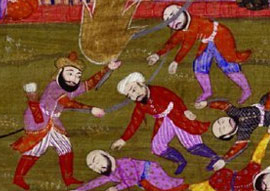
Image:The massacre of the Banu Qurayza, a Jewish tribe of Medina, 627. Public Domain