
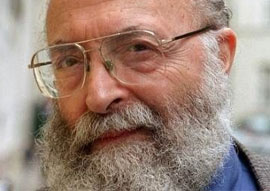
Since Chaim Potok published his first novel, The Chosen, in 1967, he has become one of the most popular and widely read authors of Judaism. Born in New York City, Chaim Potok first started writing fiction at the age of 16. In 1950, he graduated Summa Cum Laude from Yeshiva University with a Bachelor of English Literature. From there, he went on to get his Master of Hebrew Letters and his rabbinic ordination at the Jewish Theological Seminary of America (1954) and his Ph.D. in Philosophy from the University of Pennsylvania (1965). His novels include The Promise, The Book of Lights, Davita’s Harp, My Name is Asher Lev, and The Gift of Asher Lev. His nonfiction writings include Wanderings and Ethical Living for a Modern World: Jewish Insights.
Shabbat Shalom*: Your books often describe a tension between two traditions. I am thinking of the Hassid torn between religion and secular philosophy, a daughter born to parents of mixed heritage. Do you think this type of tension is healthy, and do you have any advice for those who may find themselves in such a situation?
Potok: It is not a matter of its being healthy or not, but it is a matter of its being the given situation. To a great extent, it is up to us to determine whether we can make it healthy. There is no way of avoiding coming up against ideas that are strange to you unless you lock yourself totally away from the world, and there are groups that do that. But if you are in any way located inside the world, you will come up against value systems and ways of constructing the human experience that are quite different from the way you have been taught. That sort of confrontation, in its many faces and dimensions, is what I try to explore in my books.
Shabbat Shalom: What is your definition of a Jew?
Potok: Legally, a Jew is someone born of a Jewish mother; culturally, a Jew is someone who participates in Jewish history; and religiously, a Jew is someone who participates in Jewish traditions. So there are many definitions, but I think that the whole spectrum is necessary in order for a Jew to be a full and educated participant in this rather remarkable adventure we call the Jewish people and its trajectory through history. Although, from a legal point of view, someone born of a Jewish mother is Jewish, this does not mean that you can’t enter Judaism through conversion.
Shabbat Shalom: Do you think Jewish-Christian reconciliation is possible?
Potok: Reconciliation is not only possible but is devoutly to be hoped for. That would mean, after a good century of preaching from Christian pulpits, that some major doctrines of Christianity have been wrong.
Shabbat Shalom: You have just spent some time among some Christians who have a high regard for Jewish laws and respect the same Shabbat. Do you have any comments on them?
Potok: I have known these Christians and many other kinds for thirty years or so. The fact that I am here means that I hold them in high regard. Otherwise, why would I be here? I am not here to convert them to Judaism, that’s for sure. The point is that the best destiny for us is that our people become solidly educated in the group into which they were born and, at the same time, remain open to ideas from the secular world outside our own—to face those ideas honestly and openly, with a willingness to give from themselves to that secular world and to accept that world’s best ideas. It is that back-and-forth that is the best hope of Western civilization: an intelligent back-and-forth. A back-and-forth that comes from ignorance inevitably leads to cultural aberrations and bloodshed.
Shabbat Shalom: You wrote The Book of Lights, which tackles the Kabbalah. What place do you think mysticism has in today’s religious landscape?
Potok: There seems to be some regeneration of mysticism as we get closer and closer to the millennium. I am not sure to what extent it is genuine or whether it reflects the usual fears that our species has as it turns a major corner of the calendar. We are always apprehensive when we finish a century, and even more so when we finish a millennium. But mysticism has played a major role in all religions: Judaism, Christianity, and Islam. It dimmed considerably as a result of the Enlightenment and the explosion of scientific thought. But there has been a lot of disillusionment this past century with rationalism and science. Such disillusionment leads to mysticism, which waxes and wanes depending upon where we are located in history. But mysticism, as such, is certainly an ongoing aspect of religious experience.
Shabbat Shalom: Do you think it’s a way of keeping the human and divine in touch when they diverge?
Potok: Absolutely! And that is what happens again and again in the Book of Lights. When there are no traditional religious answers, you reach out and somehow make contact with God through a mystical experience. The channel of communication is not through the rational part of the human being but through some primal, primordial, protological element in the human being.
Shabbat Shalom: What kind of values or philosophical message do you wish to impart through your books?
Potok: I do not have any messages in my books. I do not think the novel is a didactic tool; it is not supposed to preach. If there is any message, it is an urging on my part that you read carefully and understand, as best you can, the lives and values of the people I write about. Very often, what happens is that the reader substitutes his or her own conflicts for the conflicts in the books. A serious novel is a map or model of particulates, but something strange and magical occurs as the reader is experiencing that particular fictional world. A click occurs sometimes in the head of the reader, and he or she finds himself or herself inside the book, participating in what is going on, no matter how strange the book may initially have been to that reader. If there is a message, it is that one should read the books as openly and as receptively as possible, see what those lives are really like, and take from them things that may be pertinent to your own.
Shabbat Shalom: Your books have a very high Jewish content and flavor, and yet they are very popular among Christians. Do you have an explanation for this type of crossover?
Potok: When I was 15 or 16 years old, I read in rapid succession Brideshead Revisited by Evelyn Waugh, which is about upper-class English Catholics, and Portrait of the Artist as a young man by James Joyce, which is about middle-class Irish Catholics. I was a Jewish boy in New York, yet those books touched me profoundly; they convinced me that I wanted to spend my life writing serious fiction. How did those two books enter my life? I did not know anything about Catholicism. Those books engaged me in precisely the same way my books have engaged people who are not Jewish. The serious novel brings you news about worlds you might otherwise never encounter. It’s an instrument of legitimate voyeurism. Just as I was profoundly affected by the writings of two Catholics, others are affected by the writings of a Jew.
Shabbat Shalom: How do you go about writing? What is your typical day as a writer?
Potok: I am usually at my desk at about 8:30 or so in the morning. I reread everything that I had written until then in the manuscript. If I am more than halfway done, then I will start a few chapters back, rewriting and correcting as I go. Then I’ll start the new day’s work. Usually, I will have ended the previous day’s work by sketching out in a paragraph where I want to go, so I don’t start cold. I will work until one o’clock, and I will have lunch. Then I’ll come back around two o’clock and work for another three hours or so. I will then go for a walk, have dinner, and then—whatever my wife and I decide to do for the evening—go out somewhere, take in a movie, have dinner together, and hang out with our kids, who live nearby.
Shabbat Shalom: How do you decide what to write about? Do you start with an idea? How do you formulate a project?
Potok: Very often, I will start with a problem. I will ask myself: Suppose a Jewish boy is born with a really great gift for art. What is the worst problem he can encounter? Perhaps he would end up painting a crucifixion. Then comes the task of finding the boy, finding the community, and making the whole thing come alive on paper. That takes months and months of writing and a ruthlessness with yourself to throw away what is obviously not working and just keep trying it again and again until somehow gears shift and you are going. Then the real writing begins. At that point, you are creating the first draft. A sculptor goes up to the quarry and finds a piece of marble. I have to create my own marble, which is my first draft. Then I can begin to work on it; then I start sculpting it. That is essentially the way it’s done. That assumes an ability to put sentences together and a willingness to throw things out and rewrite mercilessly and not be satisfied until you are certain you’ve done your absolutely very best.
Shabbat Shalom: What are your future projects?
Potok: Right now, I am working with the violinist Isaac Stern on his memoirs. A novella was published recently in TriQuarterly, and a book of short stories is coming out in the fall of 1998.
Shabbat Shalom: What are your dreams for Jews, for American society, and for the world?
Potok: Civilty and peace.
*Interview conducted by Ciprian Gheorghe, a graduate student at Loma Linda University.
Image: http://rogovoyreport.com/2011/08/16/my-name-is-asher-lev-barrington-stage-company/