
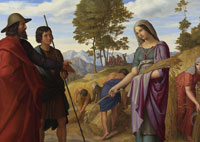
In the days when the judges ruled, there was a famine in the land. And a man from Bethlehem in Judah, together with his wife and two sons, went to live for a while in the country of Moab. The man’s name was Elimelech, and his wife’s name was Naomi.
Elimelech, Naomi’s husband, died, and she was left with her two sons. They married two Moabite women, one named Orpah and the other named Ruth.
So begins the story of Ruth. The story of a Moabite girl who converted to the religion of Israel. But the story has further reaches than the plight of a penniless widow. The story of Ruth says more than she says. Each of the actors in the story signifies more than himself or herself. A spiritual reading of the text discovers there the story of Israel, its diaspora, and its return from exile. It is a messianic tale. The text is laden with messianic allusions: Bethlehem, the mention of the goel (redemptor), and the genealogy of David. But Israel does not return alone.
Our reading will use the hermeneutical approach called the remez. The remez is an attempt to read in between the lines. Remez postulates that the words in the Bible, because they were spoken by God, are never exhaustive. Each word, because it is from God, therefore carries infinite depth. Each word is laden with meaning and signification—it points to more than itself. Each word thus has a history and conveys multiple associations. Between the lines of the story of Ruth, the Moabite, we may therefore read the history of the Jews, of their troubles, of their allies, and of their enemies. But again, this history of the Jews seems tied up with the destinies of two non-Jewish women: Orpah and Ruth.
The Actors Unmasked
The story begins in Bethlehem, which literally means the house of bread. The story begins in a place reputed for its bread, yet it is suffering from famine. Wheat is a leitmotif in the story of Ruth. Later, when she returns with Naomi, she is gleaning in the fields of wheat. In Jewish tradition, wheat symbolizes the Torah, the word of God. In the book of Deuteronomy, the two terms are coupled: “man does not live on bread alone but on every word that comes from the mouth of God” (Deuteronomy 8:3). The book of Ruth is, after all, read during Shavuoth, when we celebrate the gift of Torah. We can thus easily identify Bethlehem, the house of bread, with the land of Israel, the home of the Torah.
In Bethlehem lived a man called Elimelech and his wife. The land is barren, so they leave the land and settle in Moab. There, Elimelech dies, and his wife is left alone. Odd couple. Whose destinies does their story dissimulate? One may first recall that Elimelech means literally “my God is King.” In the name Elimelech, we thus read one of the names of God. The name of Elimelech contains an allusion to God. We thus read, instead of Elimelech, God. It is God who goes into exile; it is God who dies. The dispersion of the people of God—their humiliation and persecution—is a form of death for God. When the people of God are in danger, God Himself is in danger.
But who is Naomi? Naomi is the bride of God, the chosen of God. She stands for the people of Israel, as is said in the book of Isaiah: “A bridegroom rejoices over his bride, so will your God rejoice over you” (Isaiah 62:5). We recall, furthermore, the traditional interpretation of the Song of Songs as a story not only between a lover and his beloved but also between God and His people. We have thus read of Elimelech and his wife by searching the histories and ramifications of their names according to the Remez hermeneutic approach, the exile of God and of His people, the diaspora. But the story continues. The famine ends, and Naomi, alias the people of Israel, prepares to return home. But she is not alone.
Here, the story introduces two new protagonists: Orpah and Ruth. Who are they? And what do their names hide? We first know that they are not Jewish. They situate themselves on the contrary to the antipodes of Judaism, as is said: “no Ammonite or Moabite or any of his descendants may enter the assembly of the Lord, even down the tenth generation” (Deuteronomy 23:3). Of foreign origin, they present the goyim, that is, the nations that are outside of Israel. When Naomi returns, Orpah stays behind, but Ruth follows her. But what is this return? Where in the history of the Jews is such a return mentioned? The return of Israel from exile is mentioned throughout the book of Isaiah. “I took you from the ends of the earth; from its farthest corner I called you” (Isaiah 41:9); “I will bring your children from the east and gather you from the west” (43:5); “who says of Jerusalem, it shall be inhabited; of the towns of Judah, they shall be built” (44:26); etc. It is a time that is referred to in Jewish tradition as a messianic era because Israel shall again live in the land of bread because the famine, the spiritual famine brought about by the diaspora, shall be ended. The return of Naomi points to the return of the people of Israel from exile. But the people of Israel do not go back alone: “The sovereign Lord declares, he who gathers the exiles of Israel, I will gather still others to them besides those already gathered” (56:8).
Ruth’s Choice
It is these others that the figure of Ruth stands for in our story, for she “cleaves” to Naomi (Ruth 1:14; “to cling” in the NIV). The word “cleave” (dvekut) is a term charged with meaning. It is the word that is used to describe the relationship between a man and his wife: “For this reason, a man will leave his father and mother and be united (dvekut) with his wife, and they will become one flesh” (Genesis 2:24). The relationship here is very different from mere spiritual sympathy. To become one flesh with a people implies becoming one with the people of Israel, sharing not only the spiritual heritage but also the physical life. Orpah, on the other hand, turns away. Her name means literally “neck, back.” She is the one who turns her back on Israel. Ruth thus represents those individuals who, although they do not belong to Israel, choose to “cleave” to it. She is a graft on the olive tree that symbolizes Israel, as it is said: “You, though a wild olive shoot, have been grafted in among the others and now share in the nourishing sap from the olive root” (Romans 11:17). The figure of Ruth may thus signify the wild olive shoot of Christianity, grafted onto the root of Israel. The destiny of Ruth mirrors, thus, the destiny of the church.
But let us take a closer look at Ruth’s conversion (tshuvah; Ruth 1:22): “Where you will go, I will go, and where you will stay, I will stay. Your people will be my people, and your God will be my God.” (1:16) She adds, “Wherever you die, I will die, and there I will be buried” (1:17). “Where you will go, I will go.” The verb used here, in Hebrew halach, is of the same root as the Hebrew word for law, halacha. There is here an allusion to the law. In converting, Ruth evokes the law, the mitzvoth (commandments), that will guide her steps, as is said: “Blessed are they who keep His precepts... they walk in His ways” (Psalm 119:2, 3). “Your people will be my people, and your God will be my God.” Interestingly, Ruth mentions the people of Israel before mentioning God. Only after one has adhered or “cleaved” to the people of God can one hope to “cleave” to God. The encounter with the people of God must precede the encounter with God. Again, the reference to Israel as a people and not as a spiritual entity is highlighted. Likewise, the conversion process is not at all a mere “spiritual” experience. It implies the concrete observance of laws and commandments. But why must one pass through the law and the people of Israel to encounter this God? Simply because without this law, which discloses God’s will on earth, and without the people whom He chose to represent Him, there is no God. There is thus a theurgical power in the mitzvoth. To do God’s will is to make Him present in the world. Without the commandments and without the people of Israel, there is no evidence or sign of God. God is dead.
However, the conversion process does not stop there. It is not enough to believe. One cannot survive on a belief. One needs real food. Ruth, after her conversion, was as poor as before. There was no magical transformation in her condition. She still had to go out and glean after the harvesters. Likewise, the conversion process is not enough. One needs to go study. The wheat, as we already established, alludes to the Torah. Like Ruth, the church needs to learn to glean from those who know, the harvesters. A lesson of humility for her, who for so long switched roles and considered herself a harvester.
Israel and the Church
The story of Ruth, through the riches and polysemy of its language, can thus be read spiritually as the story of Israel and the Church: of Israel’s return from exile and of its redemption. But Israel’s return is not a family affair. It is linked to the destinies of two women: Orpah, who turns away, and Ruth, who cleaves. Cleaving, which entails more than just a spiritual affiliation, means that the one who seeks God must first seek out the people of Israel and bind himself or herself to them. The one who seeks God must first seek after the word of God and perform the mitzvoth that discloses God on earth. Only then may he or she utter, “And your God will be my God.”
A. Hadas
Graduate Student in Philosophy
Add comment