
 The Last Supper took place on the occasion of the Jewish Passover, and the Communion service is rooted in Passover. Yeshua selected some key aspects of Passover and added some other ingredients, thereby creating a powerful new service- By learning where the components of Communion come from, we can better understand its meaning.
Foot Washing
When Yeshua was about to wash Peter's feet, his words (John 13r10) make it clear that the physical washing does more than wash away physical dirt; it symbolizes moral cleansing. In this sense, the foot washing is like baptism, which also uses washing with water to symbolize washing away sin (cf. Romans 62-3).
It must be assumed that all of Yeshua's disciples had been baptized before the foot washing which took place at the Last Supper- A number of Yeshu at disciples had been disciples of John the Baptist (John 1:35ff.) and presumably had been baptized by John. Furthermore, when Yeshua’s ministry began, his disciples were engaged in baptizing other people (John 3:22; 4:2).
If the disciples had already undergone symbolic purification by baptism, why did they need the additional purification of foot washing. The same question could be asked with reference to us: If we are already baptized, why do we need further purification? The answer is found by investigating Exodus 30:17-21, This passage states that before a priest entered the Tent of the sanctuary or officiated at the outer altar, he was required to purify himself by washing his hands and feet with water drawn from the laver. But he had to be free from any specific ritual impurity (such as a genital, flow or contact with a corpse; see, for example, Leviticus 15:1-18, Numbers 19:11-22) before this purification with laver water. Even if on the previous day he had purified himself from a ritual impurity, by immersing himself in water he was still required to wash his hands and feet with laver water before entering the sacred Tent or officiating at the altar. The priest was already basically pure through total immersion in water, which is the forerunner to baptism, but he needed a higher degree of ritual purity to prepare for a higher degree of interaction with God.
So the foot washing instituted by Yeshua must be like the priestly purification of hands and feet in the sense that it prepares for a special religious experience. But two questions arise:
- Why did Yeshua wash only the disciples' feet? Why not their hands as well? The answer to this is found in the fact that Yeshua did not simply take the foot washing from the priestly purification, but also from the service of slaves to their masters.
- A priest who was free from any specific ritual impurity, and who was not about to engage in ritual service, could eat sacred food (such as portions from the offerings of the Israelites; see Leviticus 22:1-7) without the additional, purification of hands and feet. So why must we have the additional purification of foot washing before consuming the sacred Communion wine and bread? The answer is that in Communion we not only eat sacred food and sacred drink; we are also participants in a ritual which involves special interaction with God. Thus, we need a special degree of preparatory purification which only the priests in ancient Israel were required to receive. In a sense this fulfills God’s promise to make His people “a kingdom of priests and a holy nation” (Exodus 19: 6, RSV).
As mentioned above, Yeshua took the foot washing both from the priestly purification with laver water and from a custom of his own day: the washing of a master's feet by his servant. Yeshua refers to the humble service of a servant in John 13:12-16. What is remarkable about Yeshua’s action is its context in the Passover service. In Roman times, free persons reclined while eating. Since Passover celebrated deliverance from Egyptian bondage all Jews, whatever their social status, ate Passover in a reclining position to celebrate their freedom. That Yeshua and his disciples reclined at the Last Supper is shown by John 13:23,25, referring to the beloved disciple, i,e., John, lying close to Yeshua's chest. Thus, when John 13:4 says that Yeshua "rose from supper" to wash the disciples' feet, he rose from a reclining position. Then he did something rhat a free man would not dor he washed his disciples’ feet.
Yeshua's point was that while we are delivered from bondage to sin through his redeeming sacrifice, just as the Israelites at the time of the first Passover were delivered from bondage to Pharaoh, Christians are servants of one another. Passover was Independence Day, the equivalent of the American Fourth of July, when the birth of the Israelite nation was celebrated. Communion is Independence Day for Christians, celebrating the beginning of the New Covenant era, but it is also Memorial Day when Yeshua's death is remembered, and in addition, it is “Interdependence Day,” when we reaffirm our commitments to one another.
Even at the end of Yeshuas ministry on earth, the disciples needed to be reminded of the importance of humility and service. That very night at the Last Supper, a "dispute also arose among them, which of them was to be regarded as the greatest" (Luke 22:24, RSV). Yeshua corrected them with words (Luke 22:25-27), but he did more than that; he set up a tangible object lesson for them and for us too, an Ordinance of Humility. Thus, Yeshua took a mundane act, which was not part of the Passover service, and added it to the symbolic ritual in order to make a special point, thereby transforming the overall meaning of the service.
Bread
The bread which Yeshua used was, of course, unleavened Passover bread, as prescribed in Exodus 12:8. However, Yeshua's words in Matthew 26:26-28 hint at a connection with another kind of unleavened bread: the "bread of the presence" (so-called "shewbread") which rested on the golden table inside the Israelite sanctuary. The wine is specifically called the “blood of the covenant.” The implication is that the bread, which is closely linked to the wine in this service, also has to do with the Covenant.
Is there any other bread in the Bible which represents a covenant? Yes. See Leviticus 24:8, referring to the “bread of the presence.” This bread is the only offering at the sanctuary which is called an eternal covenant, It is no accident that it is renewed every Sabbath. The only other reference to an "eternal covenant" between God and the Israelites as a whole during the wilderness period is in Exodus 31:16-17, where the Sabbath, the memorial of Creation, is called an eternal covenant. The "bread of the presence" offering consisting of twelve loaves plus frankincense, is placed upon the golden table inside the sanctuary to acknowledge the dependence of the twelve tribes of Israel upon God as their resident Creator-Provider. He continues to sustain His creatures (cf . Psalms 104:14 -15 ;145 :15-16 ; Job 12:10 ; Daniel 5:23), but admits no dependence upon human beings (Psalm 50:12-13). Therefore, when the bread is removed from the table, it is consumed by the priests (Leviticus 24:9). So the covenant expressed through the "bread of the presence" offering is one in which God resides with His people and gives them life.
Wine
Wine is not specified by Exodus 12 in the directions for the original Passover service. Where did Yeshua get the idea of using wine in the Communion service? It is true, of course, that by Yeshua's day, the Passover service included wine. That is why the cup was on the table for Yeshua to use. In fact, according to rabbinic tradition which is followed today, four cups of wine are drunk by each participant at the Passover service.
But why should the drinking of wine have become part of the Passover service? In Numbers 15:1-16, God specifies that certain kinds of sacrifices require accompanying cereal offerings and drink offerings of wine. Since the Passover was a kind of sacrifice to which this rule applied, when the Israelites settled in the Promised Land and were required to slay their Passover sacrifices at the central sanctuary (Deuteronomy 16:1-8), they would have been required to include with their lambs offerings of wine along with the unleavened bread which was already specified by Exodus 12. However, just as Passover lambs were not burned on the altar,
but rather consumed by the offerers, so the accompanying bread and wine would also have been consumed by the offerers.
In Mathew 26:28,Yeshua called the Communion wine “my blood of the covenant, which is poured out for many for the forgiveness of sins” (RSV). No literal animal is sacrificed during Communion as it was in the ancient Passover service. So Yeshua used bread and wine not simply as sacrificial accompaniments, but to represent his body and blood. The idea that his blood is poured out for the forgiveness of sins reminds us of the offerings prescribed in Leviticus 4 by which Israelites received forgiveness. But the words "my blood of the covenant" point back to Exodus 24:8, which tells how Moses, at the time of the covenant sacrifices, took the blood of the sacrifices “and threw it upon the people, and said, ‘Behold the blood of the covenant which the Lord has made with you in accordance with all these words’”(RSV).
When Christians repeat the Lord's supper in the Communion service, they should remember Passover- For when they remember Passover, they remember what Yeshua meant and therefore they remember him.
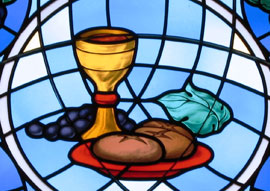
Image:St. Michael the Archangel Parish, Findlay, Ohio Eucharistic stained glass window depicting what appears to be bread and wine. Public Domain
Add comment