Roots

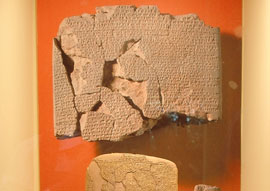
The First Peace Treaty With Israel: If it Was Possible Then, Why Not Today?

Expired

Written by: Randall W. Younker, Ph.D
Hits: 3256

Archaeologists often seem to be obsessed with ancient wars and destruction. We can often be found eagerly sifting through the debris of ancient conflicts at long-forgotten sites, looking for hints of what happened “back then.” This is not so much because we are sadistic in nature, but rather because it is often within the debris of these ancient conflicts that we find the best-preserved material remains, which, in turn, can provide us with special windows into the past—destruction layers are almost like moments frozen in time.
Jewish Roots of the Lord’s Supper

Expired

Written by: Robert M. Johnston, Ph.D.
Hits: 6215

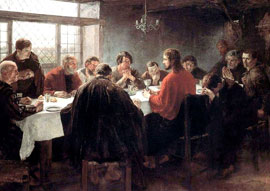
The Christian “Eucharist” is enrooted in a Jewish practice loaded with deep meaning and rich memories.

The week when Jesus was executed contained the festival of Passover (Pesach in Hebrew, Pascha in Aramaic). The gospels of Matthew, Mark, and Luke record that Yeshua ate the Passover meal with his disciples in an upper room on the night that he was arrested (cf. Matthew 26:17; Mark 14:12; Luke 22:7, 8, 15), which was Thursday night (confirmed by Paul in 1 Corinthians 11:23).

Many Types of Peace Treaties

Expired

Written by: J. Bjørnar Storfjell
Hits: 3574

Treaties generally result from negotiations that clarify the principles and foundations of the resulting relationship. We tend to distinguish between a treaty and a covenant. The former relates to a political situation, whereas the latter relates to a religious or cultic situation. These are distinctions that were unknown in the ancient Near East. Consequently, there are numerous discussions in the biblical text about covenants—283, to be exact—but no reference to treaties.

Shalom–Eirene–Peace

Expired

Written by: Reinaldo Siqueira
Hits: 11220

In the Greek culture and thought of the world of the New Testament times, the word “peace” (eirene in Greek) denoted the antithesis of war, the condition resulting from a cessation of war, and the state of law and order that yields blessings and prosperity.1 Hence, “peace” belonged basically to the political realm and was lived and enjoyed as a political reality (government was then the agent of peace through the exercise of law and government political and military powers).

The Messiah in Late Judaism

Expired

Written by: Robert M. Johnston, Ph.D.
Hits: 3827

How it came to pass that in the first century C.E., everyone was expecting the Messiah.

In Matthew 22:42, Yeshua poses a question to the Pharisaic scholars: “What do you think of the Messiah? Whose son is he?”1 The scholars answer right off, “The son of David,” but the question had been presented in such a way as to suggest that there could yet be some debate about it. When this discussion took place, a Jewish tradition that had been long in the making was just coming to maturity.