
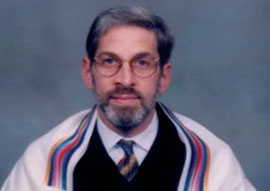
Rabbi Morley T. Feinstein is the spiritual leader of Temple Beth-El of South Bend, Indiana. He is married to Nancy Lichtenstein, and together they have two sons, Aaron and Ariel. Rabbi Feinstein is the past National Treasurer of the Central Conference of American Rabbis. Author of the Jewish Law Review and coauthor of the Jewish Values Game, Rabbi Feinstein has been published in Midstream, The Jewish Spectator, The American Rabbi, Keeping Posted, the Journal of Reform Judaism, Brotherhood, and Judaica.
He is listed in Who’s Who in American Jewry and Who’s Who in Religion. Rabbi Feinstein has lectured at many universities, including the University of Notre Dame and Indiana University-South Bend, and served on the faculty of the Department of Theology at St. Mary’s University in San Antonio.
Shabbat Shalom*: One of the most important beliefs of almost every religion, at least of Judaism and Christianity, is that of a liberating leader, the Messiah. Do you believe in the Messiah?
Feinstein: This is a critical question here, and for us as Reform Jews, we do not believe in a physical, human being, personal Messiah. There is for us the notion of a Messianic Age, which is a little bit different. The best example of this is that in the first prayer, which is used in the Tefilah and refers to the God of our ancestors, the Orthodox and Conservative prayer books use the word “Goel” for a redeemer. On the other hand, for the last one hundred and fifty years or more, the Hebrew reform prayers changed that from "Goel,” a personal redeemer, to “Geulah,” a time of redemption.
Shabbat Shalom: What is the Messiah? Could you define the term?
Feinstein: The word Messiah comes from the Hebrew "Mashiach,” which means anointed by God. We had kings who were anointed by God to be the kings, as in the case of Saul or David, and there were also special men set aside by God for certain tasks. We have the concept of what the Messiah was in the biblical age—the Mashiach was the one who was designated by God to fulfill a certain task. When the biblical age ended, there was also the notion that others may have actually been Mashiach, “appointed by God.” In the second century of the Common Era, Rabbi Akiva Ben Yoseph considered Bar Kokhba, who was a great military leader and was planning a rebellion against the Romans in 135 of the Common Era, a “messiah.” But we might call this “messiah” with a small “m” as opposed to “the” Messiah as it would be with a capital “M,” that is, when one refers to the person who would come in the age of Messianism.
Shabbat Shalom: With this wide understanding of the concept of “Messiah,” could Jesus of Nazareth be considered one of the Messiahs in Jewish history? Maybe a failed Messiah? Could you explain your answer?
Feinstein: I certainly will. I am not convinced that Akiva was right when he proclaimed Bar Kokhba as a Messianic figure. I think that too often our people, through history, have put their faith in a particular individual leader, and sadly, that has not led to a better world. Shabbethai Tzevi was a false Messiah. People thought he was going to change the world, and when he did not, it led to great sadness and tragedy among our people. Akiva, I believe, made a mistake in believing that this one person was going to be the leader of the people that would bring in the Messianic Era. He was purely a political leader, a military leader. It would be a stretch of the concept to think that Bar Kokhba, or even the zealots at Masada, or a modern political leader in Israel, would be considered Messianic.
We have to understand that the Messiah was thought to be the person who would have arrived when the Messianic Age had arrived. So the proof of the Messiah was that the Messianic Age was here. How was that proven? Knowing that there would be a time when, according to the prophet Isaiah, “nation would not lift up sword against nation, nor would they train for war; swords would be beaten into plowshares and spears into pruning hooks," that is proof that the Jewish Messiah would have arrived.
Now, I don’t think it is for a Jew to say that the Christian Messiah either was or wasn’t, will or won’t be, considered a failure. I think it is inappropriate for a Jew to comment on a Christian belief, because in an interreligious dialogue we have to understand from where the other person comes, and if I am sitting with Christians who believe that Jesus is indeed the Christ, which is the translation of the word Messiah, then that is their truth, and for them it is important. It may not be my truth, but I understand that what people believe is valid for them. It is not for me to comment on the validity of another person’s beliefs.
Shabbat Shalom: Why do we need a Messiah? Could not God do for Himself what the Messiah is going to do?
Feinstein: In the modern world, it would be seen as impossible for one person to change the course of human events. For example, in this century, we have seen that Martin Luther King, Jr., may have begun the task of changing civil rights for blacks, but it did not end with him, and everything is not perfect today. Gandhi may have done a great job liberating India, but it is not a country where you can find peace and tranquility today. Mother Teresa may have done her part, but there is still poverty around. In such a world, in a small way, each of us has to act in a Messianic way. Each of us has to work to feed the hungry, clothe the naked, house the homeless, and shelter the poor and needy. We have to be the ones to act in a way to bring about a Messianic Age. So that is critically important for me as a Reform Jew. We have a goal that is called Tikkun Olam. This is the notion that we try to repair the world, to make the world that is, into the world we want to be, to build the Kingdom of God that we pray about into the Kingdom of God that exists, and in that way we do work to better this world.
Shabbat Shalom: Which aspects does this reform include—spiritual, political, social—all of them?
Feinstein: In some ways, it begins at a spiritual level when we ask for a prayer for healing, for example. We ask God’s blessing upon those who are ill. That’s one level—the spiritual level. It can become a level that deals with health in society by making certain that we act on those beliefs by investing in the work of an AIDS ministry, by ensuring that a homeless person can receive health care, or by ensuring that someone who is without food has food available. Our Temple acts on our values by making certain that we have tutors at the local elementary school, by working at the Center for the Homeless, and by providing meat and all kinds of products to local food pantries.
Shabbat Shalom: Does this Messianic Age, in which every one of us should take part, presuppose a supernatural intervention of God?
Feinstein: We believe that God can inspire us to perform actions, but we do not pray only that people get better; we have to act on those beliefs. A Hasidic teacher said, “We have to worry about our own souls, but at the same time we have to be concerned about other people’s bodies.” In other words, for us, it is not only prayer but actions that are merged together to create a better world, a Messianic Age.
Shabbat Shalom: Is this better world of the Messianic Age only for Jews?
Feinstein: Absolutely not. We know that the problems that beset our society are problems that affect all of us. AIDS is not purely an illness for non-Jewish people; it affects Jews as well. Cancer affects Jews as well as those who are not Jews. Homelessness and illiteracy are plagues upon our society that, in a Messianic Age, will be eliminated. And until that time, we have to work very diligently to make certain that we do what we can now to make our heaven on earth.
Shabbat Shalom: Talking about this “heaven on earth,” is there any relationship between the Messianic Age and the actual Jerusalem?
Feinstein: I am one who believes much more in the world of the “here and now” than in the world that “might be” some day. And I want to work diligently now. So for me, the actual Jerusalem is reflected in the following story. There is a poem by Yehudah Amichai in which someone says, “Do you see over there, next to the vegetable vendor selling his fruits and vegetables? You see, the Messiah has just landed.” “We will know that the Messianic Age is really here,” says Amichai, “when someone says, ‘Do you see right there, next to the Messiah? There is a father talking to his children who’s selling fruits and vegetables.’” We have to be concerned about the real world, that is, not just the world of the future.
Shabbat Shalom: Popular comments say that entering the 7th millennium could have some connection with the Messianic Age. Do you think that the Messianic Age is going to happen soon?
Feinstein: I think that the time when all “swords are beaten into plowshares” is not at hand. There’s too much pain and suffering in this world today for us to say that a world of peace, of wholeness, and of Shalom is here. We recognize that there is famine in this world, there is intolerance in this world, and there is mistrust and anti-Semitism. To see that people today, as we sit here, are burning the churches of African-Americans in this country is not a sign that the Messianic Age is at hand.
Shabbat Shalom: Are the Jews, or people in general, expected to do some kind of preparation for the Messianic Era?
Feinstein: It’s interesting that for us as Jews, the Messiah traditionally is heralded by the prophet Elijah, as the prophet Malachi teaches in chapter three [Malachi 3:19–24, Hebrew; Malachi 4:1–6, English], that the prophet Elijah will come “before the awesome day of God, in order to reconcile parents with children, and children with parents.” We see family reconciliation as part of the way in which people prepare for the Messianic Age. Another story is that the Messiah had arrived, but how did people know that? Because the Messiah was sitting outside the gates of the city, binding the bandages of those who hurt and were in need of healing. We need to model our own behavior based on those teachings and care for those who are in need.
Shabbat Shalom: As is very well known, the Torah has a very important role for Judaism. What role will the Torah have in the Messianic Era?
Feinstein: We think that in the world to come, in that Messianic time, the Torah will still play a role for us in our relationship to God. For us, the Torah is the “marriage contract,” the document that connects Jewish people to God. It connects people who hold the Torah dear to them; people of other faiths may cherish the Jewish Scripture as well, so it still has a role to play in teaching us values, ethics, and morals, and so surely it will have a role in the Messianic Era as well.
Shabbat Shalom: Martin Buber said, “When the Messiah comes, the Jews and the Christians will recognize him, and he will be the same Messiah.” What do you think about that?
Feinstein: Well, if someone is ill in a hospital room, I may visit the hospital room because, for me, it is a “mitzvah.” To visit the person in need is a commandment that expresses my relationship to God. If a Christian visits the same person in the hospital room, it may be because he is imitating Jesus and his miracles of healing. It doesn’t matter to me what the reason is; what is important is visiting the person in the hospital room. So both Jews and Christians may understand the Messianic Age in a different way, but the proof that the Messianic Age has arrived is that it is a time for health, well-being, and peace for all. We know we share this goal toward which we are both working. Though the reasoning may be different, both Christians and Jews have the desire to change this world into a better world—not to sit back and watch the pain and suffering go by, but to act in the world as God’s agents for change. For that, we can be grateful that we are both working for the same universal God.
* This interview was conducted by Gerardo Oudri, a graduate theology student at Andrews University.