
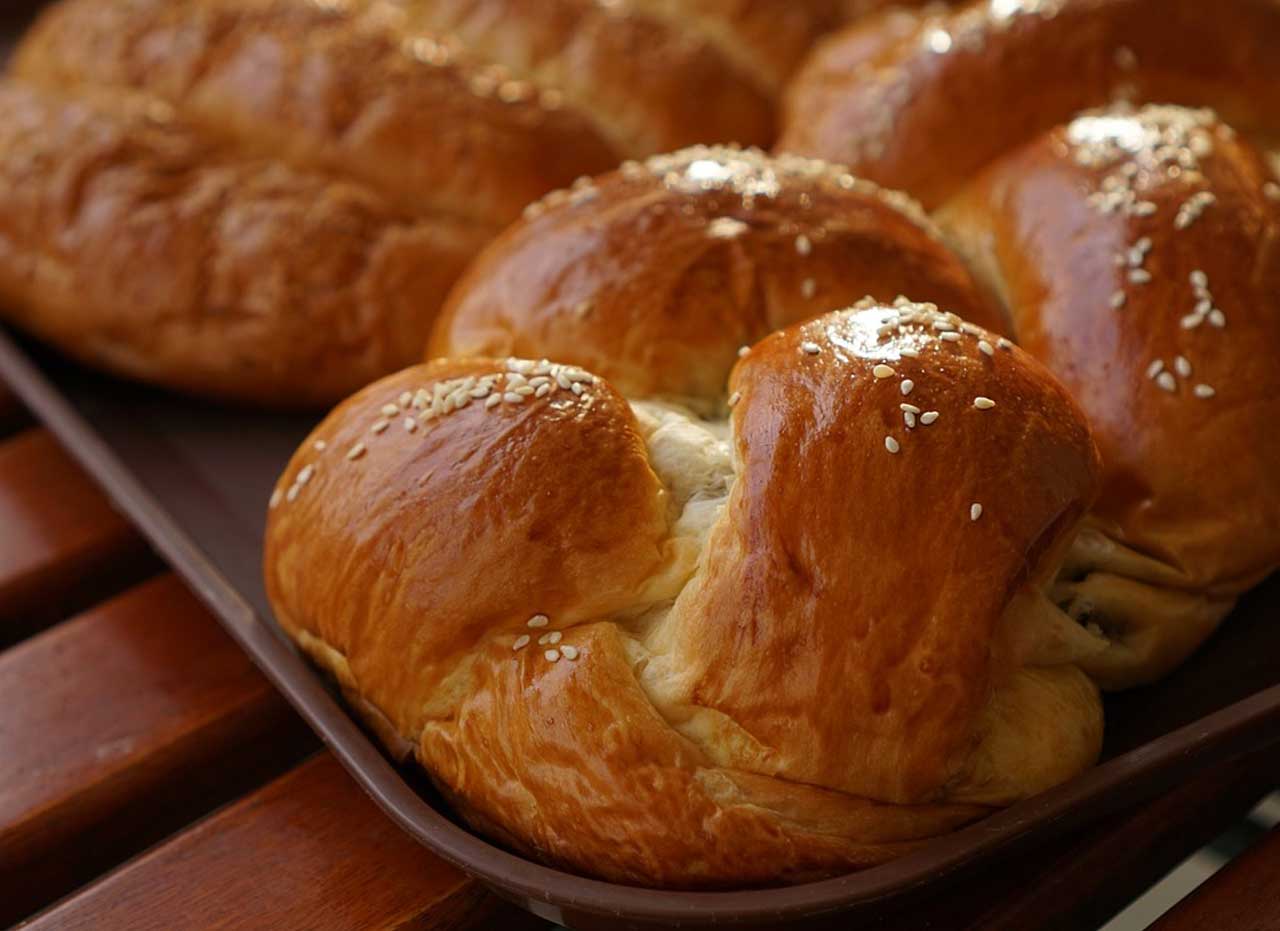
 Challah bread, translated from the Hebrew as referring to a cake, loaf, or morsel of bread, is a well-known food served at the weekly Shabbat as well as other various holidays, excluding Passover. Numbers 15:18–21 serves as the first reference to the equivalent of challah in the Bible. "Speak to the Israelites and say to them: When you enter the land where I bring you, it shall be that when you eat of the bread of the land, you shall set aside a portion for God. Of the first of your dough, you shall set aside a loaf as an offering; as the offering of the threshing floor, so you shall set it aside. From the first of your dough, you shall give to God an offering throughout your generations."
Usually pareve (containing neither dairy nor meat), the most traditional challah bread recipes seem to use various combinations of flour, water, eggs, oil, and salt, though it is possible to bake what is known as a "water challah," which eliminates the eggs and suits those who prefer not to consume animal products. In yet other recipes, a water challah may not be baked with eggs as a component of the dough but may be glazed with eggs to render a golden shimmer to the final bread product.
Some recipes may attempt to replace the sugar with alternative sweeteners such as honey or molasses or replace standard white flour with alternatives such as oat or spelt flours. Challah bread recipes also adapted over time as yeast became increasingly incorporated into traditional bread recipes.
In Biblical times and rabbinical understanding, challah was not the sweet egg-based bread that Jewish people have grown to love today, but the tithe or portion of bread given to the kohen (priest) by the local women who baked the bread in a fire, hence also being referred to as a dough offering. The term challah refers to the portion of bread that is separated before the baking process ("separating challah" or "taking challah"—the mitzvah of "hafrashat challah"), and then the remainder of the dough is baked, also called challah.
This concept theoretically applies to any bread and is not limited to breads baked for Shabbat, although the tradition may be more commonly applied to Shabbat breads compared to breads baked for the remainder of the week.
There are also requirements in Jewish tradition that any bread-baking endeavor utilizing over 10 cups of flour require that the challah be separated from the remainder of the dough. Today, the separation of the challah is still practiced among some observant Jewish people baking bread in their homes and among professional bakeries.
The actual term "challah" first appears in Leket Yosher, which was written in Austria in 1488, whereas the bread was referred to as "berches" previously. Berches is a term still used in some Jewish circles today and in some parts of the world (e.g., northern Africa: Algeria, Morocco, Tunisia, etc.).
Even into the medieval period, challah was a more traditional, simple bread made from the most basic ingredients, more resembling a pita bread. Challah bread, as it first appeared in America, was more likely to be a potato-based bread based on German Ashkenazi influences that underwent some cultural adaptations based on immigration and subsequent culinary influences from different parts of Europe.
Sugar was not always included, as sugar beets are not grown in all parts of the world, though as they become available, Jewish people may add eggs, oil, and perhaps even saffron to the basic challah bread dough for some different variations.
Of course, in America, where everything tends to be infused with more sugar and/or high fructose corn syrup than is healthy or necessary, the addition of sugar to challah bread became customary. Sugar (and also other ingredients such as poppy seeds, anise, saffron, sesame, eggs, raisins, and oils) tended to be less expensive in America compared to other parts of the world, so it was more affordable to experiment with adding additional ingredients to challah bread in America compared to other parts of the world, even if the sugar-laden bread was less healthy.
During the Second World War, many challah bread recipes published in cookbooks were eliminated due to shortages of ingredients, or if they were still published, such ingredients as sugar were not as commonly listed as ingredients due to wartime shortages and rationing.
Sephardic Jewish traditions of halachah, however, specify that any bread that contains excessive sugar can no longer be deemed bread but should rather be classified as a cake. This is important because it changes the blessing one would use from the Hamotzi blessing over the bread to the Mezonot blessing one would give over a cake or any other particularly sweet bread, rendering the latter improper for use during Kiddush.
The braiding of the bread, symbolic of the hair of the Shabbat bride, is a tradition that originated in Austria and the southern portions of Germany during the 15th century. During this time, many Jewish women started adopting the traditions of non-Jewish women of the era, who would braid the bread that they baked for their families or bakeries on Sundays.
At the time, the number of braids in one’s challah bread paralleled one’s wealth; more braids in one bread symbolized more affluence due to having more time available and assistance in the kitchen (be it servants or other domestic workers) to be able to braid the bread in more elaborate ways.
Ashkenazi culture often braided the challah bread using six strands of dough, and two loaves would therefore utilize twelve strands ("humps") of dough, which is believed to be symbolic of the Twelve Tribes of Israel or the twelve loaves of showbread offered in the Temple. If someone baking bread does not use six strands of dough, the next most common number of dough strands is either three, five, or seven.
Some have superimposed different symbolisms onto the different strands of bread, such as the concepts of truth, love, peace, creation, freedom, family, unity, justice, and harmony, and this is based on the commandments of Shamor and Zachor (the mitzvah to remember, observe, and guard the Shabbat, even the fringes of the Shabbat).
In Jewish tradition, it would not be atypical to start each Shabbat meal (Friday night, Saturday midday, and Saturday evening) with two loaves of challah bread, symbolic of the manna that fell from the heavens while the Israelites wandered in the Sinai Desert post-Exodus. As the manna did not fall on Shabbat or other holidays, a double portion of the bread would need to be prepared and set aside prior to the Shabbat or holiday so as to last through the duration of the Shabbat or holy day. Thus the two loaves. Sometimes challah bread is incorporated into weddings, circumcision festivities, or, rarely, other occasions, but this is neither required nor traditional.
In more recent times, certainly not going back centuries, some women will pray while separating challah. Their prayers will be focused on those in need of salvation, or perhaps one who is ill, enduring childbirth, or anxiously awaiting a spouse. Some women believe that separating challah during the ninth month of pregnancy bestows extra blessings and segulah (good omens) for a safe childbirth and a healthy baby entering the world.
On the Shabbat, the challah is usually covered using a special challah cloth (often white and napkin-like, perhaps decorated), allowing time for the traditional Kiddush blessings and the blessings over the wine to precede the blessing of the bread. Kiddush is said over the wine, and then Shabbat participants often wash their hands prior to eating the bread. The hand washing is done without talking to one another. The only exception to not talking is if someone forgot to place a salt shaker on the table, and there is a request for someone to go get the salt shaker and bring it to the table at this time before the blessing proceeds. The special challah cloth will be removed from the bread, and the two loaves are held up together while the head of household, often the father, will recite, "Baruch atah Adonai, eloheinu melech ha'olam, hamotzi lechem min ha'aretz" (Blessed are you, Lord our God, King of the Universe, who brings forth bread from the earth). Messianic believers may also make reference to John 6:35, which pronounces Yeshua as the Bread of Life.
After the challah loaves are properly blessed, they may be either sliced or torn and handed out to each participant at the Shabbat table. If the bread is not already salted, many will choose to salt their portion of challah bread at this time, unless they are the type to be content with the salt shaker merely being on the table.
Salting challah is considered most necessary based on the Torah specifications that Temple sacrifices are to be offered to God along with salt, though the exact way that challah is salted is left open to interpretation and personal preference. Some may choose to dip their challah bread in salt, whereas others may sprinkle salt on top of the bread, and some may be content with merely having a salt shaker present on the table.
Rabbinical literature suggests that the family table serves as a modern-day altar, replacing the ancient Temple. Consequently, it is considered improper to bless the food unless salt is available at the table in some form.
Symbolically, salt represents the eternal covenant between God and the Children of Israel. This analogy is fitting because salt acts as a preservative and does not spoil or decay, just as one would want to preserve a covenant between oneself and God, not letting their relationship spoil or decay.
Challah bread is customary on Rosh Hashanah and may be baked in a circular or spiral shape ("turban challah"), symbolic of continuity, the cycles of the year, and the changing seasons, and may include raisins and/or be brushed with honey to symbolize a sweet new year ahead. Raisins may also be indicative of a year of God’s blessings and abundance, for if the harvest was not good or a family was struggling, perhaps one would not be able to add the blessings of raisins to his or her challah bread.
Some Jewish people may bake turban challah for the duration of the time from Rosh Hashanah through Sukkot, and in certain parts of northern Africa, the shape of the turban challah is customary year-round for bread baking endeavors. The bread may also be dipped in honey at this time of the year, or it may use honey instead of salt due to the theme of a sweet new year.
As manna was provided to the Children of Israel in the barren, harsh wilderness of the desert, so Yeshua, the Bread of Life, came to each of us in a barren, degenerate wilderness in each of our lives. We were lost and destitute in sin until we welcomed Him into our lives and hearts to change our carnal ways into His ways. His gift of eternal life is available to each of us, but it must be a personal decision, not something one can bestow upon another individual. We can be content with the things of this earth, bread on this earth, and eternal sleep, or we can be content with the Bread of Life and the promises of eternity.
Our fathers ate the manna in the wilderness; as it is written, “He gave them bread out of heaven to eat.” Yeshua then said to them, "Truly, truly, I say to you, it is not Moses who has given you the bread out of heaven, but it is My Father who gives you the true bread out of Heaven. For the Bread of God is that which comes down out of Heaven and gives life to the world." John 6:31-32
Then they said to him, "Lord, always give us this bread." Yeshua said to them, "I am the Bread of Life; he who comes to Me will not hunger, and he who believes in Me will never thirst." […] "Truly, truly, I say to you, he who believes has eternal life. I am the Bread of Life. Your fathers ate the manna in the wilderness, and they died. This is the bread that comes down from Heaven, so that one may eat of it and not die. I am the living bread that came down out of Heaven; if anyone eats of this bread, he will live forever; and the bread also is My flesh, which I will give for the life of the world." John 6:35, 47–51
Add comment