
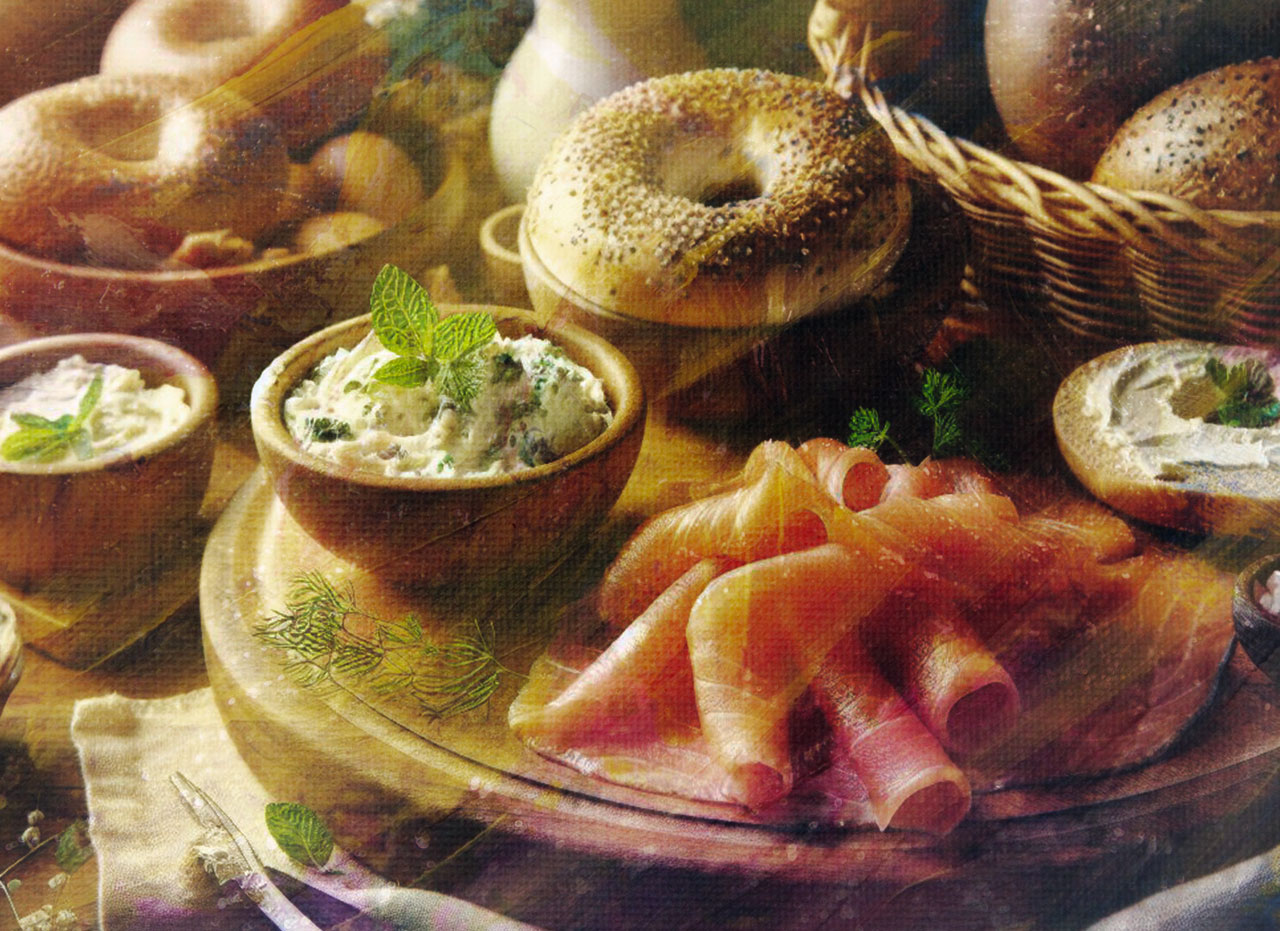
 Neither bagels nor lox originated in the Big Apple, or in America, for that matter. Yet the combination of bagels and lox was somewhat accidental and undeniably an American creation. Where did the concept come from?
The first time an equivalent term for the word bagel (“bajgiel” in Polish, “beygal” or “brygl” in Yiddish, “böugel” in the middle high German, or “beugel” in German, which means ring or bracelet) appeared in the Yiddish language was circa 1610. It was an increasingly common food not only among the Jewry of Poland but also among the Jews in various Slavic cultures. Fascinatingly, the Yiddish bagel terminology was an official regulation established by the Jewish Council of Krakow, in Poland, which further stipulated bagels being gifted by their husbands to women experiencing childbirth (just imagine a Jewish husband gifting his wife a bagel in the 21st century during childbirth).
Some historians say bagels date back to the Silk Road in China but were further refined in 14th-century Italy. Other historians trace bagels back to a 12th-century church edict that prohibited commercial Jewish bakeries from existing in Poland. However, Jews were permitted to bake boiled bread.
During a period when Jewish people were considered enemies of the Christians, the Jews were to be denied bread because bread had a significant place in Christianity (the sacrament of communion). Later, when the Jewish people were allowed to resume baking bread, the requirement that bread be boiled was instituted to counteract any poison that a Jewish person may have put into bread before selling it to Christians or other non-Jewish people. Bagels were permissible under the rules of the time because boiling was part of bagels were made. During this period in history, Christians were initially banned from buying any food products from Jewish people, though the rules loosened gradually.
Bagels then found their way to America when many Jewish people, especially from eastern Europe, immigrated to the United States in the 19th and 20th centuries.
In Eastern Europe, bagels were often sold by streetside vendors with proper licensure of the time and era; however, children, including but not limited to orphans, did illegally sell bagels at the time to bring in income for their families. If caught by the police or other officials, the bagels were taken from the children, and there may have been various consequences for the children. Once immigrants from Eastern Europe came to America and western Europe, bagels were often sold from curbside carts in the major cities. Some people have an interest in different flavors of bagels, but many are only interested in plain bagels.
Bagels are thought to have no beginning or end because of their circle shape and thus represent the eternal cycle of life. Some believe there may be some historical protection that would repel demons or other evil spirits, and therefore bagels were often served along with hard-boiled eggs at such events as circumcisions, funerals, and childbirth.
Lox (from the Yiddish “laks” and German “lachs,” both meaning salmon), is considered pareve and is of Scandinavian origin. Salmon was brined as early as medieval times and converted into a lox variation for preservation purposes. Brined salmon often lasted for upwards of a year without additional preservatives or modern refrigeration. Swedish fishermen started preserving salmon in saltwater brine at some point during the 19th century, and the recipe has evolved since then to become lox as we know it today.
Salmon was chosen because it is a kosher fish, easy to supply even from non-Jewish sources, and smoking or salting the meat rendered salmon easy to preserve, which was important in eras that predated refrigeration. Prior to lox, some people used herring in a similar manner, but salmon was cheaper and easier to source by the time the Jewish people immigrated to America.
Once the first transcontinental railroad was built in 1869, salmon was more readily transported to the east coast from the Pacific Northwest and the waters of Alaska. This increased the supply of salmon, rendering it more affordable than in Eastern Europe, where salmon was more expensive for the average person, but various other types of fish were more affordable and often preserved using similar methods. There is no significance known to the Jewish people other than salmon being readily available and relatively inexpensive in America. Today, it is most often sold as thin strips of brined salmon.
With the advent of refrigeration, salted fish of any kind became much less common. Salmon may have still been cured in a low-salt liquid, but not with the same heavy salting as before. Besides the eastern seaboard and Pacific Northwest, salmon may also be sourced from Alaska, Chile, Nova Scotia, and the Gaspé Peninsula. Preservatives started to be implemented in the baking process during the 1960s. This allowed bagels to last more than a few hours at a time. The machines that bakers used during the bagel baking process significantly improved during the 1960s as well. Preservatives as well as engineering advancements in bagel machine technology helped bagels become a more widespread phenomenon.
The combined bagels and lox concept reportedly came into existence during the 1930s with the concept of eggs benedict (ham or bacon, eggs, and hollandaise sauce on separated English muffin halves), which was a popular dish in New York City at the time. Jewish people were unable to partake in the popular egg benedict culinary creation due to the presence of pork as well as the prohibited comingling of dairy and meat. Thus, bagels and lox emerged as a Jewish-friendly alternative to the growing egg benedict fad that did not violate the laws of kashrut (Jewish dietary laws).
Salmon is a kosher alternative to ham or bacon, and lox replaced the concept of the hollandaise sauce, while bagels substituted for the English muffin halves. The five main ingredients that have become part of the beloved American tradition of bagels and lox consist of, most obviously, the bagel and lox, but also cream cheese, capers, and sliced red onion. Most commonly, the cream cheese will be spread on the bagel first, followed by the lox, and then finally the chopped red onion and the capers. Theoretically though, one could add cucumbers or any other toppings of choice.
The bagels and lox combination over time has emerged from humble beginnings to become an iconic staple in some of the premier delis in New York City. This delicious combination has transcended generations and continents and is now considered a cherished culinary tradition among Jewish people worldwide.
Add comment