
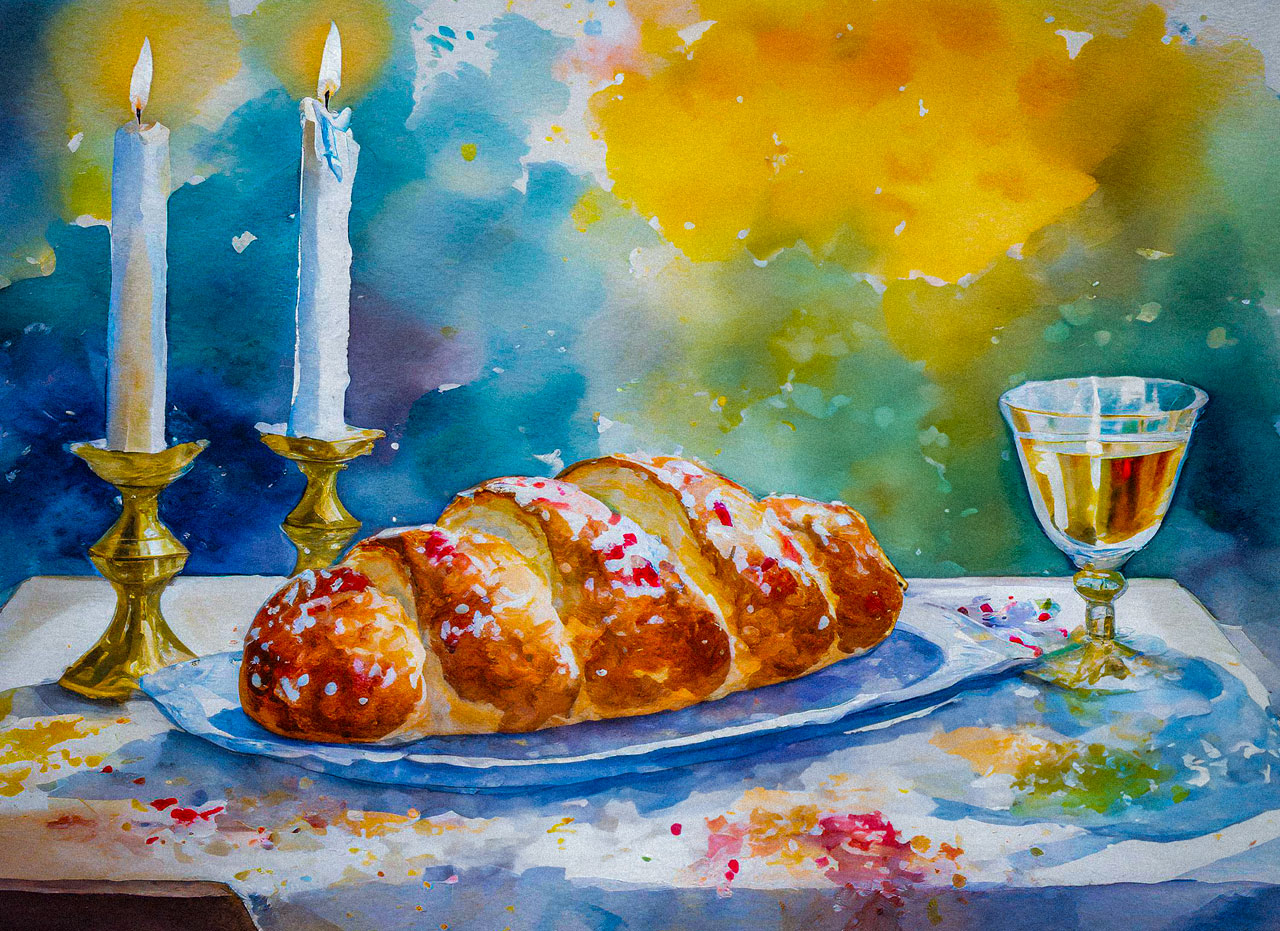
 As zikaron le-ma’asei v’reishit ("a memorial to Creation"), Kiddush ("sanctification" or "separation") is a beautiful Shabbat benediction and one of the central traditions of the Shabbat in Jewish life. It is a blessing said over a cup of wine on Friday nights and Saturday mornings, or possibly at other times, marking certain festive occasions and life milestones.
On Friday nights, Kiddush in rabbinic tradition invites all household members, including work animals, to step away from the concerns of this world and the toils of the week and to step into the peace and rest of the Shabbat, remembering the commandment to keep it holy and proclaiming us partners in God’s creation by upholding the sanctity of the Shabbat (Babylonian Talmud, Shabbat 119b).
Verbally declaring the beginning of the Shabbat in its beauty, holiness, and glory is a mitzvah, and this declaration is made via Kiddush. The rabbis have historically debated whether it is sufficient to merely remember the Shabbat or to verbally declare it as part of the sanctification process, and whether Havdalah counts as part of the Sabbath or not. Proclaiming the sanctity of the Shabbat is a concept within Adventism that many of us are already familiar with, but the same concept is perhaps more formally integrated into the Friday night Jewish Shabbat traditions that have been passed down through the centuries.
The Kiddush additionally contains a second element, "zekher li-tzi’at mitzrayim ("a memorial to the Exodus from Egypt"). This is exemplified by viewing the Shabbat as a day of not only freedom from the cares of this world but also of community. It is not merely a day to stay home and watch television as a restful activity or to focus merely on our own immediate families, but a day to fellowship with and interact with the greater faith community; we are all human beings created in the image of God, and Shabbat is the perfect opportunity to come together with that common thread that unites us all.
Though linking the Shabbat to Creation and the Exodus are the primary themes of this beautiful tradition, Judaism sometimes expands on these concepts in other ways. It may sometimes delve into concepts of protecting the environment or advocating liberty and compassion for those who are suffering, whether under opposition of any kind, poverty, slavery, or any violation of human rights. Thus, Shabbat, as a memorial to Creation, becomes the foundation and clarion call for promoting freedom and the ideals of this world for all of God’s divinely created creation while also promoting rest, rejuvenation, and refreshment of our physical bodies.
There are three main parts to the Friday night Kiddush: passages from Genesis highlighting the first Shabbat, the blessing over the fruit of the vine, and a blessing of thanksgiving that God set aside the precious gift of the Shabbat for the Jewish nation. The Kiddush prayer connects Shabbat to both Creation and Exodus. It serves as a reminder that the Shabbat is not just about what we receive from God or others, but what we can give to improve the world. The sages once described Shabbat as me-ein olam ha-ba ("an inkling of the world to come, a world redeemed").
Kiddush most likely originated sometime between the fourth and sixth centuries BCE, according to the writings of Brachot 33a in the Babylonian Talmud. The tradition of saying the blessing over a cup of wine most likely originated in the first century because it was common during this time in history in many different cultures to begin more festive meals with a cup of wine. The Shabbat counts as a festive meal. Over time, rabbis have unofficially decided that wine should be reserved for more special occasions rather than be an everyday choice. As a result, the blessings associated with wine became an integral part of religious traditions, including Shabbat.
The tradition of Kiddush did not find its way into synagogue services until closer to the Middle Ages. This was instituted so that Jewish people who were traveling away from home and their families but still found their way to a synagogue in a distant city could still have an opportunity to hear the Kiddush blessing to usher in the holiness of the Shabbat. The tradition of keeping Kiddush in synagogues has continued to this day as a matter of tradition.
No matter where in the world one goes, Kiddush is generally a standardized process, though there may be minor variations around the world in the type of wine used, the design of the Kiddush cup (often cups are elaborately engraved to honor the beauty of the Shabbat compared to a regular cup that may be used the rest of the week, but if one does not have a special engraved silver Kiddush cup, then any cup may suffice so long as it holds at least a revi’it of liquid), and possibly how the cup is held, but otherwise the concepts, the bencher (a small book with prayers, blessings, and relevant songs), and the use of kosher wine and perhaps a small amount of water are pretty much the same around the world.
The revi’it requirement of a Kiddush cup refers to a unit of measurement in the Talmud that approximates a little over 3 fluid ounces in modern terminology, though the exact equivalent in a modern form of measurement is debated among some Jewish communities (some say 3.3 ounces, some say 3.8 ounces, and some maintain other measurements are the absolutely correct measurement while other measurements are deemed incorrect). Often, Kiddush cups are considered family heirlooms or given as gifts at either weddings or bar or bat mitzvahs.
For Kiddush held within a synagogue, often the blessing will be recited over a cup of wine, and then either one appointed person or perhaps all the children of the congregation will partake of the wine or grape juice.
Within a private residence, after the meal begins and a family or gathering may sing Shalom Aleichem and Aishet Chayil, some may wash their hands, and then usually Kiddush is recited by the head of household, and often some of the wine or grape juice is poured into separate cups to be consumed by each person in attendance.
The Kiddush cup is filled to the top, symbolizing our joy in the Shabbat, and then in some communities, 3–7 drops of water (a concept known as mezigah, based on Shulchan Aruch, Orach Chayim 272:5) may be added to the Kiddush cup to cause the wine to overflow the cup. The practice originated in the Talmudic era, when there were misconceptions that wine needed to be diluted with water lest it be too strong in its pure form to be permissible on the Sabbath. Some of the rabbis believe that while wine is symbolic of justice, water is symbolic of mercy, and thus combining mercy and justice is more reflective of the true character of Adonai while asking for our loving God to judge us mercifully.
If wine is not available, grape juice may be permissible, or any other type of alcohol or fruit juice can be used. Leftover wine from a previous Kiddush or other use is not permissible; it must be a fresh cup of wine for the Shabbat. If a special beverage of any kind is unavailable, then it would suffice to skip the Kiddush and simply say the ha’motzi blessing over some challah bread. Sometimes red wine will be used on Friday nights, whereas white wine may be used for the Saturday morning Kiddush.
One would then raise the Kiddush cup using his or her dominant hand specifically and recite the Kiddush blessing aloud while facing the Shabbat candles (the Vayechulu, a passage from Genesis 2:1–3, is often invoked in more private residence settings but perhaps not so frequently in synagogue settings), followed by the blessing over the wine while facing the cup. This will be followed by a blessing of thanksgiving unto God for giving the Shabbat to the Jewish people, and whoever is reciting the blessing will continue facing the cup of wine during this portion of the blessing.
The Kiddush blessing will conclude with an "amen" from everyone in attendance at the gathering. The individual who recited the blessing is generally expected to consume at least 1.5–2 ounces of wine or grape juice. Others in attendance may sip or drink as much as they would like from their cup.
Kiddush on Saturday morning typically follows the same pattern, though it occurs in private residences and not at the synagogue. Saturday morning Kiddush is a tradition that was instituted by the rabbis, and there is much more variation in the implementation of this tradition throughout the world, whereas Friday night Kiddush is fairly standardized anywhere.
Some congregations that partake in this tradition may have a variation of Kiddush after services that includes different cakes, cookies, fresh produce, and different beverages that a rabbi or other congregational elder may bless before any food is consumed at lunch. The standard prologue of a Saturday Kiddush would be the V’Shamru, which is a prayer establishing the sanctity of the Shabbat as a sign between God and the Children of Israel and reaffirming the commandment to keep the Shabbat holy, unpolluted by work and the cares of this world.
Depending on the community, some may choose to recite verses from Isaiah 58:13–14 and Exodus 31:16–17 is pretty much universally said in any community that partakes in a Shabbat edition of the Kiddush, whereas these passages are more variable. Then some communities or fellowships may choose to conclude their Shabbat Kiddush with a recitation of the Ten Commandments. Nearly all Shabbat-day Kiddush blessings conclude with a blessing of the wine, and congregants may then partake in Oneg Shabbat (Shabbat a delight).
Kiddush may also be said for such events as a bar or bat mitzvah, a wedding, an anniversary, the birth of a new child, naming one’s child, milestones in one’s life, holidays or midday on holidays (with variations on the Friday and Saturday versions of the blessings, so consult a siddur for the proper text for imploding the Kiddush on a holiday), in memory of a loved one, new moon observances, or perhaps even just because. Even if Kiddush is said in a synagogue service, it would not be uncommon to also say Kiddush at home with family and/or friends.
Add comment