
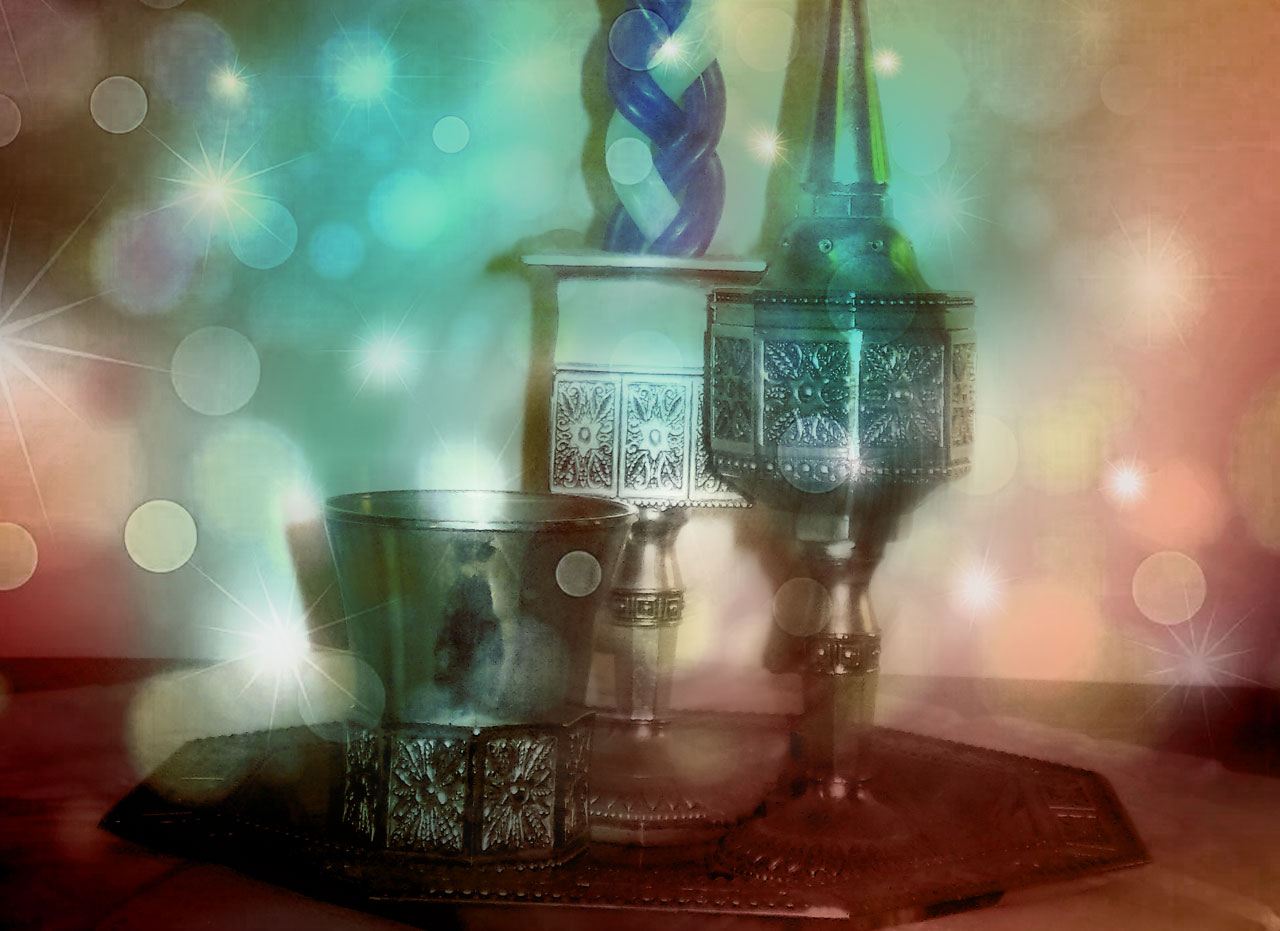
 Havdalah is a beautiful multi-sensory ceremony and one of the most ancient blessings in Jewish religious life that symbolically marks the end of Shabbat after the appearance of three stars in the sky, usually 45–60 minutes after sundown, depending on one’s latitude and season. The ceremony delineates the end of Shabbat from the commencement of the new week ahead of work, blessings, and God’s mercies, which begin every morning.
Put another way, havdalah marks the separation between the sanctity of the Holy Shabbat and the ordinary days that comprise the remainder of the week. Interestingly, in Jewish tradition, havdalah may be celebrated up through the Tuesday following Shabbat, though the conclusion of Shabbat is the most natural and frequently observed time.
Another goal of havdalah is to clearly define the boundaries of the Shabbat as part of remembering the Shabbat, keeping it holy, and not blurring it with the working week. The Talmud describes it as "the men of the Great Synagogue instituted blessings and prayers, sanctifications, and Havdalot for Israel" (Berachot 33a). Havdalah can be celebrated in numerous settings, whether it be a congregation, a synagogue, a retreat, a summer camp, or at home, whether in a family setting or individually.
Havdalah-like blessings over the wine and clearly delineating the holy from the everyday are also incorporated into the conclusion of many Rosh Hashanah and Yom Kippur celebrations, the first days of Sukkot, Simchat Torah, and Shavuot, and both the first and last days of Passover. When one of the major Jewish holy days follows Shabbat, it is customary to incorporate the havdalah service into the holiday kiddush, excluding the blessing over the fragrant spices and the braided candle. Special festival candles are used instead of the braided candle so as not to diminish the symbolism of the braided candle on Shabbat. This helps signify that while these holidays and festivals are important and have holy meanings that are distinct from the everyday, they have a lesser degree of holiness compared to the Shabbat.
Such distinctions are not uncommon in Jewish religious life, which seeks to delineate not only holy time from non-holy time but also holy books from non-holy books and holy spaces from non-holy spaces. This is based on teachings in the Torah that God made distinctions during creation—between light and dark, between water and land, for instance. As the Jewish people lit two candles and recited the berachah (blessing) at the commencement of Shabbat, now one must conclude Shabbat, hence havdalah.
The scriptural foundation for havdalah is derived from the fourth of the ten commandments: "Remember the Shabbat day to sanctify it" (Exodus 20:8). Over time, rabbis and Jewish religious leaders determined that "remembering" Shabbat required "sanctifying it" at both its beginning (kiddush) on Friday at sundown, and its conclusion (havdalah) on Saturday at sundown, and the tradition has subsequently transcended time and place. The customs as we know them today began in the medieval period and contained exceptions for those who did not have wine in their homes by permitting grape juice or other beverages.
Generally, the ceremony can be summarized in five parts - an introductory paragraph in Hebrew based on numerous Bible verses, followed by the four blessings over, in order, the wine, spices, light, and conclusion of the Shabbat. Havdalah is an experience requiring a believer to use all five senses granted by God: the ability to smell the aromatic spices, visually see the flickering candlelight, hear the beautiful blessings being recited, taste the wine, juice, or other liquid being used, and feel the cup that holds the spices and the other ritual objects being passed around.
A traditional havdalah ceremony includes a braided candle with several wicks, a cup of kosher wine (or grape juice or other beverages if wine or grape juice are unavailable), and sweet-smelling spices (b’samim in Hebrew) such as nutmeg, cloves, cinnamon, bay leaves, or some combination of those or related spices.
The first blessing is over the wine. The standard Havdalah blessing includes, "Baruch atah, Adonai Eloheinu, Melech ha'olam, borei m'orei ha'esh." If wine or grape juice is unavailable, "shehakol nih'yeh bid'varo" (by whose will all things come to be) is traditionally substituted for "borei p'ri hagafen" (who creates the fruit of the vine). One is not to consume the wine or grape juice immediately, but once the final blessings have concluded.
Lift the cup of wine or grape juice and recite the blessing:
Baruch atah, Adonai Eloheinu, Melech haolam, borei p'ri hagafen.
(We praise You, O Lord our God, Sovereign of all and Creator of the fruit of the vine.)
Havdalah’s second blessing is over the spices. The spices are often stored in a highly decorative spice container known as a b'samim box or in a decorative bag, which is intended to imply the beauty and honor of this Shabbat mitzvah. The spices are handed around so that everyone participating can smell the fragrance, intended to help one remember the sweetness of Shabbat as compared to the ordinary weekday ahead.
In the Talmud, Beitzah 16a, Rabbi Shimon ben Lakish teaches that the Jewish person will receive an additional soul, yetera, on Shabbat, and this soul will wither away upon the conclusion of Shabbat. Per this teaching, the spices are symbolic of this additional soul, and smelling the spices as part of the havdalah ceremony helps us to remember the Shabbat even as this additional soul leaves upon the conclusion of the Sabbath. This teaching is not found in Scripture.
Hold up the spice box and recite the blessing:
Baruch atah, Adonai Eloheinu, Melech haolam, borei minei b’samim.
(We praise You, O Lord our God, Sovereign of all and Creator of varied spices.)
The third blessing is over the multi-wicked havdalah candle, marking the end of the Shabbat rest. This distinction can be profound, given that one cannot kindle a flame on Shabbat. The braided candle with multiple wicks is lit, or two candles if the braided havdalah candle is unavailable, with the flames of the two candles being enjoined in one, and the special havdalah blessings are recited. This light is to represent the light of Shabbat, and the extinguishing of the candle represents snuffing the light of Shabbat as we transition into the week ahead.
According to the Midrash, Adam and Eve were thankful for God’s blessing of fire upon the conclusion of the first Shabbat, and thus incorporating the flame into the havdalah service reminds us to thank God for the gift of fire, lest we endure cold and dark nights. The multiple wicks are representative of different types of fire that we can thank God for providing for us.
It becomes customary to hold one’s hands up to the candle and gaze upon the reflection of the candlelight on one’s fingernails or along the lines in the palm of one’s hand. Then the wine, grape juice, or other beverage is poured into a small dish, and the candlelight is quenched in the grape juice, symbolizing the end of Shabbat. Some Jewish faithful will dip their finger in the juice and touch their eyes or their pocket as a segulah, or well wish, for the week ahead. This is based on Psalms 19:9, which reads, "The commandment of the Lord is clear, enlightening the eyes."
Hold the Havdalah candle and recite the blessing:
Baruch atah, Adonai Eloheinu, Melech haolam, borei m'orei ha-esh.
(We praise You, O Lord our God, Sovereign of all and Creator of the lights of fire.)
The final blessing is an overall havdalah blessing over the wine. When the blessing is complete and the havdalah candle is extinguished in the wine, one may choose to drink the wine, though consuming the wine is not required.
Baruch atah, Adonai Eloheinu, Melech haolam, hamavdil bein kodesh l'chol, bein or l'choshech, bein Yisrael l’amim, bein yom hash'vi-i l'sheishet y'mei hamaaseh. Baruch atah Adonai, hamavdil bein kodesh l'chol.
(Praise to You, O Lord our God, Sovereign of all, who distinguishes between the holy and ordinary, between light and dark, between Israel and the nations, between the seventh day and the six days of work. Praise to You, Adonai, who distinguishes the holy from the ordinary.)
(Sip the wine or grape juice. Then extinguish the candle in the remaining wine or grape juice.)
Groups participating communally in a havdalah service will often conclude the service by singing a song and then saying shavua’tov—blessings for a good week. One example of a song that is traditionally sung at the conclusion of a havdalah ceremony is Eliyahu Hanavi. Lyrics include, "Elijah the prophet, Elijah of Tishbi, Elijah of Gilead, may he soon come to us along with the Messiah, son of David..." in hopes that Elijah the Prophet will soon herald in the messianic age and Shabbat will be continuous and forevermore, without beginning and end.
May we all be a light and a sweet fragrance in a world of darkness as we carry the peace, love, rejuvenation, and delight of the Shabbat into the work week and interact with a world that is exponentially falling away from the light and truths of scripture.

Add comment