
 "Guard our coming and our going; grant us life and peace, now and always. (Siddur Sim Shalom, p. 33)
(ufros aleinu sukat sh’lomecha) "Spread over us Your shelter of peace... (Siddur Sim Shalom, p. 285)
I lift up my eyes to the mountains—where does my help come from? My help comes from Adonai, the Maker of heaven and earth. He will not let your foot slip. He who watches over you will not slumber; indeed, He who watches over Israel will neither slumber nor sleep. Adonai watches over you—Adonai is your shade at your right hand; the sun will not harm you by day, nor the moon by night. Adonai will keep you from all harm; He will watch over your life. Adonai will watch over your coming and going both now and forevermore (Psalm 121).
*****
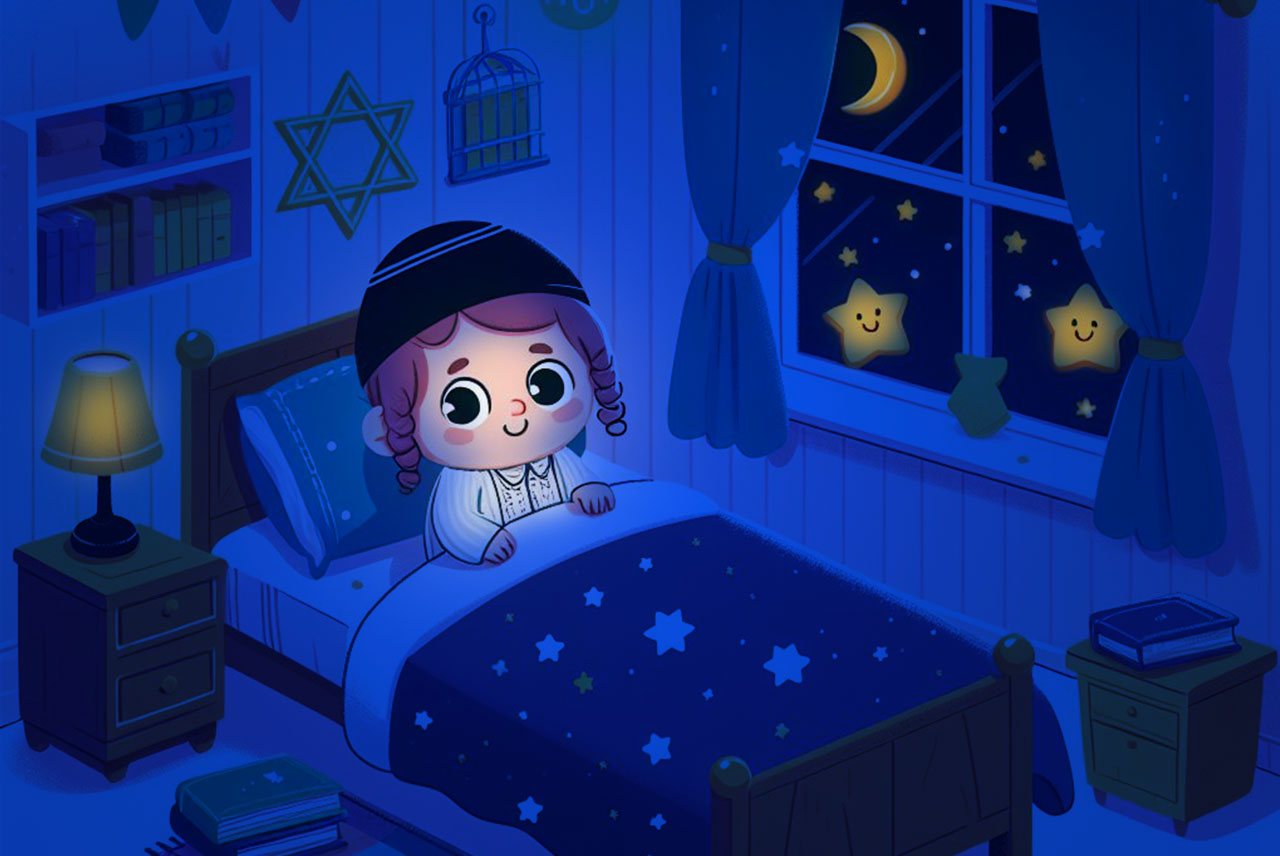
One of the most beautiful and perhaps beloved centuries-old Jewish prayers is the Hashkiveinu (derived from the Hebrew phrase "Hishki vainu" or "Cause Us To Lie Down In Peace), which asks God to protect us throughout the night and awaken us the next morning, watching over our lives and protecting us while we sleep, delivering us from our slumber in the morning, providing a restful and peaceful night’s sleep, our souls holy and at peace in God while we rest, and for refreshment when we arise in the mornings, ready to experience His mercies granted anew each day while asking for His protection throughout our daily lives.
In a larger sense, the Hashkiveinu may transcend our personal safety through the night and request that God bestow peace and tranquility upon the entire world. Hashkiveinu is an imperative, a request, or a command for God to make us lie down and to wake us up.
This beautiful prayer could also be symbolically extrapolated to lying down being metaphorical for death, as we pray to meet death peacefully when that time comes for each of us, that we may be at peace with not only ourselves, not only our family members, and our circle of influence, but ultimately at peace with God Almighty. Some people may choose to couple the Hashkiveinu with chesbon hanefesh, an accounting of the soul, or making peace with ourselves, with other people in our lives, and with God on a daily basis, and not letting grudges or issues fester unresolved for long periods of time.
The text of the Hashkiveinu is part of the liturgy in evening services, with no equivalent or parallel prayer in morning services, and there are often variations of that liturgical text between the version recited during the week and the version recited on Shabbat and other holy days. Then the Hashkiveinu is said again at home as a prayer or lullaby at bedtime. Generally, the Hashkiveinu will follow the Shema and Mi Kamocha, but come prior to the Amidah prayer.
Some cite the origins of the Hashkiveinu prayers in ancient Jewish folklore. One version of this includes the Israelites praying for safety, peace, and deliverance while the Angel of Death passed by in the night. The other folkloric version includes the first night the Jewish people spent in the wilderness, when they were afraid of the dark in the wilderness without shelter, unsure of what wild animals may be around or pestilences may be lurking in the unknown land, and with perhaps limited starlight to illuminate the desert nights. Per folklore, the Jewish people then prayed, "Cause us, Eternal One, to lie down in peace and rise again to life!” Then, over the centuries, this primal prayer would have evolved into the Hashkiveinu prayer we know today.
Meanwhile, others take a different approach to the origins of the Hashkiveinu prayer and believe it is an extrapolation of the prayers the Jewish people would have said as God redeemed them from slavery and asked for His protection from the terrors of the night, similar to the concept of b’tzeil k’nafecha (‘"in the shadow of Your wings"). Others translate that concept as a "shelter of peace" or a "sukkah of peace. Some also speculate the Hashkiveinu originated and evolved from the text of Psalms 121:4, in which the Guardian of Israel neither slumbers nor sleeps.
There are those who believe that during the Talmudic Age in ancient Babylonia, people who lived in the countryside were simply scared of the pitch-dark nights in a world without electricity, and therefore the prayer was added to the Maariv service requesting God’s protection against any terrors of the night and the uncertainty of darkness.
Some scholars cite the origins of the Hashkiveinu as Talmudic in nature, pointing to such passages as Berachot 60b for inspiration: "... and may the good inclination have sway over me and let not the evil inclination have sway over me... and let not evil dreams and evil thoughts disturb me...” Yet unlike Christianity, Judaism does not recognize satan in the same context, and thus "spiritual inclination" would simply refer to any evil in the world that causes man to deviate from God’s plan and laws without necessarily being a fallen angel as recognized in Christianity.
Therefore, some siddurs remove the entire line "remove spiritual impediments from before us and behind us" or any variation of that entirely to resolve this theological conundrum within Judaism. Some of the first Reform siddurs entirely eliminated this line on this theological basis, though the line appeared in some later versions of Reform siddurs despite the theological controversy of mentioning protection against satan. Some of the most recent editions of the Reform prayer books try to strike a compromise, omitting the line referencing satan but maintaining some of the other themes and imagery intended to surround the concept.
Others will point to a possible source of inspiration as Berachot 57a, when sleep science was not understood as it is today and the sages of the time believed that sleep was 1/60 of death. Furthermore, if a person is sleeping, consciousness is not there to protect that person from an attacker, rendering that individual more susceptible to harm or death from an outside attack than if the person were awake. Therefore, the concept of praying before bedtime was established, which over time asks God not only for peaceful sleep and His mercy in awakening us in the morning but also that we may hear good advice during our sleep and that our enemies will not attack us or cause other problems for us while we sleep.
Over the centuries, the rabbis have acknowledged that "there is something very holy about sleep. As Maimonides wrote in Hilchot De’ot (Laws of Conduct), 3:3, "Even when he is sleeping, a person should have the intention that he is allowing his mind and body to rest in order that he should not become sick, which would prevent him from serving God. Thus, his sleep becomes part of his service to God [avodah l’makom]."
*****
Grant, O God, that we lie down in peace, and raise us up, our Guardian, to a life renewed. Spread over us the shelter of your peace. Guide us with Your good counsel; for Your name’s sake, be our help. Shield us and shelter us beneath the shadow of your wings. Defend us against enemies, illness, war, famine, and sorrow. Distance us from wrongdoing. You, God, watch over us and deliver us. You, God, are gracious and merciful. Guard our going and coming, to life, and to peace evermore.
Lay us down to sleep in peace, Adonai our God, and raise us up, our King, to life; spread over us the shelter of Your peace. Guide us with Your good counsel, and save us for the sake of Your name. Shield us from foe, plague, sword, famine, and anguish. Remove wrongdoing from before us and behind us, and shelter us in the shadow of Your wings. For it is You, O God, who protects and rescues us; it is You, O God, who are our gracious and compassionate King. Safeguard our coming and our going, to life and to peace, from now to eternity.
Blessed are You, Adonai, Who spreads a shelter of peace over us, over all Your people Israel, and over Jerusalem.
Very much, the concepts of the Hashkiveinu prayer also reflect the sentiments of the well-known 91st Psalm: Whoever dwells in the shelter of the Most High will rest in the shadow of the Almighty. I will say of the LORD, "He is my refuge and my fortress, my God, in whom I trust. Surely he will save you from the fowler’s snare and from the deadly pestilence. He will cover you with his feathers, and under his wings you will find refuge; his faithfulness will be your shield and rampart. You will not fear the terror of night, nor the arrow that flies by day, nor the pestilence that stalks in the darkness, nor the plague that destroys at midday (Psalm 91:1-6).
The Hashkiveinu includes a request to God to rebuke the enemy in our lives: "Remove the adversary from before us and from behind us. Shelter us in the shadow of your wings. In each of our lives, may the forces of the enemy striving to prevent God’s children from lying down in peace be bound in the name of Yeshua. May the peace of God and Yeshua our Messiah be with us all.
Comments