
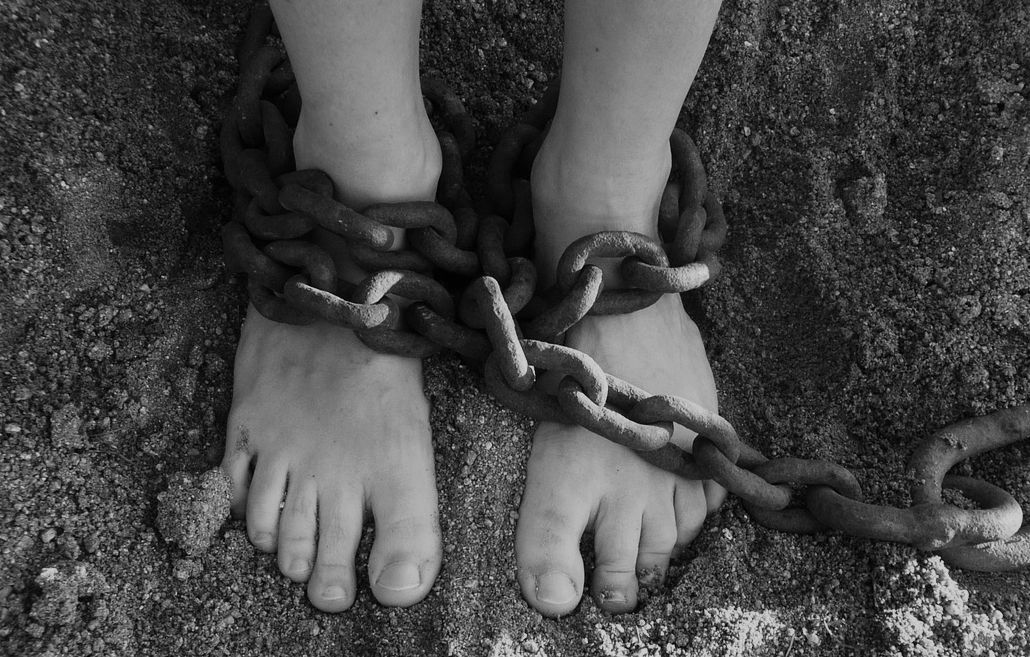
 "Today’s slavery flourishes precisely because slaves are kept invisible, without the ability to make their voices heard. As the voices of the Israelites were heard by a compassionate God insisting on justice and human dignity in the world, so must we hear and take action." -Rabbis for Human Rights
"This year we are slaves; next year, may we be free." -Passover Haggadah
"No one shall be held in slavery or servitude; slavery and the slave trade shall be prohibited in all other forms." -Universal Declaration of Human Rights, Article 4
Human trafficking, which includes sex trafficking, child sex trafficking, forced labor, involuntary domestic servitude, forced child labor, or any other type of forced, coerced, fraudulent labor or debt bondage, is a grave human rights travesty that has plagued nearly every nation in the world. The Jewish people and Israel have not been exempted.
"The fact that there are still millions of people in our world suffering from modern slavery is inexplicable and intolerable," Israeli Foreign Minister Yair Lapid said. "We refuse to be bystanders. Part of our DNA, part of our national memory, is the world’s silence in the face of injustice. As Jews, as Israelis, as human beings, we have an obligation to fight this."
Maimonides, one of the most prolific and influential rabbis of the Middle Ages, wrote about the mitzvah of redeeming the captives and those otherwise enslaved in conditions beyond their control. He wrote this mitzvah even took precedence over clothing and providing for the poor. Per Maimonides’ writings, this mitzvah is based on multiple commandments in scripture, including but not limited to:
- Do not harden your heart and shut your hand.
- Do not stand idly by the blood of your neighbor.
- Do not rule over your laborers ruthlessly.
- Open your hand to the poor.
- Let your brethren live by your side.
- Love your neighbor as yourself.
- Not refrain from rescuing those taken off to death.
Trafficking of humans in Israel was first recognized by non-governmental organizations (NGOs) in 1997 and amplified by media/radio campaigns and other public awareness initiatives in the late 1990s. In the 20th century, there was an influx of approximately 25,000 humans trafficked from Eritrea, Sudan, and South Sudan. However, this inflow was largely halted with the construction of a 245-mile-long fence at the Israeli-Egyptian border, effectively shutting down the Sinai-Negev trafficking routes. This has not done anything to help those who were already trafficked into Israel, however, often under the guise of employment, financial resources to lift them out of poverty, or massage services.
Additionally, the 20th century saw an influx of women trafficked from the former Soviet Union into Israel for commercial sex. This phenomenon has somewhat improved due to increased awareness and activism by NGOs, the Israeli police, the Knesset, and an unfavorable report on the situation published by Amnesty International in 2000.
Taking this message to heart, legal activists and human rights organizations in Israel were able to push forward favorable legislation to provide victims with more legal recourse, legal rights, access to medical services, and shelters. The Knesset Subcommittee on the Trafficking of Women and Prostitution was created in 2000, as was the nation’s first ever anti-human trafficking legislation passed the same year. This was progress, but not fully sufficient to address the problem.
"We are aware of women and even girls who work in prostitution; we know about the cases of 11- to 13-year-old girls being in the trade," said Ph.D. Naama Goldberg, CEO and founder of Lo Omdot Me'negged (Assisting Women in the Cycle of Prostitution). "They stay there until an older age. There are also male prostitutes, who are mostly very young until the age of 30," Goldberg told the media.
Palestinian women have faced special challenges with exploitation, especially when compounded by difficulties in crossing military checkpoints from Gaza or the West Bank into Israel. These difficulties often result in individuals turning to smugglers to attempt to facilitate passage to their intended destinations. Other cases of smuggling involve attempts to escape domestic violence or abuse in the home.
"In the case of Palestinian women, the situation is different," Goldberg said. "There is no solution at all. Israel doesn’t recognize them as human trafficking cases, and this situation is much more challenging from the point of view of helping them. In this sense, these women do not have any hope. One of the dangers in the situation is that the woman will be sent back to the Palestinian territories, and in this case, there is a big concern about her life."
Palestine has tried to address the issue through passing legislation that would better attempt to identify, investigate, and prosecute trafficking. Furthermore, besides simply deporting foreign workers without permits, attempts to actually define and classify these incidents as human trafficking cases are a work in progress. Palestine has also implemented a national hotline for refugees and migrants.
The U.S. State Department tracks human trafficking in different nations and publishes annual reports on the status of human trafficking around the world. Each nation in the world is ranked on one of four tiers:
- Tier 1 (which fully complies with minimum standards for the elimination of trafficking)
- Tier 2 (does not fully comply with minimum standards but is making significant progress)
- Tier 2 Watch List (does not fully comply; making progress, but the number of victims is increasing)
- Tier 3 (does not fully comply with minimum standards and is not making significant efforts to do so)
The need to address the issue within Israel increased in fervor when the U.S. State Department downgraded Israel to Tier 3 in 2006 based on various intelligence gleaned from the Israeli government and NGOs. This Tier 3 status declared to the world that Israel was, in the eyes of the State Department, essentially doing nothing to address human trafficking in the small New Jersey sized nation-state, especially in the agricultural and construction sectors.
"The government [of Israel] maintained woefully inadequate efforts to prevent human trafficking, and government policies towards foreign workers increased their vulnerability to trafficking," according to the State Department report. "Eritrean and Sudanese male and female migrants and asylum-seekers are highly vulnerable to sex and labor trafficking in Israel."
In response, legislation was amended in 2006 by the Knesset to crack down on organ trafficking and trafficking for labor. Penalties for violating the laws include 16 years in jail for the trafficking of an adult and up to 20 years in jail for trafficking a minor child. Traffickers—but not donors or recipients in illegal transactions—will get three years in prison or a fine equivalent to $50,000.
Furthermore, the legislation permitted more aggressive prosecution for perpetrators, stricter border control measures, and defined new deportation procedures. These measures, while contested at the time of legislation, were highly effective in achieving their objectives of reducing the trafficking of women for prostitution, though exploitation for sexual and labor purposes remains an ongoing issue.
In 2007, shelters for male victims were established, namely to protect men from abusive employers. In 2009, Israel received numerous asylum seekers from Africa who had survived Bedouin smugglers in Sinai. It took Israel’s Welfare Ministry a long time to recognize these as the human trafficking cases that they were, especially when the original crimes occurred outside of Israel, but support was offered to these individuals once the scope of the situation was fully realized. In 2011, there was an uptick in Thai, Indian, and Filipino workers invited to Israel under the guise of employment in the fishing sector, when in reality they were being brought to the country for less than pure motives. Meanwhile, there were increases in the numbers of Israeli women trafficked to Ireland, England, and Canada during this same time frame.
All of this motivated the Israeli government, in coordination with nonprofits, to expand its efforts to build and maintain shelters primarily for survivors of sex trafficking. These shelters offer medical treatment, psychiatric and social services, living stipends, and temporary residency and work permits. The government also provides legal aid to survivors of trafficking and actively works to identify victims and refer them to resources such as food, clothing, household items, academic assistance, mental and medical help, and legal representation. For survivors who face risk of hardship or retribution upon returning to their home countries, the government provides legal alternatives to deportation.
Fast forward to the last few years, and Israel’s Justice Ministry’s Governmental Unit for Coordinating the Fight Against Human Trafficking has published its first ever report on human trafficking in the Holy Land. Here are the main points of the report:
- From 2017-2021, 325 victims of human trafficking were identified in the report, with 71 percent of the victims being women, and one percent being minors.
- The victims that were primarily trafficked for sexual purposes or slavery, with a minority of cases being other reasons.
- Out of 789 suspects questioned about potential trafficking activities, there were 155 indictments and 99 convictions.
Israel was upgraded to Tier 1 in 2017; however, in the early 2020s, the State Department downgraded Israel from Tier 1 to Tier 2 based on data gained from Israeli NGOs and the Israeli government itself regarding migrant workers toiling in slave-like conditions. There were also reports of trafficked women from Eastern Europe, South America, and due to increasing anti-trafficking legislation in Eastern Europe, a shift to domestic trafficking within Israel.
Israel is one of several countries, including but not limited to New Zealand, Portugal, Switzerland, Norway, and Cyprus to not have made "appreciable progress" in tackling the human trafficking issue, hence the downgrade in tiers. Tier 2 countries encompass nearly 100 countries, including first world countries in western Europe; while over 50 countries are on the tier 2 watch list. Seventeen countries are considered tier 3 per the report at the time.
The report also highlighted that despite the COVID-19 pandemic, Israel’s number of human trafficking investigations and prosecutions decreased from 18 investigations in 2019 to 11 investigations by the Israeli police in 2020, and 9 prosecutions in 200 compared to 20 investigations in 2019. This was problematic given the increase in traffickers exploiting those in economic distress or unemployment directly resulting from the pandemic.
The State Department report specified that, "Israeli children, Israeli Bedouin and Palestinian women and girls, foreign women, and transgender adults and children are vulnerable to sex trafficking in Israel," and stated that, "in 2020, an NGO reported there were approximately 3,000 Israeli child sex trafficking victims in Israel." The report called out social media as one means that traffickers are accessing their victims. Israel’s Justice Minister responded to this report, publicly stating that combatting human trafficking is an issue at the heart of Israel’s basic values, and that Israel would establish a five-year plan to tackle the issue.
In the present day, data suggests there may be an increase in human trafficking in Israel as the war in Ukraine unfolds. As refugees have fled the warzone and been dispersed around the world, some women and children in particular have fallen prey to traffickers. In response to the Ukrainian situation, Israel’s Justice Ministry, border patrol, and police presence at Tel Aviv’s Ben Gurion Airport have ramped up awareness and vigilance campaigns. The reports of trafficking were higher in the beginning of the war, and have diminished somewhat, but remain higher than normal. Even outside of the Ukraine situation, clients in Israel still do invite women on false promises of work and money, suggesting an ongoing problem independent of the Ukrainian war.
Thus, the State Department has made several recommendations to Israel, including methods to better identify and refer victims to care without retraumatizing them, better enlisting the government in identifying victims, improving screening methods for African migrants and foreign workers, and creating a Knesset committee to address trafficking, especially in the area of forced labor.
Despite the recommendations for improvement, the State Department report has also praised Israel on some of its efforts to provide "a wide range of protective services for victims of all forms of trafficking" and resources "to assist in the investigation and prosecution of their traffickers."
The Jewish people were liberated from slavery 3,000 years ago, and the American slaves were emancipated nearly 150 years ago. As we in the church well know, the Jewish story is one of both slavery and redemption. Every year at Passover, the Jewish people recount the Exodus, the journey of the Jewish people’s redemption from bondage to freedom. The Jewish tradition of the Passover shapes a moral imperative within Judaism, and ultimately Christianity, to uphold the freedom of each individual, and that God will bless the desire to be a free people.
Yet tragically, justice does not roll like a river as nearly 21 million people today are in the slavery of forced labor and exploitation today. Outside of some activist groups, rarely is anything heard about these vulnerable souls longing for freedom. Awareness is one of the first steps to combatting the problem, whether it be in Israel, among the Jewish people, or anywhere in the world.
The Bible has plenty to say about human trafficking, a modern slavery, because we as Christians are to care about the dignity and inherent value of every person created in the image of God – male or female, adult or child, Jew or Gentile, immigrant or local, all of whom Jesus paid the ultimate ransom for on the Cross and deeply desires to reconcile with for all of eternity. Because every life is a gift from God and is sacred, it deserves to be protected and nurtured; we each have a responsibility to fight against the violation, contempt, and degradation of our brothers and sisters. The clarion call to share good news to the world includes the mission to declare the good news of Christ to and show extra care to those who are oppressed, orphaned, widowed, fatherless, hungry, naked, or otherwise exploited.
Add comment