
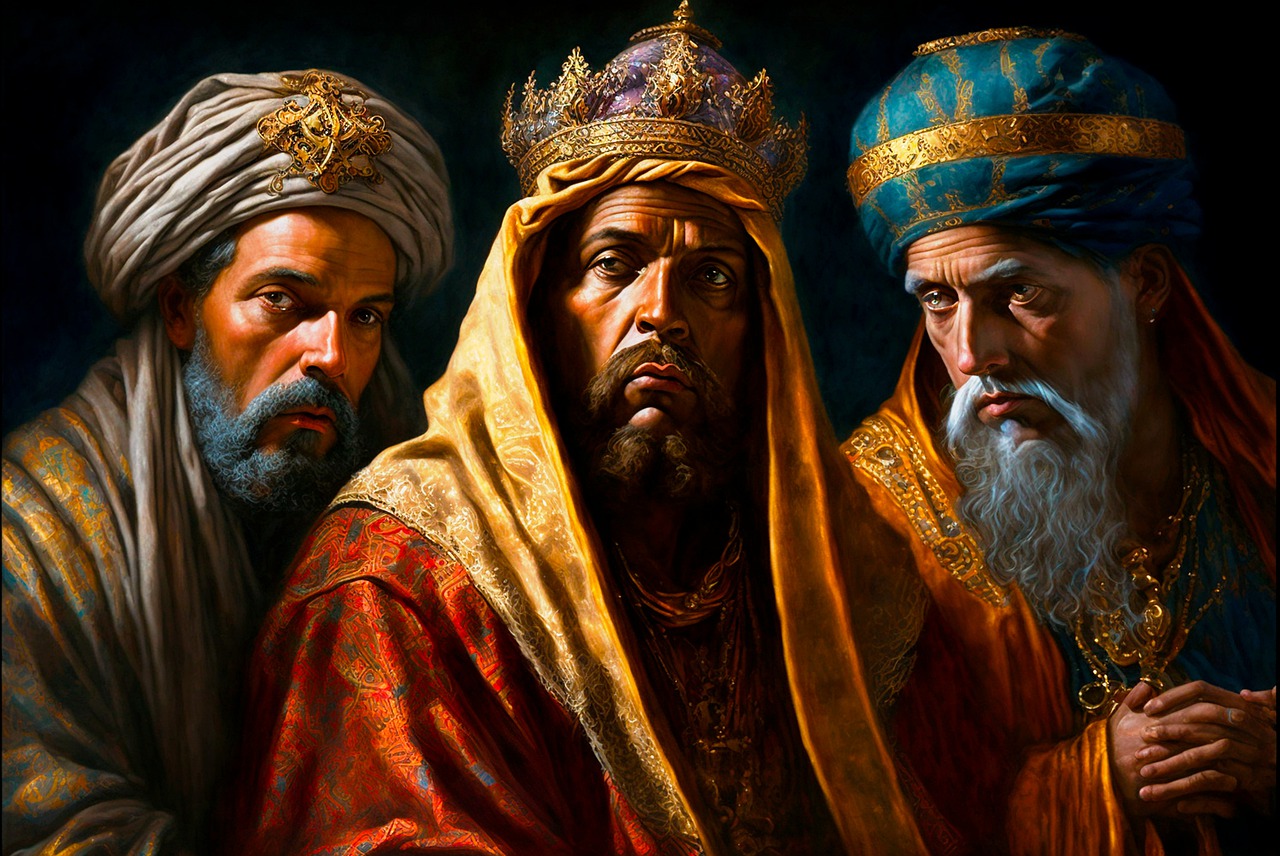
 Thanks to the prevalence of the Christmas story and nativity scenes, even non-Bible scholars are familiar with the general story of the three wise men arriving on the eve of Yeshua of Nazareth’s birth in a barn outside Bethlehem, as there was no room in the inn for Mary to give birth to her child in better circumstances. The three wise men, or magi, heard of the birth of the King and followed the Star of Bethlehem until they arrived at the stable, bearing gifts of gold, frankincense, and myrrh.
Matthew 2 depicts this story Biblically:
After Jesus was born in Bethlehem in Judea, during the time of King Herod, Magi from the east came to Jerusalem and asked, "Where is the one who has been born king of the Jews? We saw his star when it rose and have come to worship him."
When King Herod heard this, he was disturbed, and all of Jerusalem was with him. When he had called together all the people’s chief priests and teachers of the law, he asked them where the Messiah was to be born. "In Bethlehem in Judea," they replied, "for this is what the prophet has written:
"‘But you, Bethlehem, in the land of Judah, are by no means least among the rulers of Judah; for out of you will come a ruler who will shepherd my people Israel.’"
Then Herod called the Magi secretly and found out from them the exact time the star had appeared. He sent them to Bethlehem and said, "Go and search carefully for the child. As soon as you find him, report to me, so that I too may go and worship him."
After they had heard the king, they went on their way, and the star they had seen when it rose went ahead of them until it stopped over the place where the child was. When they saw the star, they were overjoyed. On coming to the house, they saw the child with his mother, Mary, and they bowed down and worshiped him. Then they opened their treasures and presented him with gifts of gold, frankincense, and myrrh. (Matthew 2:1-11)
A Botanical Overview of Frankincense and Myrrh
Sweet-and-citrusy-smelling frankincense and piney-and-bitter-smelling myrrh are both considered tree resins with the consistency of gummy sap that originate from the bark of two different trees, Boswellia sacra and Commiphora trees, or related species of thorny shrubs, respectively. Both trees are native to the more cool, arid regions of the Middle East and North Africa (Boswellia in Somalia, Oman, and Yemen; Commiphora is often grown in the rocky soils of Ethiopia, Oman, Somalia, Kenya, and Saudi Arabia). Boswellia trees have a papery bark, paired leaves found in bunches, and white flowers with either a red or yellow center, while in contrast, the Commiphora trees are spinier.
Cultivators extract the resins by making longitudinal incisions into the bark of the trunk of either the Boswellia or Commiphora trees at certain times of the year, and the sap pours out from the resin reservoirs in the bark. The resin drips down the tree based on gravity and forms tear-like droplets, which eventually harden on the tree. Cultivators then come back two weeks later to scrape the resin off the sides of the trees.
This extraction process is identical for both frankincense and myrrh. Due to the fact that the relevant trees only grow in the Arabian Peninsula and Northeast Africa, the economic principles of supply and demand come into play, and thus the resins are of high value due to their low supply and high demand. The trees are nearly impossible to grow elsewhere in the world.
Historical and Spiritual Overview of Frankincense and Myrrh
Neither gold, frankincense, nor myrrh were considered cheap gifts. Gold was considered a precious metal and a valuable commodity even in Yeshua’s day, as it is today. Sometimes it was found as nuggets in nature, and sometimes gold would have to be smelted from ore. References to frankincense and myrrh are found not only in the gospels depicting Yeshua’s birth but even in the Books of Exodus and Esther, which shaped not only early Christian life but early Jewish life.
Frankincense was burned in the ancient temples and in other spiritual ceremonies throughout the world. Additionally, frankincense would sometimes be used as a perfume, a spice, or combined with wine to make a beverage. Some Egyptian women also burned frankincense and utilized the ash as a component of personal care products such as eyeshadow.
Biblically, Frankincense was used in temple worship in ancient Israel as a component of the salted, pure, and holy perfume, along with spices, used in the sanctuary (Exodus 30:34), as well as a component of grain offerings that were to be brought to Aaron’s sons, the priests (Leviticus 2:15). Frankincense (incense) was also a component of the shewbread, as depicted in Leviticus 24:7. In Psalm 141:2, frankincense is referenced indirectly via the use of the word incense: "May my prayer be set before you like incense; may the lifting up of my hands be like the evening sacrifice."
Myrrh was used as a holy anointing oil, as referenced in Exodus 30:23–25, and in embalming, as evidenced in John 19:39. Additionally, myrrh is referenced scripturally as part of the personal beauty regimen of Queen Esther, as depicted in Esther 2:12.
The Greek writer Herodotus has suggested that both frankincense and myrrh were used by the ancient Egyptians in preparing human mummies and offering various animal sacrifices. This was also an era when people might smoke either frankincense or myrrh resins to combat body odor issues, prior to daily bathing becoming more commonplace.
Financial gains from the aromatic frankincense and myrrh rendered the locals richer than if they were loaded with gold alone. Even without factoring in the gummy resin otherwise known as myrrh, frankincense alone was foundational in establishing trade routes between the Arabian Peninsula and India, as well as the greater Mediterranean area with China’s famous Silk Road.
The role of frankincense and myrrh diminished with the rise of the early Christian church in the 3rd and 4th centuries due to prohibitions on burning incense to avoid pagan worship styles or even the mere appearance of pagan worship. Both frankincense and myrrh would later re-emerge in the Roman Catholic Church for ceremonial incense purposes.
Biblical scholars have differed in their interpretations of the significance of the gifts that the magi presented to Yeshua, as depicted in Matthew 2:11. It would not have been uncommon to bestow such valuable items upon any king or deity in ancient times. According to ancient inscriptions, King Seleucus II Callinicus may have offered these same three gifts to the god Apollo at the temple in Miletus. The Book of Isaiah depicts nations and kings who will "bring gold and frankincense and shall proclaim the praise of the Lord" (Isaiah 60:6) upon the restoration of Jerusalem. Thus, for the magi to render these three items as a gift to the King of the Universe would not be uncommon amidst ancient traditions.
Some scholars believe the gold is further symbolic of Yeshua’s dominion as King of the Universe; frankincense is symbolic of His priesthood and prayers rising to the heavens like the smoke of the burning frankincense (incense); and myrrh is symbolic of His death and burial in Gethsemane. Symbolically, myrrh represents bitterness, affliction, and suffering; we know from scripture that Yeshua suffered in His time on earth and took on many afflictions on the road to the Cross, where He died in the ultimate sacrifice that all who believe may have eternal life with Him.
Medicinal Overview of Frankincense and Myrrh
Other scholars believe the gifts were more practical and medicinal, yet of high value to Mary and Joseph and their family, who did not come from affluence.
Gold may have helped fund Mary and Joseph's travels as they fled Herod to the land of Egypt. Gold, despite the Biblical depictions in illustrations of idolatry, could very well be symbolic of Yeshua’s divinity as God in living flesh. Or possibly, these additional gifts could have been sold for funds to help Mary and Joseph in their travels or to otherwise fund their basic earthly necessities.
Both frankincense and myrrh would have contained antiseptic, analgesic, and other medicinal properties that would have been of value to Yeshua and His family on earth.
Frankincense is a milky-white gum that contains a compound known as boswellic acid. This compound is similar in chemical structure to testosterone, which is anti-inflammatory and possibly helpful against certain cancers, especially colorectal cancers. Even in the ancient Middle East and North Africa, frankincense was known as an herbal remedy for arthritis pain. Frankincense also has the ability to repel insects.
Myrrh, which has a reddish hue and is a primary ingredient in anointing oils used for consecrating kings, priests, and the tabernacle, was historically used in embalming and ancient Jewish burial practices due to its anti-bacterial and anti-microbial properties.
In herbal medicine and Chinese medicine, myrrh can help fight infections by stimulating the immune system to produce white blood cells, which can then engulf pathogens and heal the body of infection. Myrrh resin can also potentially be used for healing wounds or sores, ingestion, and coughs. More modern studies indicate it may have painkilling capabilities by acting on the brain’s opioid receptors.
In the writings of Papyrus Ebers, a compilation of Egyptian medical texts documented on scrolls, some priests of antiquity suggested using frankincense and myrrh as a salve for treating wounds and also as a remedy for hemlock poisoning and other conditions such as worms, snakebites, worms, plague, diarrhea, baldness, and scurvy. New medicinal uses are still being discovered to this day; both frankincense and myrrh have had a place in traditional Chinese medicine and Ayurvedic medicine, which are, of course, both ancient medicinal modalities spanning centuries.
Today, frankincense is most frequently found in perfumes or as an essential oil. Some modern studies indicate that using frankincense and myrrh together synergistically provides some anti-cancer effects, but more studies are needed.
Spiritual Applications
The gifts the magi bestowed upon the Savior of the Universe at His birth in a manger in Bethlehem were the best gifts they knew how to give. They may have been men in a high position at the time, and yet they traveled to a modest stable in a faraway land to give the best gift they knew how to two new parents, struggling peasants, and their newly born infant. They recognized Yeshua for who He was: The King of the Jews and the Messiah of the Universe. They came to worship this newly-born King of the Jews.
May we offer the best we have to Yeshua, whether that be time, service, or other goods, in our ministries and daily walks with God. But more importantly than the giving of funds or material things, for we may not have frankincense, myrrh, or other high-value gifts to contribute, we can worship the King of the Jews by giving our hearts and our whole selves to Yeshua anew each day, surrendering our ways to His ways, and allowing Him to write His laws on our hearts. We can give Him our love, our worship, our prayers, our diligent study of His ways, the searching and cleansing of our hearts, and our whole lives as we share with others the story of His birth, death, and resurrection.
As we reflect on His sacrifice on the Cross for us, may we be filled with awe, with gratitude, and with reverence for His atoning sacrifice, love, grace, and mercy. The Heavens do not need our things, our tithes, or our funds, for all things and all money are already His. As the magi bestowed upon the newborn King the most valuable gift they knew was so short of their whole hearts, we want to give our best on earth for advancing Biblical relationships in the here and now. Yet ultimately, we show our love for Him not through gifts, not through trying to buy our way into Heaven, but by following Him, keeping His commandments, and sharing His testimony unto the ends of the earth.
Add comment