
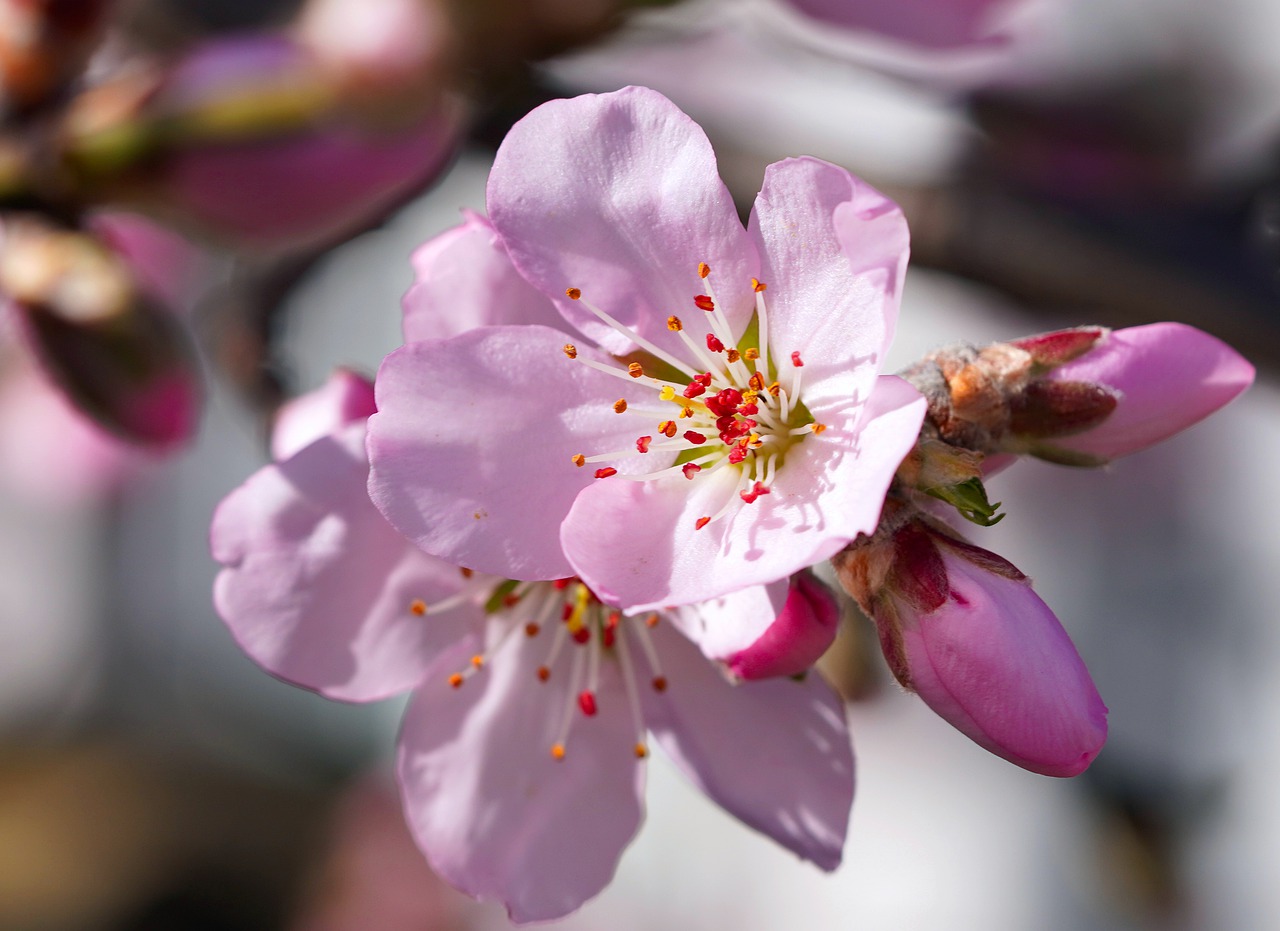
 The end of January and early February tend to be a beautiful time in Israel, with a kaleidoscope of pink and white blossoms peppering the otherwise barren, bronze Israeli hills and valleys characteristic of wintertime, thanks to the abundance of winter rains.
For Israelis, the first almond blossoms tend to impart hope that winter will soon be over and that warmer springtime days are visible on the horizon in the Holy Land. Other flowers also start to bloom with the emergence of springtime, like cyclamens, red anemones, and various wildflowers and grasses, but the almond trees characteristically bloom first. The picturesque flowers will linger for a narrow time frame—2–3 weeks—but then the petals start to fall to the ground as the almond fruits begin to appear and ripen into green almond shells. These almonds are abundant in Israel and the Middle East and are often sold by vendors on street corners and in marketplaces, especially during this late winter season.
The almond blossoms with a whiff of citrus fragrance in the crisp, cool air is a telltale sign of winter fading into spring, just as the leaves changing colors and falling from the trees in other parts of the world are a telltale sign that summer is transitioning to fall. Almond trees flourish during the mild, wet, dreary Mediterranean winters combined with the hot, arid summers of the Middle East, especially in the central portions of Israel. While the flowers signify the approach of springtime, the nuts (or, more accurately, seeds or kernels) themselves are not actually ripe until the harvest time toward the end of summer.
This annual blossoming of the almond trees almost perfectly coincides with Tu BiShvat, and, therefore, the almond is often included in Israel’s Tu BiSh’vat festivals. Many look upon the blossoming trees and reflect meaningfully on their Jewish heritage. Almonds are such a beloved part of Israeli culture that there is even an entire museum dedicated to marzipan located in Kfar Tavor in the Jezreel Valley.
There are two general types of almond trees: cultivated almond and bitter almond. The cultivated almond trees are the ones we enjoy eating the shelled fruits from. The bitter almond trees are less desirable for human consumption because they contain hydrogen cyanide, which is poisonous, and the chemical component of the almonds that imparts the bitter flavor. There is a process these types of almonds undergo to eliminate the hydrogen cyanide to render the resulting nut meat edible. These types of almonds, derived from a bitter almond species, are generally used more in almond extracts.
Almonds grow plentifully throughout the kibbutzim, private farms, and lush green hills of Israel, from Galilee to Jerusalem to the Hula Valley to Golan Heights to the Judean hills to the northern Negev. The village of Iksal, located just south of Nazareth, is an Arab region that is especially well known for its almond trees, particularly the Um al-Fahem (sometimes called Hassan) variety, which is known for its superior size, particularly robust nutty taste, and especially soft skin. This Um al-Fahem almond is sometimes deemed the premier Israeli almond.
The growth, breeding, research, and development of high-yield, low-water-consumption commercial varieties, pest and disease control methodologies, and overall maintenance of Israel’s almond tree population are overseen by the Plants Production and Marketing Board as well as Israel’s Ministry of Agriculture.
Almond trees are plentiful even in the Gaza Strip, which is sometimes better known for its olive trees compared to its almond trees, despite the latter growing plentifully throughout the Gaza region. Sometimes the almond trees of the Gaza Strip will reach a magnificent ten meters in height and bear fruit after merely three years of maturity.
Besides geopolitical tensions and wars ravaging the Gaza area, almond trees in that region have been on the verge of extinction due to mismanagement of groundwater; freshwater that the almond trees need to flourish is being replaced with sea water. The salinity of the water is not optimal for almond trees. This is coupled with issues of contamination from sewage and toxic agricultural chemicals being sprayed on the farmlands. In Gaza, the almonds are deemed a symbol of health, abundance, and greatness in addition to being a common snack, whether salted or added to various vegetable, soup, or hummus recipes.
Whether in the form of straight off the tree, almond butter, marzipan, frangipane, almond milk, Greek skordalia, Spanish ajo blanco, macarons, Sephardic bademli, travados, almond baklava, or endless other recipes, or the use of almond oil extrapolated for locally produced cosmetics (e.g., facial scrubs, creams), pharmaceuticals, or aromatherapy, almond consumption in Israel has steadily increased in recent years due to abundant growth in the Holy Land. There are nearly 10,000 tons of almonds produced in Israel each year, which are larger than the almonds produced in the United States. What almonds do not originate in Israel are often imported from California.
Over the years, there has been increasing public awareness of the health benefits of almonds, which provide calcium (believed to be 10% higher in calcium than California-grown almonds), magnesium, phosphorus, zinc, copper, manganese, potassium, antioxidants, vitamin B complex, vitamin E, various natural fibers, and monounsaturated fats, which may be helpful in preventing diabetes and cardiovascular disease. These nutritional benefits have led to further increased levels of research and development in Israel’s almond trees in recent times.
The Hebrew word for almond is "shaked," which, besides being a popular name for both boys and girls, appears in the Old Testament: Genesis 30:37, Genesis 43:11, Exodus 25:33, Exodus 37:19-20, Numbers 17:8, Ecclesiastes 12:5, and Jeremiah 1:11–12. Other than pistachios, almonds are the only nut mentioned within the Torah, though the almond is not technically a nut but a drupe, and it is the seed that we consume. The description of the golden menorah in Exodus even highlights the almond: “Three cups shaped like almond flowers with buds and blossoms on one branch, three on the next branch, and the same for all six branches extending from the lampstand. And on the lampstand were four cups shaped like almond flowers with buds and blossoms.”
Meanwhile, the Hebrew word for “to watch, to be steadfast, to awaken” or “hastening” is also spelled the same way as the Hebrew word for almond. Thus, many people deem the almond symbolic of God’s watchfulness and protection over the Jewish people, as well as a symbol of hope, renewal, rejuvenation, and happiness. This concept sometimes gets extrapolated to Jewish weddings, where wedding guests may shower newlyweds with almonds as they exit from the chuppah or pass out almonds at wedding receptions.
As King Solomon once wrote in Ecclesiastes, there are times for rejoicing and times for mourning. The seasons of our lives will come and go. The almond blossoms are a visible reminder of the changing seasons and that a bleak winter can and will indeed, in time, transform into a marvelously colorful springtime of renewal and growth. For those who feel trapped in a personal wintertime, may the almond blossom serve as a reminder that spring will come, God is always at work, God’s word is true and certain, and one day He will make all things beautiful, including the darkest and bleakest of winters, whether that be wintertime on earth or wintertime in our own life’s journey.
Add comment