
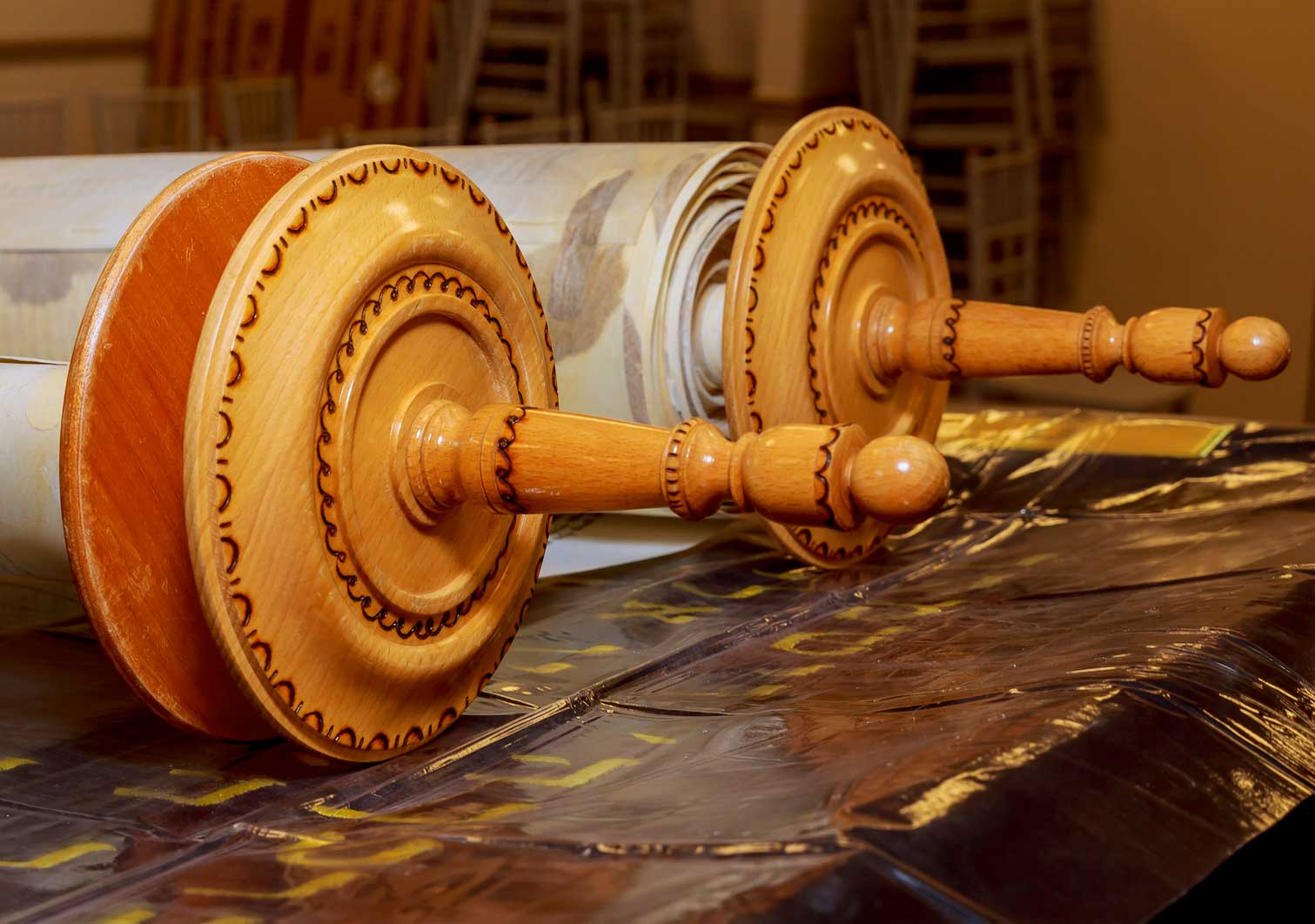
 Simchat Torah ("rejoicing of the Torah"), most likely of medieval origins, is observed by the Jewish people on the last day of Sukkot. The overall theme of Simchat Torah is the spirited joy that the Jewish people feel toward Torah observance, an affirmation of the foundational role of the Torah in Jewish religious life, and the celebration of completing the annual cycle of Torah readings. which starts with Genesis 1 (Bereishit) and concludes with the final liturgical passage (parashah) of Deuteronomy 34 (Devarim), then the cycle repeats again starting with Genesis 1.
Origins
Simchat Torah has no known Biblical references. Deuteronomy does reference rejoicing over the Torah and regular Torah study and commands Israelites to rejoice on Sukkot. Moses does command the priests to read the Torah to Israel during the season of Sukkot. But Simchat Torah, as it is known, is not a day specifically addressed in scripture and most likely originated from the Shulchan Aruch, which is a medieval compilation of Jewish laws written by a Spanish rabbi.
Festivities
The night before Simchat Torah, women and girls may light candles and recite blessings, and Jewish people may gather with friends and family to partake in festive meals and the kiddush while refraining from work, writing, and sometimes even turning on any electrical device, depending on the Jewish community. Cooking is permitted in most Jewish communities, except on Shabbat.
During these joyful festivities, it is customary for a cantor or equivalent of an elder to remove the Torah scrolls from the Ark and march the Torah scrolls throughout the synagogue seven times (hakafot) in a spirit of rejoicing, both during the morning and evening synagogue services. The Jewish people often refrain from work on this particular day (yom tov). As many people as possible are invited to participate, and children are invited to the processional, often carrying a toy or miniature Torah, as regular Torah scrolls are generally much too heavy for the average child.
Only seven circles around the bimah are required in the tradition, but often congregants will extend their dancing beyond seven circles. Dancing is based on the concept of the Jewish people being the "feet" of the Torah scrolls.
Children may be waving flags, sweets (symbolic of the sweetness of the Torah) and alcohol may be served; "chag sameach," the generic holiday greeting, is the only greeting associated with this holiday, and congregants may be singing and dancing. Singing and dancing may carry over to the streets and public squares. The priestly blessing may occur earlier than usual in the service to minimize the chances of the kohanim consuming excessive alcohol by the time the priestly blessing would regularly occur. Men and children are given the opportunity to say an Aliyah blessing over the Torah. Confirmation ceremonies for children beginning their Jewish education may be held in some synagogues at this time, around Simchat Torah.
Unlike other Jewish holidays, Simchat Torah is not known for traditional foods per se, though it is not terribly uncommon to encounter Simchat Torah fellowship meals that are somehow based on cabbage, due to the cylinder-like shape of cabbage possibly being symbolic for the shape of a Torah scroll. In certain Ashkenazi communities, stuffed cabbage is not uncommon. Other foods that may be incorporated due to this cylinder-like shape mimicking the shape of the Torah scroll include blintzes and Torah-shaped cookies.
Shemini Atzeret
In Israel, Simchat Torah is combined with the holiday of Shemini Atzeret ("assembly of the eighth day), which occurs on the same day. In the Diaspora, Simchat Torah and Shemini Atzeret are more distinct, with Shemini Atzeret occurring on Tishri 22 and 23, and Simchat Torah exclusively occurring on Tishri 23. Both holidays are distinct from Sukkot, as one no longer waves the lulav and etrog during these one or two holidays. Jews in the Diaspora may still spend time dwelling in the sukkah, but traditional Sukkot blessings are not recited.
Alternatively, there is the explanation that Sukkot was created not only for the Jewish people but for all of humanity. Yet when Sukkot concludes, God encourages the Jewish people to linger for one more day for a more personalized celebration. While Simchat Torah’s significance clearly centers around the Torah being a foundational pillar in Jewish religious life, the significance of Shemini Atzeret remains largely unknown.
It is believed by some that Shemini Atzeret was mentioned in the Bible, perhaps in the form of a day focused on the ritual cleansing of the altar in Second Temple times, but has become obsolete ever since the destruction of the Temple. Thus, the purpose of the day was never clearly defined. Shemini Atzeret does coincide with the beginning of the rainy season in Israel and the greater Mediterranean region. A short prayer for rain may thus be included in the second blessing of the Amidah, kicking off several days in which the Jewish people may pray for rain. It is not uncommon to include the Yizkor (a memorial service asking God to remember the souls of the departed) as a component of the Shemini Atzeret liturgy.
Rabbinic literature explains Shemini Atzeret as God, King of the Universe, who loves His people enough that it is hard to have us leave a month full of holidays, so when it is time for us to leave the High Holy Day season and transition into the remainder of the new year, He enjoyed His time with us so much that He wants us to spend another bonus day communing in fellowship with us.
*****
Both Simchat Torah and Shemini Atzeret symbolize joy in the study of the Torah, delight in seeking obedience in God’s ways through the Law, and celebrating the cycles and seasons of the Jewish calendar. Once these holidays are over, the goal is for the Jewish people to nurture, rejoice in, and continue to grow upon the deeper connection with God that was developed throughout the High Holy Day season. The Torah reading cycle then starts over again, and it is back to normal life, with no holidays (Mar Heshvan, "Bitter Heshvan") describing the two months devoid of festivities until the lighting of the menorahs at Chanukah.
Add comment