
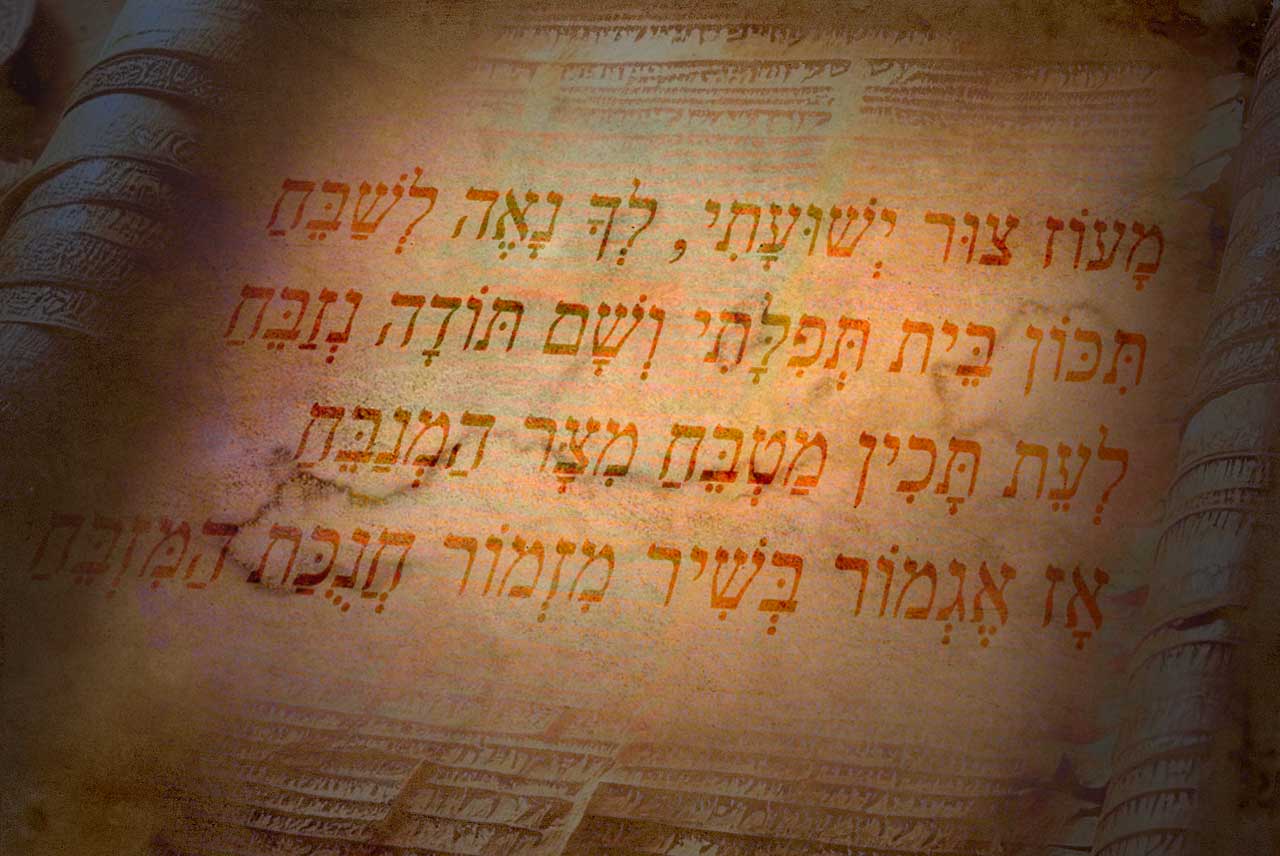
 As one of the most popular Chanukah hymns and most well-known Jewish melodies, Ma’oz Tzur (“strong rock of my salvation” in English, with the name referencing the Hasmonean fortress of Beth Tzur) dates back to the Ashkenazi Jewish culture of the Crusades in the late 12th or possibly even early 13th century. The exact date is disputed.
Ma’oz Tzur is musically aligned stylistically with that of a 16th-century Protestant chorale according to some renowned Jewish music scholars such as Abraham Zevi Idelsohn and Eduard Birnbaum. This could arguably be a song appropriate for Purim or Passover as well. It is possible that Ma’oz Tzur was assigned to Chanukah at some point in Jewish history as the Festival of Lights lacks a distinctive megillah or Haggadah of its own.
The original five stanzas of Ma’oz Tzur Yeshuati were written by an author only known by the name of Mordechai. Mordechai’s exact identity is shrouded in mystery and open to speculation. His name appears as an acrostic formed by the first letter in each of the five original stanzas. Some believe it could possibly refer to Mordechai ben Yitzhak Halevy, an Iraqi poet and rabbi who emigrated to Germany in medieval times. Others speculate it may refer to Mordechai ben Isaac ha-Yafit, who composed a beloved Sabbath hymn. Regardless of the exact identity of Mordechai or whoever the author was, the author was undeniably livid and reflected his infuriation in his writing.
Ma’oz Tzur has a distinct anti-Christian sentiment resonating throughout. The liturgical poem was originally a rallying cry about the Jewish people being murdered during the Crusades in the name of Jesus Christ, the Holy Cross, and everything Christianity seemed to represent. This included some people making unholy pilgrimages to the Holy Land in the name of Christ but slaughtering the Jewish people along the way.
Tensions between Christians and Jewish people were running high during the Middle Ages. If anything, the Jewish people would have arguably rather aligned themselves with Islam than Christianity, based not only on monotheistic beliefs but also because living under Islam at the time would have been less brutal on the Jewish people than enduring life under so-called Christianity at the time. Because of some of these more reprehensible moments in Judeo-Christian history, it can be understandable why some Jewish people may equate anti-Semitism with the teachings of Jesus, and therefore why the Jewish people want nothing to do with Christianity.
Geographically, the origins could possibly be traced to the Rhineland Valley in Germany, though the Ashkenazi population did seem to shift to France after the First Crusade; most research has seemed to indicate the poem was written in Germany. It was not written for Chanukah originally but was based on the Sephardic piyyut of the time and later became a six-stanza hymn adopted into standard Chanukah liturgy throughout the world, juxtaposing some extremely negative sentiments on top of a beautiful melody.
In analyzing Ma’oz Tzur, the five and eventually six stanzas have a distinct breakdown.
The first stanza acknowledges God as the rock of our salvation, worthy of our praise and devotion, while perhaps even acknowledging some concept of Jewish martyrs during the time of the Crusades.
The four stanzas in the middle describe the persecution, exile, and triumphant deliverance of the Jewish people from Pharoah in Egypt, Nebuchadnezzar’s reign during Babylonian exile, Haman’s plan to murder the Jewish people of Persia, and Antiochus, which would later be connected with the Chanukah story. While these four middle stanzas are written in the past tense, the first and final stanzas, in contrast, are written in the present tense.
Added later, the sixth stanza did not appear traditionally in liturgy until it was first published in 1702 in Amsterdam. This stanza calls for the deliverance of the Jewish people from futuristic or current enemies. It is believed to be genuine liturgy passed down orally during the past five centuries but never before put to print due to how harsh the tone is in its anti-Christian fervor.
Some believe that the line “bring the end, the redemption” also has ulterior motives or perhaps a double meaning in referring to “bringing an end to Jesusism/Christianity.” The perhaps double meaning of the term redemption allows for a disdain of Christianity without being so open about it; the hatred of Christianity is more concealed through the veiled double meaning. Taken out of its historical context, many modern Jews do not have the historical or theological knowledge of why divine retribution would have a place in a Chanukah song. It is seemingly out of place without historical knowledge.
This became apparent to some scholars when a Russian Jew who had converted to Christianity in the late 19th century was able to get the uncensored version into publication rather than redacting the stanza or trying to use redemption instead to veil the reference. Thus, some Russian Jewish congregations had “brought an end to Jesusism/Christianity” in actual print for some of the first times in history.
Within Chanukah celebrations from the Middle Ages through the present day, it is common for the candles on the menorah to be lit, followed by the Hanerot Hallalu, followed by Ma’oz Tzur. Prior to the 19th century, the song was usually sung at home prior to festive or oily foods being served and various dreidel games being played, but became more commonplace in Chanukah services held at synagogues after at least the 15th century, if not possibly sooner (at least in western and central Europe, even if not everywhere).
The lighting of the candles is rabbinically ordained, usually following the afternoon service on weekdays, though acknowledged by the rabbis to serve no practical or functional purpose. It is merely symbolic of everything God did to liberate the Jewish people. Ma’oz Tzur follows the candle lighting, and Hanerot Hallalu echoes that theme of gratitude with the part that reads, “Establish the Temple, and there I shall sacrifice in gratitude. For the occasion, prepare an offering of the braying enemy.”
Jews of ancient times expressed their anger at being mistreated by Christianity and various non-Christian governments through both direct and veiled references in Ma’oz Tzur. However, there are also prevailing themes not only of resentment and vengeance but also of hope for the end of exile, persecution and suffering of the Jewish people, and faith that God will bless the Jewish people with better times yet to come. Ma’oz Tzur is not written about Chanukah specifically, but is certainly relevant to the Chanukah theme in terms of the primary themes of trials, tribulations, and triumphant victories in Jewish history.
Add comment