
In the Mishnah, the tractate Aboth i.2 states that the world is “sustained” by three things: the law (Torah), the temple service, and good deeds. This statement presents, in a nutshell, the great importance of the temple for Judaism and the centrality of the idea of the sanctuary for the Jewish faith.
Indeed, since the very beginning of the People of Israel, when God was establishing them as His own people and His holy nation, He gave them orders to build a sanctuary so that He might “dwell among them” (Exodus 25:8). The sanctuary would also provide a way of approaching God in a very direct and tangible way.1 According to the biblical text, God went so far as to precisely instruct Moses on the pattern of such a sanctuary, in all its structure and furniture (Exodus 25:9).
Even after the total destruction of the temple of Jerusalem by the Romans in the year 70 C.E., the centrality of the idea of God’s sanctuary in Judaism remained alive. It can be seen in the daily liturgy of the synagogue religious services (the morning service, Shacharit, the afternoon service, Minchah, and the evening services, Arvit, remind the worshiper of the time of the religious services in the temple and its sacrifices); in the liturgy of the Sabbath; in the annual holidays and in the solemn liturgy of the Yom Kippur; in the fast of the 9th of Av (Tisha b’Av), the date of the two destructions of the temple; in one of the requests of the Great Prayer, the Amidah, that asks for the rebuilding of the temple and the reestablishment of its service; and in many practices of religious Jews that have the intention to show their sorrow for the destruction of the temple.
The enormous importance of the idea of God’s sanctuary and of the temple of Jerusalem is well felt throughout the New Testament and in many of its texts. They play an important role in its history and theology. They are so frequent that the New Testament is an important historical source for Jewish history and ideas concerning the temple. They also portray thereby some very deep Jewish roots of the New Testament preaching and faith that have been either forgotten or misunderstood by many of its believers or readers.
First of all, many of the historical facts depicted in the New Testament took place inside, or in relation to, the Temple of Jerusalem. The Gospel of Luke, for example, starts with the story of Zachariah, a Cohen (priest), officiating inside the Temple. He was offering incense (Qetoret Samim), apparently at the time of the afternoon service (Minchah), inside the Holy Place, in front of the golden altar, when a heavenly messenger announced to him that his wife would give birth to a son and he should call his name Yochanan (John). This boy would be great at the sight of the Lord, for he would prepare the way for the coming of the Messiah in the power and the spirit of Elijah, fulfilling thereby the prophecy of Malachi (see Luke 1:5-24). Luke also reports many different events in the childhood of Jesus that, as a normal Jewish boy of the time, were related to the Temple of Jerusalem, for example, his ceremony of Pidyon-haBen (redeeming of the firstborn male) and the purification of his mother after childbirth (Luke 2:22–38), and his Bar Mitsvah (a boy’s religious maturity ceremony), which is the most ancient historical report of that ceremony that we know (Luke 2:41- 52).2 The Gospel of John is another example, for it usually presents Jesus as teaching and healing in the temple courts and being there for the festival ceremonies, as a religious Jewish man would be (see John 2:13-225; 5:1-47; 7:10-53; 10:22-42). As for the book of the Acts of the Apostles, it presents the early Jewish believers in Jesus as faithful to the Temple service. Living in Jerusalem, being numbered by the ten thousands—including many priests (Cohanim, Acts 6:7) and Pharisees (Perushim, Acts 15:5)—these believers were described as zealous of the Law, and their habitual place of daily worship was the Temple (see Acts 2:46; 3:1-4:4; 5:12-16; 21:17-26; 22:17; 24:17-18; 26:21).
But if the Temple is seen in the New Testament as the place for worship and for religious gathering, it is above all because it was considered to be, in the line of the biblical and Jewish view of the time, the special place of God’s dwelling. This view can be plainly seen in Jesus’ warnings against careless swearing and oath-taking. In his warnings, he recalls the holiness of the temple and its sanctity as God’s sanctuary. One should always be careful and keep in mind that “he who swears by the temple swears both by the temple and by Him who dwells within it” (Matthew 23:21). The temple precincts were therefore sacred, for they were the House of the Lord and should be used for worship and prayer in all their extensions. Twice in his short ministry, hence, Jesus raised himself against the abuses promoted by the leaders of the Sadducees, who were in charge of the Temple. The high priest Caiaphas had allowed money changers and sellers of cattle and other sacrificial animals to occupy part of the temple’s ground, which the court reserved for the gentiles, for their business. The Talmud reports that on the Mount of Olives, which is right in front of the Temple area, there were four markets dedicated to providing the religious Jewish pilgrims with all they needed for their sacrifices and worship. Therefore, it was unnecessary to allow the merchants to do their business on the temple grounds, and the Talmud curses the Sadducees for such desecration of the holy grounds.3 By overturning the tables of the money changers and casting the merchants out of the Temple, Jesus portrayed the same abhorrence and refusal of such abuses. After having expelled these merchants, Jesus quoted Isaiah 56:7, saying that the Temple of Jerusalem was a “House of Prayer” for all the nations, therefore the courts of the gentiles should fulfill such a purpose (see John 2:13–17; Matthew 21:12–13; Mark 11:15–17; Luke 19:45–46). At the end of his life, the Gospel reports that Jesus, considering the prophecies of Daniel, looked at the near future to the destruction of Jerusalem and of the Temple by the Roman army, and he cried. The sight of the evil and all the suffering that would befall his own people was so overwhelming that his concerns were with those who would endure such a time, even when he was facing his own death (see Matthew 23:37–24:2, 15–22; Luke 19:41–44; 23:27–31).
The New Testament ideas about God’s sanctuary are also presented in three other lines, lines that represent well the New Testament’s biblical and Jewish roots: The people of God are seen as His sanctuary; the individual believer as well; and finally, it speaks about a heavenly sanctuary where the throne of God is located.
In the Hebrew Bible, Psalm 114:2 states that when Israel came out of Egypt, Judah became God’s sanctuary and Israel his dominion. In the New Testament, likewise, Paul (Shaul) says that the Ekklesia of God (God’s Qahal), the congregation of children of God, was His sanctuary, the very midst in which God dwells with His Spirit (1 Corinthians 3:16). This idea of a community of faith serving as a sanctuary for God’s presence is very present in the basic Jewish concept that where there is a group of ten or more Jewish men praying together (in Jewish terms, what is known as a Minyan), the “Divine Presence, the Shekhinah, is in their midst.4
As Isaiah 57:15 declared that God dwells “in a high and holy place [i.e., heavens], and also with the contrite and lowly of spirit,” so would Paul (Shaul) also assert that the individual believer is himself a temple of God (1 Corinthians 6:19–20). This concept of an individual as a temple of God is related to the religious concept of “holiness.” To be “holy” (Hebrew: qadosh) is to be separated from God, dedicated to His service, and used for His dwelling. All these concepts are fundamental to the biblical concept of sanctuary; hence, the Tabernacle of the Desert and the Temple of Jerusalem were usually called the Qodesh (the Holy). This concept of holiness has been applied to Israel since its beginnings, for it was a “holy nation” (Exodus 19:5–6). In the first century of the Common Era, it was not uncommon to call the members of God’s people the qedoshim, the “holy ones,” the “saints” (1 Corinthians 1:2; see the common usage of such an expression in the Jewish literature of the Qumran).
The New Testament speaks also of the existence of a heavenly sanctuary in which is located the glorious throne of God. According to the book of Hebrews, it is in this sanctuary that the Messiah officiates continuously as a High Priest (Cohen haGadol), interceding and ministering in favor of humans. The Tabernacle of the Desert and the Temple of Jerusalem, with their religious and ritual services, were symbols of this heavenly sanctuary and the ministry and service of the Messiah therein (Hebrews 2:17–18; 4:14–16; 6:19–20; 8:1-6; 9:1–10:23). In the Book of Revelation, John (Yochanan) saw Jesus (Yeshua) as the heavenly High Priest, standing by seven golden menorot (or seven golden lampstands), ministering in front of the throne of God, surrounded by angels and heavenly beings (Revelation 1:12–16; 4:1–5:14). The description of such a vision has much in common with the visions of the throne of God found in Isaiah 6, Ezekiel 1, and Daniel 7. In this heavenly sanctuary, John also saw the golden altar, the offering of the incense (Qetoret samim) with a golden censer, golden trumpets, the ark of the covenant, and many other objects and rituals that belonged to the context of the sanctuary (Revelation 8:2–11:19; 15:1–8). Similar ideas about the heavenly sanctuary and the ministry of the Messiah as its High Priest were very common in the Judaism of the time when the books of Hebrews and Revelation were written. They can be found in much Jewish apocalyptic and rabbinic literature.5
Finally, at the end of the New Testament, the end of the book of Revelation draws on the message and meaning of the Jewish Tabernacle Festival and presents the coming new world, upon which will descend the heavenly Jerusalem, as the full realization of the idea of the Sanctuary. God Himself will dwell in this Golden Jerusalem, and there will be unrestricted communion between humans and their Creator. While he was seeing it through a vision, John heard a loud voice coming from the throne of God, "saying, ‘Behold, the Sucah (tabernacle) of God is with man. He shall dwell among them, and they shall be His people, and God Himself shall be among them. He shall wipe away every tear from their eyes, and there shall no longer be any death; there shall no longer be any mourning, crying, or pain; the first things have passed away.’ And He who sits on the throne said, ‘Behold, I am making all things new.’ And He said, ‘Write, for these words are faithful and true’” (Revelation 21:3-5).
1 The ideas of nearness and relationship are very basic to the Israelite sanctuary. It is well expressed, for example, in the very common words used to expressed the verb “to sacrifice” (hiqriv) and the substantive “offering, sacrifice” (qorban); both come from the root QRB which has the idea of “to be close,” “to be near.” Hence, to sacrifice in Hebrew means literally “to approach,” and the offering brings in itself the idea of “closeness, relationship.”
2 See for a short description of the ancient practice of Bar Mitsvah Daniel B. Syme, The Jewish Home: A Guide for Jewish Living (Northvale, NJ: Jason Aronson, 1989), 69.
3 See William L. Lane, The Gospel of Mark, The New International Commentary on the New Testament (Grand Rapids, MI: William B. Eerdmans, 1974), 402-408; and David H. Stern, Jewish New Testament Commentary (Clarksville, MD: Jewish New Testament Publications, 1996), 63.
4 See Hayim Halevi Donin, Rezar Como Judio: Guia Para el Libro de Oraciones y el Culto en la Sinagoga, trans. Oscar Sapolinsky, ed. Eliahu Birnbaum (Jerusalem: Eliner, 1986), 28.
5 See, for example, Testament of Levi 3:4-8; 5:1; 2 Apocalypse of Baruch 4:3- 6; 4 Ezra 7:26; 8:52; 13:36; Mishnah, tractate Tamid. See discussion on the topic in William L. Lane, Hebrews 1-8, Word Biblical Commentary, vol. 47a (Dallas, TX: Word Books, 1991), 204- 206, and Jacques Doukhan, Revelation of Yohanan: The Apocalypse Through Hebrew Eyes (forthcoming).
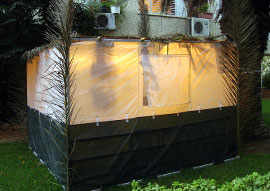
Image: A sukkah in Herzliya by - self-made, http://flickr.com/photos/ronalmog/1447764673. Public Domain
Add comment