
The Mishnah tells the story of four famous sages who entered the Pardes, the mystical paradise of the apocalyptic vision.1 No one survived the visit, however. The first died right away, the second lost his faith, and the third became demented. As for the fourth, he proclaimed himself the Messiah.
This parable brings us—with a smile—an important warning: the concept of the apocalypse is, indeed, a dangerous one. It has an aura of death, doom, and fear about it. Thus, before we venture into the biblical book of the Apocalypse, we need to prepare ourselves and make sure that we will read and understand it the way God meant it to be.
The Apocalypse is more Hebrew than any other book of the New Testament. It contains more than 2,000 allusions to the Hebrew Scriptures, including 400 explicit references and 90 literal citations of the Pentateuch and the Prophets. With regard to textual citations, the Apocalypse is more faithful to the original Hebrew than to its Greek translation, the Septuagint. Ernest Renan observed that “the language of the Apocalypse is traced from Hebrew, thought in Hebrew, and can hardly be understood by those who do not know Hebrew.”2 This characteristic invites us to consider the book’s Hebrew background and perspective.
The structure of the Apocalypse, what I call the menorah or sevenfold pattern, supports the whole book (see Menorah table3). The book unwinds in seven cycles of visions, parallel and simultaneous, not unlike the book of Daniel.4 At the beginning of each of the seven cycles, the vision returns to the Temple with a liturgical note that alludes to the calendar of Israel’s high holy days (as prescribed by Lev. 23). The book thus places each prophetic cycle within the perspective of a Jewish festival, one often alluded to within the cycle itself. The author invites us to read the Apocalypse in the light of the Jewish festivals and rituals that shed symbolic meaning on history.
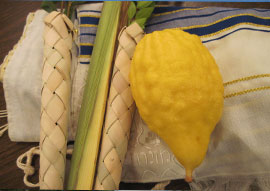
The promise of the New Jerusalem concludes the Apocalypse. In this article, we shall explore this phenomenon in relation to the seventh vision of the Apocalypse, in which the author sees the end, the vision of the New Jerusalem, when God is at last with us. At this juncture, significantly, the author thinks about Sukkot, the Feast of Tabernacles.
The Dwelling of God
The book of Revelation employs language similar to that used in the context of Sukkot—the Feast of Tabernacles, which is the last in the Jewish calendar—thus associating New Jerusalem with the festival. A key passage in this regard is: “And I heard a loud voice from the throne saying, ‘Now the dwelling [or tabernacle] of God is with men, and he will live [or dwell] with them’” (Rev. 21:3).
The word “dwelling” or “tabernacle” translates the Greek word skene. The Greek word echoes the Hebrew word shekinah, the physical sign of God’s presence among His people (Exod. 40:34–38). Also, the shekinah derives from the same root as the Hebrew verb shakan (“to dwell”), rendered by the Greek skenoun (“to dwell, to spread the tent”). Such background suggests that Rev. 21:3 is emphasizing that God will actually be with humanity.
The New Jerusalem will be God’s actual presence and not simply a symbol of that presence, as was the case with the Temple. Later, the text is even more explicit: “I did not see a temple in the city, because the Lord God Almighty and the Lamb are its temple” (Rev. 21:22). Here is the principal difference between the new Jerusalem and the old. In the new city, God’s literal presence replaces the Temple, which had functioned as the symbol of His dwelling. The book of Ezekiel follows the same pattern, concluding likewise with God’s presence in the city: “And the name of the city from that time on will be: the Lord is there” (Ezek. 48:35).
God is finally here. True communion between Him and His people is at last possible. The Apocalypse expresses this in the language of the covenant: “They will be his people, and God himself will be with them and be their God” (Rev. 21:3). “I will be his God, and he will be my Son” (Rev. 21:7). 6 It is one of the favorite themes of the Song of Songs: “My lover is mine, and I am his” (Song 2:16; cf. 6:3; 7:10).
Both the conjugal metaphor and that of the father testify to the proximity of a God with whom it is at last possible to have a direct and reciprocal relationship without the problems of distance, sin, and error, and without the intervention of a priest or a ritual. What God had to refuse to do to Moses (Exod. 33:20–23) now becomes an everyday occurrence: “They will see his face” (Rev 22:4).
God will be there—physically present—like the man or woman that we live with, with whom we converse, laugh, eat, and think. It is a new experience that we cannot express in either words or thought.
The Experience of Sukkot
The physical presence of God as the Temple of the New Jerusalem infinitely magnifies that of the Feast of Tabernacles, which owes its name (sukkot, tabernacles) to the makeshift dwellings from branches and vines that the people built for the celebration. The custom commemorated Israel’s wandering in the desert and God’s presence among His people: “Then have them make a sanctuary for me, and I will dwell [shakan] among them” (Exod. 25:8).
In Jewish tradition, the sukkah, like the sanctuary, symbolized the shekinah.7 The psalms read in the sukkah testify to such symbolism—they all speak of God’s protective presence (Ps. 23, 27, 36, 57, 63, 91). Furthermore, the fragile nature of the sukkah recalls the precariousness of the world’s cities, while it strengthens the longing for the heavenly kingdom. The branches of the roof must always retain open space so that we may see the heavens through the holes. Significantly, the liturgical readings of the Feast of Tabernacles cover the book of Ecclesiastes, in which everything—our lives, our deeds, our dwellings—is vanity (see esp. Eccl. 2:4ff.). We find the same lesson of hope inscribed in the other name for the festival—the “Feast of Ingathering” (Exod. 23:16; 34:22)—for it also marked the end of the harvest.
In the Apocalypse, the allusion to the Feast of Tabernacles is particularly appropriate. After Kippur (Rev. 11:19), the harvest of grain and grapes (Rev. 14:14–20; 16:17–18), the rite of Azazel (Rev. 20:2, 3), and the purification of the camp from evil (Rev. 20:7–15)—after these things follows the great gathering of God’s people from the four corners of the earth. We see the universality of the assembly hinted at in the general expression: “The dwelling of God is with men” (Rev. 21:3). The prophet Zechariah had already foreseen the Messianic overtones of the Feast of Tabernacles: “Then the survivors from all the nations that have attacked Jerusalem will go up year after year to worship the King, the Lord Almighty, and to celebrate the Feast of Tabernacles” (Zech. 14:16). The prophet of the Apocalypse uses similar language: “The nations will walk by its light, and the kings of the earth will bring their splendor into it” (Rev. 21:24).
Humanity’s thirst for God is finally quenched: “To him who is thirsty, I will give to drink without cost from the spring of the water of life” (Rev. 21:6; cf. 22:1). The image also appears in the context of the Feast of Tabernacles. On that occasion, it was customary for the priest to draw water from the pool of Siloam with a golden jar during the morning and evening rituals of the daily sacrifices. The people greeted his return by singing, “With joy, you will draw water from the wells of salvation” (Isa. 12:3). 8 It was the custom Yeshua alluded to during the Feast of Tabernacles when He said, “If anyone is thirsty, let him come to me and drink” (John 7:37).
The Meaning of Jerusalem
The Apocalypse gives the fulfillment of all hopes, the answer to all the longings of the world, the quenching of all thirst (Rev. 21:6), and the descent of the city of God as a final point: “It is done” (v. 6). And indeed, the city’s name—Jerusalem—is laden with meaning. First and foremost, it is the city of peace, as connoted by its ancient name, “Salem.” It is the city of Melchizedek, the king of justice. The city of Jerusalem was also built on Mount Moriah (2 Chron. 3:10), alluding thus to the sacrifice of Isaac (Gen. 22:1–18). 9 Jerusalem was also the place where God stopped the deadly sword about to decimate the people of Israel (1 Chron. 21:14–16). David conquered it and made it the first capital of Israel (1 Chron. 11:1–9), then kept the ark of the covenant within its walls (2 Sam. 6:12–23). But the collective memory of Israel primarily associates Jerusalem with the Temple. Jerusalem is a place of prayer and worship (Ps. 48:2; 122:1). The city is also the antithesis of Babylon and the symbol of the return from exile and the end of oppression. It is the city that incites nostalgia—God’s people cannot forget Jerusalem (Ps. 137).
Through these memories, the people of Israel came to identify Jerusalem with God’s presence. The city stood for God’s dwelling place in heaven, the place where the saints could shelter resplendent in God’s inconceivable glory (Ps. 48:1–3).
The prophet Daniel also envisioned the heavenly Jerusalem. Beyond the earthly kingdoms that finally disappear without a trace (Dan. 2:35), the prophet sees “a kingdom that will never be destroyed” (v. 44) in the shape of a mountain (vv. 35, 45), the traditional symbol of Zion, or Jerusalem.
In the spirit of the biblical tradition, Jewish tradition affirms the reality of the “Jerusalem of above” (Yerushalayim shel Maalah) that existed even before the creation of the world11 and inspired the poets of love.12 Jewish apocalyptic literature views the heavenly Jerusalem and its Temple as coming down onto the cities of the world, “for no human work may compare to the dwelling place of the Most-High.”13 According to the Kabbalistic rabbi Bahya b. Asher, the plural form of the Hebrew word for Jerusalem (Yerushalayim) alludes to the existence of two Jerusalems, one on earth and the other in heaven.
The Jerusalem of the past, however, hardly compares with the New Jerusalem. Nothing is the same. The first words of Rev. 21 describe the New Jerusalem in terms of creation: “Then I saw a new heaven and a new earth, for the first heaven and the first earth had passed away, and there was no longer any sea” (Rev. 21:1). The parallel text in Isaiah makes an explicit reference to creation: “Behold, I will create a new heaven and a new earth. But be glad and rejoice forever in what I will create, for I will create Jerusalem to be a delight” (Isa. 65:17, 18).
The new earth will be radically different. The first characteristic of this new universe is that the “sea” is no more (Rev. 21:1). The “sea” in the Hebrew mindset had a negative connotation, representing void and darkness (Gen. 1:2; Ps. 18:12; Job 26:19; Prov. 8:27), death and “nonbeing”14 (Ezek. 26:19-21; Jonah 2:6; Hab. 3:10), and evil (Isa. 27:1; 51:9, 10). Scripture also associates “sea” with Babylon (Rev. 16:12) and, in the Apocalypse, with the origins of the beast (Rev. 13: 1).15
The Greek word neos that qualifies Jerusalem means radically and “totally other.”16 God gives the New Jerusalem a new configuration and lowers it down to earth from the heavens (Rev. 21:2; cf. Rev. 3:12). It is not the Jerusalem of the Six-Day War, nor that of the Mosque of Omar, of the Wall of Lamentations, nor that of the Holy Sepulcher. The New Jerusalem is more than a new coat of paint or some new roadwork. The change is radical and affects everything: “I am making everything new!” (Rev. 21:5).
The Consolation of God
On a personal level, the Jerusalem of the above means, first of all, great consolation. It is the first truth that the Apocalypse infers: “He will wipe every tear from their eyes” (v. 4). Like death and suffering, tears shall also be no more.
Human suffering is certainly humanity’s oldest and most serious grudge against God—the God who remains silent in the presence of suffering. Where was God during times of pain and oppression? The tears of the little girl tortured by the soldiers went, apparently, unseen, but now God wipes them with His own hand. He offers no words, no explanations—only a gesture, accompanied by the promise that there are to be “no more tears.” It is the ultimate consolation and the only possible answer to the problem of suffering.
1Hag. 14b; cf. TJ Hag. 2:1, 77b.
2Ernest Renan, Antichrist: Including the Period From the Arrival of Paul in Rome to the End of the Jewish Revolution, trans. and ed. Joseph Henry Allen (Boston: 1897), 17.
3Cf. K. A. Strand, Interpreting the Book of Revelation: Hermeneutical Guidelines, with Brief Introduction to Literary Analysis, rev. and enl. ed. (Worthington, OH: Ann Arbor Publishers, 1976), 51
4See Jacques B. Doukhan, Daniel: The Vision of the End, rev. ed. (Berrien Springs: Andrews University Press, 1989), 3-6
5For a similar pattern of the Jewish feasts in the Gospel of John, see George R. Beasley-Murray, John, 2d ed., Word Biblical Commentary 36 (Nashville: Word, 1999), lix.
6Cf. Hos 2:25; Zech 13:9.
7Babylonian Talmud, Sukkah 116a-b.
8Mishnah, Sukkah 5.1.
9The Midrash finds within the name of Jerusalem allusions to Melchizedek and the sacrifice of Isaac: Jerus, from the same root as Moriah, alludes to the sacrifice of Isaac; and Salem hints at Melchizedek (Midrash Rabbah, Genesis 56.16).
10See, e.g., Ps 24:3; Isa 2:3; 27:13; Zech 8:3; cf. Dan 9:20; 11:45.
11Midrash on the Psalms, Psalm 122, section 4; Midrash Tanhuma, ed. Salomon Buber (1885), Numbers, 34, 35.
12Babylonian Talmud, Taanith 5a; Tanhuma, Pekudei, 1.
134 Ezra (2 Esd) 10:54; 7:26; 1 En. 90:28, 29.
14The expression is borrowed from Johannes Pedersen’s Israel: Its Life and Culture (London: 1926-1940), vols. 1- 2, 464; cf. Reymond, L’Eau sacrée, 213: “The Old Testament often identifies the ocean with death . . . a place of no return . . . a place where there is no communion, neither with humans nor with God.”
15See Jacques Doukhan, The Genesis Creation Story (Berrien Springs: Andrews University Press, 1982), 70ff.
16Gerhard Kittel, ed., Theological Dictionary of the New Testament, trans. and ed. Geoffrey W. Bromiley (Grand Rapids: Eerdmans, 1964-1976), 3: 447- 450..
* The followings is an exerct from Jacques Doukhan’s Secrets of Revelelation (Hagerstown, MD, Review and Herald, 2002)
Image: Yakov Chernin for Shalom L.C.
Add comment