
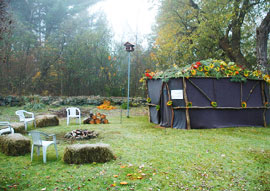
The festival of Sukkot is a special time of rejoicing (Lev. 23:40). One of the unique mitvos associated with this holiday is the mitzvah to dwell in a sukkah. The sukkah, a temporary dwelling used during the first seven days of Sukkot, is a reminder of the protective clouds of glory that HaShem surrounded the people of Israel with during their wilderness wanderings.
Constructing and decorating a sukkah can be an enriching family activity, during which parents may tell stories of HaShem’s redemption and guidance. A sukkah must have at least three complete walls that are not less than 3 feet tall and not more than 35 feet tall. It should cover a minimum area of 24.5 inches by 24.5 inches and should be able to withstand a normal wind.
The sukkah must be covered with “schach,” which is any plant material that grows from the ground, such as tree branches or corn stalks. These materials must be separated from the ground before they are used in construction, and they may not have a bad odor. Finished products, such as curtains or wooden lattices, should not be used for schach. The schach must be spread so that there is more shade than sun within the sukkah, but there should be enough spaces so that the stars may be seen from within.
The Torah requires us to dwell in the sukkah for all seven days of Sukkot, just as we live in our home the rest of the year. However, the elderly, the very young, the ill, and the traveler are exempted from this mitzvah.
Whenever a meal is eaten, the following blessing is to be said: “Blessed are You, HaShem, who has sanctified us with His commandments and commanded us to dwell in the sukkah.” The sukkah is to be considered a sacred place, so common activities, such as washing dishes, are not done in it. Within the walls of the sukkah, the family may contemplate and rejoice about HaShem’s tender care.
Image: Sukkah in the U.S. Public Domain
Add comment