
Did the early Christians reject the law? A careful examination of the old texts witnessing early Christianity points in another direction.
The problem that many thoughtful Jews have with Christians is not so much their belief in Jesus as their apparent rejection of the Torah.1
A return to Christian beginnings, however, reveals not a rejection of the law but a very sensitively nuanced relationship to it.
At Sinai, the Lord gave the Ten Commandments, written with His own finger, to Israel. Additionally, He caused Moses to deliver a great body of laws (traditionally 613 in number) to the nation. Philo, the Jewish philosopher of Alexandria, regarded the Ten as summaries of the 613.2 But it would be more appropriate to regard the 613 as contextual applications of the great moral principles embodied in the Ten.3
Around the time of Yeshua, several rabbis were trying to formulate summaries and simplifications of the Torah. The most famous attempt is that of Hillel the Elder, who said it can all be summed up in the “silver rule”: “Do not do to others what you do not want them to do to you. All the rest,” he said, “is commentary on that.”
The 613 laws are of various kinds. Some are case laws (mishpatim) describing offenses and prescribing punishments. Others are apodictic laws (“thou shalt” or “thou shalt not”) dealing with hygiene, ritual purity, worship, or ethics. The later prophets made a distinction between ritual and ethics, affirming the primary importance of the latter. Thus, in Hosea 6:6 (RSV), the Lord declares, “I desire steadfast love and not sacrifice, the knowledge of God, rather than burnt offerings” (cf. Micah 6:6–8, Isaiah 1:12–17, Psalm 40:6, etc.).
Even as the 613 laws of Moses were designed to interpret and contextually apply the Ten Commandments, at the time of Yeshua, the Pharisaic scholars were generating hundreds of oral laws intended to interpret and apply the 613, thus “making a fence around the Torah” (Mishnah Aboth 1:1). Other Jewish parties (such as the Sadducees and Essenes) rejected this oral law. In their eyes, much of it tended to vitiate the written law. In fact, some of this tradition was intended to make obedience much easier. Thus, the provision of the prozbul (Mishnah Shebiith
Against this backdrop, Yeshua appeared on the stage. His relation to the Torah was essentially an extension of the attitude of the prophets, but with important nuances. His basic teaching on the subject is laid down in the Sermon on the Mount (see Matthew 5-7), a compendium of his teachings that early Christians regarded as the foundational statement of how they should live, the quintessential Christian halakah.4 Yeshua begins by flatly declaring: Think not that I have come to abolish the law and the prophets; I have come not to abolish them but to fulfill them. For truly, I say to you, till heaven and earth pass away, not a yod, not a corner of a tav, will pass from the law until all is accomplished. Whoever then relaxes one of the least of these commandments and teaches men so shall be called least in the kingdom of heaven; but he who does them and teaches them shall be called great in the kingdom of heaven. (Matthew 5:17–19, adapted from the RSV)
He immediately adds, “For I tell you, unless your righteousness exceeds that of the scribes and Pharisees, you will never enter the kingdom of heaven” (verse 20).
Yeshua saw serious problems with the oral law. While it may have been originally intended to be a “fence” around the Torah, he saw that it very often supplanted it. Thus the rule of Corban (see Mishnah Nedarim) was being invoked in such a way as to violate the spirit of the fifth commandment of the Decalogue, “Honor your father and your mother” (see the discussion in Mark 7:1–13, Matthew 15:1–9). Furthermore, he decried the emphasis on external behavior that masked inner corruption (Mark 7:14–23).
Yeshua’s emphasis on the importance of inner righteousness and his scathing denunciation of hypocrisy find expression in the Sermon on the Mount in the form of a series of antitheses between his interpretation of the law and the oral tradition of the Pharisees (Matthew 5:21–48). In fact, some of the antitheses sound like an attack on the written Torah, such as the law of “an eye for an eye and a tooth for a tooth” (Exodus 21:34, Leviticus 24:20, etc.). But Yeshua introduces each antithesis with some variation of the words, “You have heard that it was said..." When he introduced Scripture, he used the formula, “It is written that..." He was therefore not opposing the written law itself, but the traditional interpretation of it. In the case of the Lex talionis, the oral tradition had misapplied a rule of jurisprudence and made it a principle of personal ethics. Originally, it was a guide for magistrates with a force like our maxim, “Let the punishment fit the crime.”
Yeshua insists that one can be a murderer or adulterer in thought; hatred is wishing harm upon another, and lust is having mental sex with someone who is not your wife. The only thing that keeps hatred or lust from becoming a physical act is a lack of opportunity or fear of temporal consequences, and it is murder and adultery in God’s sight. (This insight, of course, did not lessen the seriousness of literal murder and adultery!) Thus, Yeshua really intensified the law and opposed those who, in any way, relaxed it.
However, for Yeshua, the law was preeminently the Ten Commandments. They took precedence not only over the oral law of the scholars but even over the 613 laws of Moses. In the tradition of the prophets, he taught that ethics and righteous human relations have priority over sacrifices (Matthew 5:23–26), and the Lord’s original intention for husband and wife in Eden overrules Mosaic accommodations to human weakness in the divorce law of Deuteronomy 24:1-4 (Mark 10:2-12, Matthew 19:3–9). When a young scholar came asking what he should do to receive eternal life, Yeshua told him to keep the Ten Commandments (Mark 10:17–22; Matthew 19:16–22). But when Yeshua wanted to summarize the Commandments (Matthew 22:35–40), he did so in terms of two Mosaic precepts: Deuteronomy 6:5 (love God supremely) and Leviticus 19:18 (love your neighbor as yourself).
This insistence on the centrality of the Ten Commandments is reflected throughout the New Testament, including the writings of Paul. It is fair to say that the New Testament makes far more of the Decalogue than either the Old Testament or Pharisaic tradition does. But there is a careful understanding of the function of the law: it does not save; rather, it reveals why we need salvation. When the rich young scholar heard what Yeshua had to say about keeping the Ten Commandments, he responded that he had always done so. But Yeshua tested him, and it turned out that he was in fact not obedient to the very first commandment, for he had made another god or an idol of his wealth.
This concept is prominent in the writings of Paul: You cannot depend on your keeping of the law to save you because you have not kept it, and your sinfulness will keep you from keeping it. If you break any of it, you break it all (a point also taught by several rabbis). So the law condemns you. It is God’s mercy that saves you. (In making this point, Paul sometimes used radical language that was vulnerable to misunderstanding; see 2 Peter 3:15–16.) This is the New Testament teaching of grace, freely offered to those who repent and have faith.
The true function of the law, therefore, is to place a moral yardstick alongside a person and make him conscious of his shortcomings so that he might return to God and seek healing. A mirror cannot make a dirty face clean, but without it, one might not resort to soap and water!
Yet another function of the law is to make known God’s will, and God’s grace not only forgives but also motivates and empowers people to obey. Just as the Ten Commandments are prefaced by a recollection of God’s gracious benefactions (Exodus 20:2), keeping His commandments is a response to grace, not a prepayment for it. Even so, a Christian’s obedience to God’s law is a response to God’s grace, supremely shown in what He did for us in Christ, and not a precondition for receiving that grace. The believer does not work toward salvation; he works from it.
History saw two negative responses to this early Christian teaching, one Jewish and one “Christian.” The Christian insistence on the preeminence of the Ten Commandments provoked Pharisaic Judaism, which became normative to downplay the Decalogue vis-à-vis the rest of the Torah. It had been part of the temple liturgy, included in the recitation of the Shema, and enclosed in the tefillin and the mezuzoth. But now they were dropped from these things, says the Talmud, “because of the insinuations of the heretics, who say that only these are from God.”6
The second distortion arose on the Christian side in the form of gnosticism. The Gnostics were typically antinomian; they believed the law was an evil that enslaved. Furthermore, they were anti-Jewish, and following the Bar Cochba rebellion (135 C.E.), they worked to distance Christianity from Judaism in every way possible. The Gnostic guru Marcion repudiated the Old Testament, the Jewish people, and even the Lord, the God of the Old Testament whom the Gnostics regarded as a weak, inferior god.
This anti-law, anti-Jewish way of thinking became popular among Christians in Rome, especially, and also in Alexandria, from which it spread elsewhere. The purveyors of these ideas mistakenly thought that they found support in some of the more unguarded statements of Paul in Galatians, Romans, and some other places. But in fact, they profoundly misunderstood Paul and the rest of the New Testament writers. Pretending intellectualism and sophistication, Gnostics scorned anything literal or physical, anything material or “external,” as though the inner person could dispense with the outer. Hence, they denied the Incarnation and derided the law. But Gnostic thought does not resonate with Jesus or the New Testament. In fact, some of the later writings of the New Testament firmly oppose it (cf. 1 Timothy, 1 John 4, 2 Peter 3, Jude).
Such misunderstanding still rears its head in certain Christian circles, unfortunately. These circles read Paul’s attack on the misuse of the law and see an attack on the law itself. They fail to see the total teaching of the New Testament, according to which faith and works are like right foot and left foot, and the complementarity of law and grace. The New Testament has much to teach such circles, if they will take it up and read it; it likewise has much to teach serious Jews.
1 See, for example, the observation made by Michael Wyschogrod, cited in Jacques Doukhan, “The Two Witnesses,” Shabbat Shalom, August 1995, p. 18.
2 See his tractates, De Decalogo and De Specialibus Legibus.
3 Notice, for example, how many of the mishpatim were generated. The Ten Commandments are in “apodictic” form—imperatives that do not specify the punishment for disobedience. They define sin. But they have corresponding laws that describe an offense and prescribe a punishment (the “casuistic” form), thus making a sin into a crime. In Leviticus 24:10-23 we read the case of a man who blasphemed the Name. The people knew that blaspheming the Name was wrong, because one of the Ten Commandments forbade taking the Lord’s Name in vain, but they did not know what should be done to someone who did it. The Lord through Moses gave them a law that prescribed death by stoning (verses 15, 16). Clearly the commandment in the Decalogue preceded the mishpat that was based on it and applied it. Likewise all of the 613 are logically secondary and the Ten Commandments are primary.
4 The best known version of the Sermon on the Mount is in Matthew 5-7, but comparison with Luke 6 and other Lucan parallels shows that Matthew has inserted into the basic framework of Jesus’s sermon other sayings that he uttered on other occasions. We may use the expression “Sermon on the Mount” as a description of all that early Christianity regarded as Jesus’s core teachings. This collection of his instruction is alluded to throughout the New Testament and other early Christian literature. The letter of James is virtually a commentary on it. The early church manual called the Didache begins with instruction for new believers based on the Sermon on the Mount and the Ten Commandments.
5 This teaching of God’s grace for the penitent and contrite soul is in the tradition of the prophets (cf., for example, Isaiah 57:15-18).
6 It is interesting to observe that in the Midrash Rabbah in the commentary on Exodus and on Deuteronomy, in the places where one might expect to find comments on the Decalogue, the Ten Commandments are rather completely passed over in silence, a conspicuous lacuna!
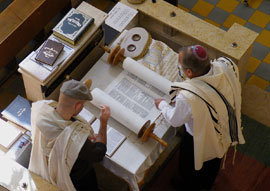
Image: Reading of the Torah by Roy Lindman. Public Domain
Add comment