
The Feast of Shavuot (“Weeks”) is the second of three pilgrim festivals in the annual round of holy days described in the Torah. In biblical times, Shavuot was a one-day festival, occurring on the sixth day of the third Jewish month, Sivan (in our modern calendar, late May or early June). In later Jewish practice, a second day of the festival was added for those living in the Diaspora (outside the land of Israel).
In the Hebrew Bible, the festival has several names: "Feast of Weeks" (chag [ha] shavuot, Exodus 34:22; Deuteronomy 16:10, 16; 2 Chronicles 8:13), "Feast of Harvest" (chag haqqatsir, Exodus 23:16), Day of First Fruits" (yom habikkurim, Numbers 28:26), and “First Fruits of the Wheat Harvest” (bikkurei qetsir chittim, Exodus 34:22). The various festivities of Shavuot—both ancient and modern—yield important lessons of value to both Jewish and Christian audiences. Let us consider some of these lessons that emerge from the festival of Shavuot.
The Lesson of Counting the Omer
Although Shavuot is a distinct festival on its own, it is also presented in Scripture as closely linked to even the closing phase of Pesach (Passover), as is evidenced by the counting of the omer described in Leviticus 23:15–16: "And from the day on which you bring the sheaf [Heb. omer] of elevation offering—the day after the sabbath [of Pesach]—you shall count off seven weeks. They must be complete: you must count until the day after the seventh week—fifty days; then you shall bring an offering of new grain to the LORD" (JPS Tanakh). From the reference to "seven weeks" comes the festival's name Shavuot (Hebrew for "Weeks"), and from the reference to fifty days comes the New Testament name "Pentecost" (pentecoste is Greek for "fiftieth"; Acts 2:1; 20:16; 1 Corinthians 16:8; cf. Josephus1).
In Jewish tradition, these fifty days of counting became known as sefirat—"the counting"—
A Christian interpretation of this close connection between Passover and Shavuot suggests that what happened during the New Testament Pentecost described in Acts 2 is grounded in the events of Passover. The gift of the Holy Spirit is rooted in the death and resurrection of the Messiah. Foundational to all else that happens in salvation history is the sacrifice of the Lamb of God. This is further illustrated in the next lesson, dealing with the first fruits.
The Lesson of the First Fruits
The most basic function of Shavuot was as an agricultural festival, a celebration of the beginning of the wheat harvest (indicated by several of the names for the feast mentioned above). As Shavuot approached, the Israelite families in biblical times made the pilgrimage to Jerusalem, each bringing baskets of the first fruits (bikkurim) from the seven kinds of food for which the land of Israel was praised in the Torah: wheat, barley, grapes, figs, pomegranates, olives, and dates [date honey] (Deuteronomy 8:8; 16:10–12; 26:1–11). The Mishnah colorfully paints the scene of this pilgrimage as it transpired during the Second Temple period in the reign of Herod Agrippa,2 when tens of thousands of worshipers came to Jerusalem each year.3
With the destruction of the temple, this practice was discontinued, and nothing comparable has taken its place. Christians likewise have no liturgical event during which to present and express their gratitude for the first fruits of the harvest. The offering of first fruits at Shavuot calls both Jews and Christians to a renewed sense of appreciation for God's good bounties of harvest and perhaps to some creative thinking as to how to provide a time for offering to God one's first fruits of harvest yet today.
Christian interpreters see a spiritual fulfillment of the "Feast of Harvest" in connection with Yeshua and His followers. In the year 31 C.E., fifty days after Yeshua's resurrection, when Pentecost had “fully come” (Acts 2:1)—when it had reached the 50th day—the seed that Yeshua had sown in His earthly ministry (Matthew 13:37; Luke 8:11) witnessed a mighty harvest as He poured out His Spirit on His waiting disciples, and three thousand people became followers of Yeshua in a single day (Acts 2:41). This harvest of Pentecost was only the first fruit of the general harvest that will take place at the end of the world (Romans 8:23; James 1:18; Revelation 14:14–16).
The Lesson of the Two Loaves
Leviticus 23:17 describes the special corporate first fruits offering of two loaves of bread presented at the time of Shavuot: "You shall bring in from your dwelling places two loaves of bread for a wave offering, made of two tenths of an ephah; they shall be of a fine flour, baked with leaven as first fruits to the LORD" (NASB). These were gigantic loaves! Each loaf used one-tenth of an ephah of flour, or two dry quarts (2.20 liters). According to the Mishnah,4 in the second Temple period, each loaf measured seven handbreadths long (about 20 1/2 in. or 52 cm.), four handbreadths wide (about 12 in. or 30 cm.), and (including its added "horns" of dough on the turned-up corners imitating the horns of the altar) four fingers high (about 3 in. or 7 ½ cm.). Each loaf of bread would have weighed about four or five pounds.
The bread was made from the best ingredients possible, including finely ground wheat flour (Heb. solet) that, according to the Mishnah, was ground from wheat grown in the best district of the country5 and passed through twelve sieves!6 Thus, these loaves were the best bread that could be produced by human hands.
But this very feature makes the two loaves unique when compared with the other first fruit offerings, as Jewish commentators have recognized: “The two loaves of bread are unusual, for they are explicitly the products of human labor. Not grain, not sheep or lambs or goats, straight from God's hand—but bread, mixed and kneaded and leavened and baked, is the distinctive offering of Shavuot.”7 The symbolism of this uniqueness is suggested: “Shavuot celebrates the partnership of human beings with God in giving food to the world,”8 In Christian interpretation, Pentecost represented the gift of the Holy Spirit in the lives of believers, and the bread represents the best efforts of humans imbued with the divine Spirit.
But we must note further that these loaves were made with leaven, in contrast to the unleavened bread of Pesach. The rabbis explicitly interpreted leaven to symbolize moral and spiritual corruption,9 and Paul in the New Testament likewise identifies the leaven of Passover time as representing “malice and evil” (1 Corinthians 5:8). A Christian interpretation of the leaven in the two loaves suggests that, in contrast to the Messiah's sacrifice at Passover time, which was a perfect and unblemished offering without corruption or sin, even our offerings to God that represent our finest works of sanctification through the power of the Holy Spirit are still corrupted with sin and cannot be acceptable to God by themselves.10
According to Leviticus 23:19–20, the two loaves of leavened bread were to be waved together with two male lambs. The Mishnah describes the scene: “The two loaves are put beside the two lambs, and he [the priest] puts his two hands beneath them and swings them forward and backward and upward and downward." 11 A Christian reading interprets this action to mean that even our best offering, our finest work in Spirit-filled sanctification, is only acceptable on the basis of the Messiah, the Lamb of God (John 1:29).
The Lesson of Sinai and the Giving of the Torah
When did the first Shavuot occur? To ask the question differently, where were the Israelites fifty days after the first Pesach? Exodus 19:1 indicates that “On the third new moon after the Israelites had gone forth from the land of Egypt, on that very day, they entered the wilderness of Sinai” (JPS Tanakh).12 The third new moon of the Jewish year would be the first day of Sivan. It is reasonable to assume that on Sivan 2, Moses ascended Mt. Sinai (Exodus 19:3-6) and came back to camp to tell the elders what the LORD had told him (v. 7). On Sivan 3, he went back up the mountain and told the LORD the people's response and returned to tell the people about God's desire to speak His covenant with them (vv. 8–9a). On Sivan 4, he went back up the mountain with the people's response (v. 9b), and God told Moses that the people should sanctify themselves “today and tomorrow,” Sivan 4 and 5 (v. 10), in preparation for the “third day."
Sivan 6 (v. 11). On Sivan 6, the "third day" of their sanctification, God gave His law of the Ten Commandments (Exodus 19:15–25; 20:1-20).13 Sivan 6—the date for the giving of the law—was the date of Shavuot! 14 Even though the biblical text does not explicitly connect Sinai with Shavuot, the chronology of Exodus 19–20 points to the conjunction of these two dates. The reference to the two loaves of bread offered at Shavuot (which, according to the size and shape indicated in the Mishnah, may well have closely resembled the two tables of stone given by God at Sinai), perhaps provides a hint of the connection between Shavuot and the giving of the Law at Sinai (Leviticus 23:17–20; cf. Deuteronomy 8:3; Matthew 4:4; and the continuing living Jewish tradition that links the two loaves of hallah bread eaten on the eve of the Sabbath with God's law on two tables of stone).
Jewish scholars have convincingly argued that by the dawn of the early first century C.E., the connection between Sinai and Shavuot was clearly recognized.15 In the Amidah of the Jewish Prayer Book, Shavuot is called Z’man Matan Toratenu, “The Season of Giving of Our Torah.”
In the New Testament, detailed parallels between the first Pentecost at Sinai and the Upper Room Pentecost experience (recorded in Acts 2) make evident that the Pentecost of 31 C.E. was understood to be a counterpart of the first Shavuot at Sinai. The Church Fathers explicitly commented on the link between Sinai and the Pentecostal experience of Acts 2. Jerome (342-420 C.E.), translator of the Hebrew Bible into Latin (Vulgare), succinctly summarizes the parallels: “There is Sinai, here Sion; there the trembling mountain, here the trembling house; there the flaming mountain, here the flaming tongues; there the noisy thundering’s, here the sounds of many tongues; there the clangor of the rams horn, here the notes of the gospel trumper.”16 Beyond these parallels, we may note that at Sinai, God wrote the Ten Commandments on tables of stone with His own finger (Exodus 31:18; 34:28; Deuteronomy 10:2-4). In the New Testament, the "finger of God" is equated with the Spirit of God (cf. Matthew 12:28 and Luke 11:20), and at the Pentecost of Acts 2, God wrote the law in the minds and hearts of the people by His Spirit (Acts 2:1-4,38; cf. Hebrews 8:7–13; 10:15–18) in fulfillment of Jeremiah 31:31–34. Just as at Sinai God incorporated the people of Israel into His covenant community (Exodus 19:5–6), on the day of Pentecost described in Acts 2, this covenant was continued and expanded as the followers of Yeshua were consolidated into a Messianic eschatological community (Acts 2:41).
We have already noted the close connection between Pesach and Shavuot, as evidenced in the counting of the omer. The rabbi, physician, and philosopher Maimonides (1135–1204 C.E.) eloquently captures the spirit of eager expectation for the giving of Torah as the continuing motive behind the counting of the omer: “Just as one who is expecting the most faithful of his friends is wont to count the days and hours to his arrival, so we also count from the omer of the day of our Exodus from Egypt to that of the giving of the law, which was the object of our Exodus, as it is said: 'I bare you on eagle's wings, and brought you unto myself" [Exodus 19A].17 This is in harmony with biblical thinking, in which every succeeding generation of Jews was to consider not only that they personally were Pharaoh's slaves and came out of Egypt, but also that they personally stood at Mt. Sinai and witnessed the giving of the Torah (Exodus 13:8, 14; Deuteronomy 5:2-4).18
So close is the tie between Pesach and Shavuot that in Jewish tradition, Shavuot is called Chag ha Atzeret, “Feast of the Conclusion,” or just Atzeret, “Conclusion [of Pesach].” Seen in this light, a beautiful pattern between the spring and fall festivals emerges. Pesach is a seven-day festival that culminates (fifty days later) in a one-day festival called Shavuot. Sukkot (the feast of Tabernacles) is likewise a seven-day festival that culminates in a one-day festival called Simchat Torah ("The Rejoicing in the Law").19 The two major Jewish pilgrim festivals both end on holidays celebrating the Torah. (Today, as I put the finishing touches on this Shavuot article, is the Festival of Simhat Torah; perhaps it is more than coincidental that one Torah festival is the occasion for completing an essay on another Torah festival!)
While Simchat Torah captures the spirit of joyous celebration over Torah, Shavuot, in commemorating the revelation of Torah at Sinai, has become a festival capturing the mood of awe and gratitude to God for giving the Torah. Shavuot is characterized by serious study and deep reflection—remaining awake all night poring over Torah.
During the morning synagogue service of Shavuot, the Torah reading is Exodus 19–20, which describes the revelation at Sinai and the giving of the Ten Commandments. The worshipers stand as the Ten Commandments are read, imitating the occasion of Sinai when Israel stood to hear the "Ten Words" spoken by God from the mountain (Exodus 19:17).
Tragically, in the Christian tradition, there is no liturgical Torah festival, no moment to rejoice in the giving of the Torah, and no occasion to stay up all night poring over the Bible. Christians need to learn from our Jewish brothers and sisters how to rejoice in and pour over Scripture and how to celebrate the giving of Torah!
The Lesson of Love and Marriage
In Exodus 19, Yahweh uses intimate language to describe the relationship between Himself and Israel: "I bore you on an eagle's wings and brought you to Myself. You shall be a special treasure to Me above all people" (vv. 4-5). Even the Ten Commandments contain the intimate language of a Jealous Married Lover: "I, the Lord your God, am a jealous God... showing love to a thousand generations of those who love me and keep my commandments" (Exodus 20:5–6, NIV).20
The Hebrew Bible, in contrast with other ancient Near Eastern texts,21 develops the marriage imagery to describe the relationship between God and His people.22 In Jewish tradition, the love and marriage between God (the groom) and Israel (the bride) is highlighted by reading books from the Megillot ("Scrolls") of Scripture. The Song of Songs is read at Pesach, celebrating the courtship of God and Israel, while the book of Ruth, describing the love relationship and marriage between the kinsman redeemer Boaz and Ruth in the setting of the grain harvest, is read at Shavuot, celebrating the actual marriage of God and Israel at Mt. Sinai.
The New Testanment continues the imagery of God as married to His covenant people, but the Christian community has no regularly recurring ritual where this marriage relationship between God and His people is specifically highlighted or celebrated. Taking our cue from the Jewish tradition, it might be well to mark a set time, perhaps the celebration of the communion service (the Lord's Supper) at a date near Shavuot, as an opportunity to emphasize the marriage imagery and covenant renewal between God's people and their husbands.
The Lesson of the Descending Oil
Christian interpreters usually think that the meaning of Pentecost in Acts 2 centers primarily on the giving of the Holy Spirit to the Christian Church. But this is not the deepest meaning of Pentecost! According to Acts 2:33, the pouring out of the Holy Spirit on the disciples was only the earthly sign that Yeshua had been inaugurated as Priest-King in the heavenly sanctuary! Hebrews 1:9 indicates that after Yeshua's ascension, He was anointed with the oil of gladness above His companions. Psalm 133 gives us a picture of that anointing service in the Old Testament. In this psalm, David describes the unity of the people of God, and he casts about to find the most glorious memory in Old Testament history with which to compare this unity. He finally finds a suitable analogy: “It is like the oil upon the head that ran down upon the beard, even Aaron's beard, and down off the hems of his garments.” This was the one-time occasion of the anointing of the high priest when the sanctuary services started up (see Leviticus 8:12). It was a time of great rejoicing for Israel, for with the anointing of Aaron the High Priest, they now had a mediator to represent them in the sanctuary.
So is the anointing of the Messiah as High Priest and King in the heavenly sanctuary a time for great joy? Following Yeshua's ascension on the forty-first day after his resurrection, there was a ten-day inaugural celebration—the greatest inaugural ball in the history of the universe!24 And as the climax of that celebration, Yeshua was anointed. Can you picture it in the light of Psalm 133? The heavenly anointing oil associated with the Holy Spirit (Zechariah 4:1–6; cf. Revelation 4:5) was poured on Yeshua's head, flowed down upon His beard, and was so abundant that it bowed down and off the hems of His garments. As I like to visualize it, the anointing oil kept right on flowing, from heaven to earth, and on the way between heaven and earth, that heavenly oil was ignited into tongues of fire! And the waiting disciples who received that gift of the Holy Spirit recognized it as the earthly sign of the descending oil. The Holy Spirit never testifies of Himself but of Yeshua Ha Mashiach (John 15:26). So the outpouring of the Holy Spirit was the sign to the disciples in the upper room that Yeshua had been inaugurated as High Priest in the heavenly sanctuary. They had a mediator before the Father!
The Lesson of Reconciliation and Rapprochement
During the morning service of Shavuot, just before the Torah reading, the Ashkenazic synagogues customarily chant a medieval piyyut (liturgical poem) called Akdamut (named after its opening words, "Before I speak"). This Aramaic poem was written by Rabbi Meir ben Isaac Nehorai of the German city of Worms during the First Crusade, which starred in 1096 C.E. Rabbi Meir's father Isaac was killed in the Crusade, as Christian knights on their way to liberate the Holy Land from the Moslem "infidels" terrorized the Jewish communities that they encountered on their route. During this time, the Christians tried to force Jews to convert to Christianity. They conducted mock "debates" between Jewish rabbis and priests concerning the correctness of Judaism versus Christianity. Rabbi Meir was forced to participate in one of these rigged "debates,' and afterward he wrote the Akdamut in Aramaic (a language the Christian priests could not read) to celebrate the Jewish joyous commitment to Torah even in the face of persecution.
The Akdamut starts with the following words (freely translated from the Aramaic acrostic) "Before I begin to read his Words (the Ten Commandments), I will ask Permission of the One Whose Might is such that - Even if all the heavens were parchment, and all the reeds pens, and all the oceans ink, and all the people were scribes, it would be impossible to record the Greatness of the Creator."25 Ironically (or providentially), these beautiful words written as a secret protest against Christian persecution of Jews found their way into English verse—penciled onto the walls of an insane asylum by one claimed to be demented, discovered after the inmate's death, and published by Christian songwriter Frederick M. Lehman in 1917—and have become the climactic final stanza in one of the most beloved Christian hymns of modern times.26
A few years ago, I had the privilege of visiting Jerusalem at the time of Shavuot. There I saw and heard simultaneously both the Jewish fervor for the law and the Christian fervor for the Messiah. As a Seventh-day Adventist who treasures both Torah and Messiah, I am still contemplating that special experience, longing for Jew and Christian to come together in rapprochement around these two fundamental pillars of Judaism.
According to the Book of Jubilees, Shavuot was also the date when Abraham's two sons, Isaac and Ishmael (the father of the Arab peoples), were reconciled in a covenant of peace while their father was dying.27 Drawing a lesson from this Jewish tradition, Arthur Waskow expresses a wish for Shavuot that precisely represents my sentiment as well: "So it may be that on Shavuot we might seek the meeting between the peoples that would carry out the ultimate meaning of the meeting between God and our people at Mount Sinai: the meeting of the covenant of peace.28
1 Josephus, Jewish Wars, 2.42, refers to Shavuot as the “Feast of the Fiftieth Day.”
2 This king was either Agrippa I (37-44 C.E.) or (more likely) Agrippa II, who completed the building of the Jerusalem Temple begun by Herod the Great, in 62 or 64 C.E., and reigned till the Jewish war broke out in 66 C.E.
3 Josephus, Antiquities of the Jews, 14.338; 17.254.
4 Menachot 11.4.
5 Menachot 8.1.
6 Menachot 6.6, 7.
7 Arthur I. Waskow, Seasons of Our Joy: .A. Handbook of Jewish Festival s (New York Summit Books, 1982), 186.
8 Ibid.
9 See, e.g., b. Ber. 17a: “leaven represents the evil impulse of the heart.” Cf Gen. R. 34:12. For additional post-biblical Jewish references, cf. Nahum Sarna, Exodus, The JPS Torah Commentary, vol. 2 (New York: Jewish Publicarion Society, 1991), 58,245 (n. 44).
10 Sec Alfred Edersheim, The Temple: Its Ministry and Services, updated ed. (Peabody, MA: Hendrickson, 1994), 210: "they [ the Two Loaves] were leavened, because Israel's public thank-offerings, even the most holy, are leavened by imperfectness and sin, and they need a sin-offering." Alternatively, the leaven (which may be seen ro represent "the pervasive influence of external principles, either good or bad, which work silently from within to transform the substance into which they are incorporated"), following Yeshua's usage in the parable of the leaven (Matthew 13:33), has been interpreted as the quickening power of the Spirit in the lives of God's people (Leslie Hardinge, With Jesus in His Sanctuary [Harrisburg, PA: American Cassette Ministry, 1991), 447-448). In the context of Leviticus 23, where the unleavened bread (v. 6) is seen by Christians to symbolize absence from sin (in the life of Yeshua), it seems preferable to interpret the reference to leaven a few verses later in the same chapter (v. 17) consistently as a symbol of sinfulness (in the lives of believers in Yeshua).
11 Menachot 5.6.
12 Since Exodus 19:1 does not give any day of the month, the phrase chodesh hashlishi means "third new moon" and not “third month” (as recognized by several English translations, including JPS Tanakh, RSV, NRSV and ESV). See Sarna, 76; and Umberto Cassuto, A Commentary on the Book of Exodus (Jerusalem: Magnes Press,1983), 224.
13 Support for chis chronology, climaxing in Sivan 6, is found in the exegesis of Cassuto, 224-230. The steepness of the climb up Jebel Musa (which is the traditional and most probable sire of Mr. Sinai; see Richard M. Davidson, In the Footsteps of Joshua [Hagerstown, MD: Review and Herald, 1995], 13-17), a gain of nearly 3000 feet of elevation from the valley floor co the summit, would make it highly unlikely that Moses made multiple ascents in any given day.
14 “This is widely recognized in Jewish tradition: Targ. Jon. To Exod.l9:16; Shah. 86b; Pes.68b; Yoma 4b; Ta’am. 28b; cf. Tosef. Ar. 1:9.
15 See Moshe Weinfdd,"Penrecosr as Fesrival of che Giving of the Law," Immanuel 8 (1978):7-18.
16 Jerome, Ad Tabiol 7, cited in the International Standard Bible Encyclopaedia, s.v. "Pentecost" (Grand Rapids: Eerdmans, 1960), 4:2319.
17 More Neb, cited in Edersheim, 207.
18 For further development of this principle of personalization in Hebrew thought, see my article, “The Peace of Passover.” Shabbat Shalom, June 1994, 17-18.
19 For discussion of these festivals, see my articles, "Sukkot: Festival of Joy!" Shabbat Shalom 55, no. 2 (2008): 4-10; and "Simhat Torah: The joy of the Bible," Shabbat Shalom, December 1995, 20-23.
20 See Richard M. Davidson, Flame of Yahweh: Sexuality in the Old Testament (Peabody, MA: Hendrickson, 2007), 113-114.
21 In extra-biblical ancient Near Eastern texts, the deity is never depicted as "husband" of, or in covenant relationship with, a people (see Davidson, Flame of Yahweh, 112).
22 See especially Deuteronomy 33:3; Isaiah 54:5; 62:5; Jeremiah 2:2-3; 12:7; Ezekiel 16:8; and Hosea 2.
23 See, e.g., Ephesians 5:22-32; Revelation 14:1-5; 19:7-8; 21:2; cf. Matthew 22:1-14; 25:1-13.
24 See Ellen White, Acts of the Apostles (Mountain View, CA: Pacific Press, 1911, reprint 1958), 38-39, for elaboration of the biblical data.
25 Translation from www.ou.org/holidays/shavuot accessed 9 October 2009.
26 See Scott-Martin Kosofsky, The Book of Customs: A Complete Handbook for the Jewish Year (San Francisco: Harper, 2004), 166; www.ranbible.com/tolsng/theloveofgod.htm, accessed 10 October 2009. A favorite song survey conducted by the Voice of Prophecy among thousands of radio listeners in 1953 rated the song “The Love of God.” number two among favorite songs (Wayne Hooper, compiler, The Voice of Prophecy Song Book [Winona Lake, IN: Rodeheaver, 1953], 1-3).111e English verse rendition is stanza no. 3 of the song: "Could we with ink the ocean fill, And were the skies of parchment made; Were every stalk on earth a quill, And every man a scribe by trade; To write the love of God above Would drain the ocean dry; Nor could the scroll contain the whole, Though stretched from sky to sky."
27 Jubilees 22:1-4.
28 Waskow, 203.
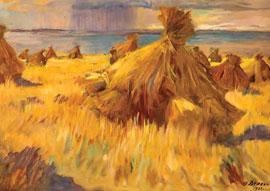
Image: Снопы 1933 г. by Olga Lyudvigovna Della-Vos-Kardovskaya. Public Domain
Add comment