
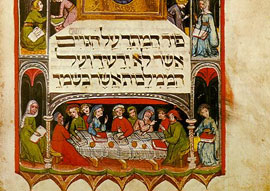
The hidden principle of Passover is discovered through the holy words of the ancient biblical testimony and the holy gestures of those who remember.
The Passover Haggadah makes reference to four types of children who ask questions about the meaning of Passover: the wise, the wicked, the simple, and the one who doesn’t know how to ask. According to the Haggadah, the wicked child, in phrasing his question, “rejects the main principle of the Passover.” What is this “Passover principle” that lies at the heart of the seder and the whole festival of Pesach?
Already implied in the account of the wicked child, this principle is made explicit later in the Haggadah: “Let every person, in every generation, think of himself as one of those who came out of Egypt, as it is said in Scripture, ‘And you shall tell your son in that day saying, “This is done because of what the Lord did for me when I came up from Egypt."'" (Exodus 13:8). * The Passover Haggadah (Hebrew for “telling”) is not intended to be just the commemoration of an important event in Israel’s past, but the personal retelling of an event in which we participated and continue to participate.
It is not enough to see Passover as the celebration of Israel’s Exodus from Egypt if the basic Passover principle is missing. Even if one focuses on the rich symbolic and theological themes of liberation, rebirth, and ultimate redemption, without this principle, one misses the essence of the festival.
The Haggadah substantiates this principle of personalization by citing one or two biblical references, but in fact, the Passover principle is underscored repeatedly in the Torah in connection with the whole Exodus experience. In the various references to Passover observance, God consistently instructs future generations to consider that they personally experienced the Exodus: He “delivered our households” (Exodus 12:26–27); “By strength of hand, the Lord brought us out of Egypt, out of the house of bondage” (Exodus 13:14); “We were slaves of Pharaoh in Egypt, and the Lord brought us out of Egypt with a mighty hand; and the Lord showed signs and wonders before our eyes” (Deuteronomy 6:21–22).
Some forty years after the covenant-making service at Mt. Sinai, and after the whole generation of adults who actually witnessed the events had died in the wilderness, Moses calls upon the new generation born in the desert to consider that they themselves had been there. With five strong Hebrew constructions, Moses presses the point home: “The Lord did not make this covenant [only] with our fathers, but with us, those who are here today, all of us who are alive” (Deuteronomy 5:3). Later in his farewell address, Moses instructs that those who, in Canaan, would bring their offerings of firstfruits to the central place of worship should repeat a personalized credo before the Lord: “So the Lord brought us out of Egypt with a mighty hand and with an outstretched arm, with great terror and with signs and wonders. He has brought us to this place and has given us this land, ‘a land flowing with milk and honey’” (Deuteronomy 26:5–9).
In Joshua’s last charge and covenant renewal service before he dies—as the last of the adult generation who actually witnessed the Exodus—the Lord Himself retells the Exodus story, alternating between the expressions “your fathers” and “you”: “Then I brought your fathers out of Egypt, and you came to the sea, and the Egyptians pursued your fathers. So they cried out to the Lord, and He put darkness between you and the Egyptians. And your eyes saw what I did in Egypt” (Joshua 24:6–8).Even though the whole generation that physically experienced the Exodus is dead, the Lord insists that the succeeding generation of Israel reckons that they personally came out of Egypt.
The Passover principle is rooted in the biblical understanding of corporate solidarity. Israel is a single, unified corporate entity; what happens to one or some, happens to all. The history of Israel’s forefathers is the personal history of every subsequent generation.
Our modern society of Western individualists—especially Gentiles who have never participated in the Passover seder—finds this concept of corporate solidarity difficult to grasp or internalize. The closest I came as a child to assimilating the Passover principle was the Sunday night “ritual” of watching that classic TV documentary hosted by Walter Cronkite. Every week I entered history; I experienced the signing of the Declaration of Independence, the famous battles of the Civil War, and the sinking of the Titanic. And always, Walter Cronkite would intone the title of the show as we came to the climax of the historical event: “You Are There!”
Simply stated, the Passover principle is: You are there! The Passover Haggadah retells the narrative, not just of a people far away and long ago; not even a story of our Hebrew ancestors. For all of us sharing the Judeo-Christian heritage, we were there. The Haggadah is our personal diary!
Each of the central themes of Passover—redemption (by the Passover lamb), liberation (from Egyptian bondage), rebirth (new life at Springtime), and removal of leaven (symbolic of the evil inclination of pride)—has a spiritual counterpart in the individual who “retells” the story. The retelling invites us to identify the Pharaohs in our lives that have enslaved us, to remember the ways that God has redeemed us and liberated us from bondage, to focus upon the ongoing experience of spiritual rebirth, and to remove the leaven of sinful pride from our lives.
And there is another theme, not prominent in the original Passover account but coming to the fore in the prophetic announcements of the eschatological “New Exodus.” The synagogue readings of the Haftorah at Passover time highlight it—the motif of shalom, the divine reign of ultimate peace. “The wolf also shall dwell with the lamb, . . . and the lion shall eat straw like the ox. . . . They shall not hurt nor destroy in all My holy mountain. There will be a highway for the remnant of His people, as it was for Israel in the day that he came up from the land of Egypt” (Isaiah 11:6–9, 16). "Moreover, I will make a covenant of peace with them, and it shall be an everlasting covenant with them” (Ezekiel 37:26; see also Ezekiel 34:25; Isaiah 52:7; 54:10, 13 for other references to shalom in the context of the New Exodus).
Redemption and liberation, rebirth, purification—to what end? All Passover themes are ultimately incomplete without shalom! It was foreshadowed in the rest brought about through Joshua in the Promised Land. But ultimately, this peace can only come through the Messianic Hope.
What is our response to the great themes of Passover, including that of peace? In the Passover Haggadah, the “You are there” principle leads spontaneously and ultimately to doxology. Since God brought us out of Egypt, “therefore it is our duty to thank, to praise, to pay tribute, to glorify, to exalt, to acclaim, to bless, to esteem, and to honor that One who did all these miracles for our fathers and for us, and therefore let us sing before him a new song, Halleluya!” The singing of the Passover Hallel (“praise”) psalms (Psalms 113–118) and the Great Hallel (Psalm 136) is the climax of the seder.
Here, in the glorious “retelling” of the Exodus, the Passover principle has found its loftiest expression.
*All biblical quotations are from the New King James version.
Image: Illuminated Haggadah (14th century). Public Domain
Add comment