
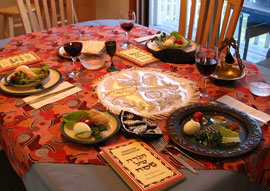
 The Passover Seder is one of the most widely observed of all Jewish customs, and at the center of every Seder is a Seder plate. Because of the popularity of the Passover Seder, and because of the Seder plate's central position in its observance, the plate has become a very common outlet for Jewish artistic expression.
Most Seder plates have six dishes for the six symbols of the Passover Seder. These are:
Maror (bitter herbs)
Karpas (vegetable)
Chazeret (bitter vegetable)
Charoset (apple, nut, spice, and wine mixture)
Zeroa (shankbone)
Beitzah (egg)
Some Seder plates have only five dishes because the second bitter herb (or bitter vegetable) is omitted.
Maror
Bitter herbs (usually horseradish) symbolize the bitterness of Egyptian slavery. The maror is often dipped in charoset to reduce its sharpness. Maror is used in the Seder because of the commandment (in Numbers 9:11) to eat the paschal lamb "with unleavened bread and bitter herbs.” Some prefer mild horseradish at the Seder; others say that it doesn’t serve its purpose (to remind us of the bitterness of slavery) unless it's hot enough to bring rears to the eyes.
Karpas
Vegetable (usually parsley) is dipped into salt water during the Seder. The salt water represents the tears shed during Egyptian slavery. The dipping of a vegetable as an appetizer is said to date back to biblical times. It may now be identified with biblical description of the Hebrew slaves marking their doorposts at the time of the first Passover. A bunch of hyssop was to be dipped in the blood of the paschal lamb and used to strike the lintel and the doorposts (Exodus 12:22) so that the tenth plague (death of the firstborn) would not be visited upon their households.
Chazeret
Bitter Vegetable (often lettuce) is often used in addition to the maror as a bitter herb. The authorities are divided on the requirement of chazeret, so not all communities use it. Since the commandment (in Numbers 9:11) to eat the paschal lamb "with unleavened bread and bitter herbs" uses the plural ("bitter herbs") most Seder plates have a place for chazeret, Some use a green vegetable (such as lettuce - as long as lettuce is not also used for karpas), some use the green top of a bitter herb, while some use a second bitter (such as raddish) for the chazeret.
Charoset
Apple, nuts, and spices ground together and mixed with wine are symbolic of the mortar used by Hebrew slaves to build Egyptian structures. There are several variations in the recipe for charoset. The Mishna describes a mixture of fruits, nuts, and vinegar, for example. In order to enhance the symbolism of mortar, it is customary in some communities to mix in a small amount of sand. The charoset is sweet because sweetness is symbolic of God's kindness, which was able to make even slavery more bearable. According to legend, the use of apples in charoset stems from Pharaoh's decree that all male Hebrew children were to be killed at birth. Mothers would go out to the orchards to give birth, and thus save their babies (at least temporarily) from the Egyptian soldiers.
Zeroa
The shankbone is symbolic of the Paschal lamb offered as the Passover sacrifice in biblical times. In some communities, it is common to use a chicken neck in place of the shankbone. Vegetarian households often use beets for the shankbone on the seder plate. The red beets symbolize the blood of the Paschal lamb, which was used to mark the lintel and doorposts of the houses during the first Passover (Exodus 72:22).
Beitzah
The roasted egg is symbolic of the festival sacrifice made in biblical rimes. On Passover, an additional sacrifice (the Paschal lamb) was offered as well. The egg is also a traditional symbol of mourning, and has been interpreted by some as a symbolic mourning for the loss of the Temple. Since the destruction of the Temple in the year 70 C.E., neither the festival sacrifice nor the special passover sacrifice could be offered. It is also a symbol of spring - the season in which Passover is always celebrated. In many households, it is customary to use a brown egg on the seder plate. The egg should be baked or roasted if possible.
During the Seder four glasses of wine are poured to represent the four stages of the exodus mentioned in Exodus 12:6-7: freedom, deliverance, redemption, and release. A fifth cup of wine is poured and placed on the Seder table. This is the Cup of Elijah, an offering for the Prophet Elijah. During the Seder the door to the home is opened to invite the Prophet Elijah in.
After the meal is eaten, the children search for the Afikomen, the hidden matzah. The Seder is finished when the children have found the Afikomen and everyone has eaten a piece.
Rabbinic wisdom
"On the last days of Passover, the Jew sings the song of Moses; the Rabbis said that song does not only refer to the song that Moses sang in the past, but also to the song that Israel will sing in the Kingdom of God. The biblical text does not say “then Moses sang”, but “…then Moses will sing” -and here we find the proof of resurrection in the Torah' (Sanhedrin, 91b)
Image: Jews identified by w:Yellow badge are being burned at stake. Public Domain
Add comment