
 In a previous Shabbat Shalom meditation on Passover,1 I focused on the principle of personalization (corporate solidarity) found in both the Hebrew Bible and the Passover seder—a principle that embraces Jews and Christians alike in their common Hebraic roots. I also mentioned other common Jewish-Christian themes associated with Passover: liberation, hope, rebirth, purification, and peace. In this study, however, I offer a uniquely Christian perspective on Passover.
New Testament writers insist that already in the Hebrew Bible the sacrificial system, including the sacrifice of the Passover, pointed forward to the death of the Messiah (see, e.g., Hebrews 10:1–10, citing Psalm 40:6–8; 1 Peter 2:23; and Acts 8:32, citing Isaiah 53J; cf. Daniel 927), Jesus, at the time of the Passover meal eaten the night before his crucifixion, announced that the Passover bread and wine were symbols of his atoning sacrificial death (Matthew 26:26–28; Mark 14:22–24; Luke 22:14–20). The apostle Paul affirms the historical importance of the Exodus read from Egypt, which the Passover commemorates (1 Corinthians 10:1–13), and at the same time sets forth a Christian interpretation of the Passover: “For Christ, our paschal lamb, has been sacrificed. Let us, therefore, celebrate the festival, not with the old leaven, the leaven of malice and evil, but with the unleavened bread of sincerity and truth (1 Corinthians 5:7-8). By pointing to Christ as the fulfillment of the Passover lamb and by identifying leaven as symbolic of “malice and evil," Paul opens the way for a thoroughgoing Christian reading of the Passover ritual.
Following Paul's lead, in this article I highlight the many-faceted Passover ritual set forth in the biblical text (primarily Exodus 12) and suggest a Christian interpretation of the Passover that emerges as one examines these details in light of the sacrifice of Jesus.
1. The foundational significance of Passover. Exodus 12:2 indicates that the month in which the Passover lamb was slain (called Abib [later Nisan]; see Exodus 13:14) was henceforth to be considered by Israel as “the beginning of months.” This underscored the foundational nature of Passover in the Hebrew liturgical calendar, and this is further emphasized in the placement of Passover as the first of the annual round of festivals in Leviticus 23. Understood Christologically, Passover may be regarded as the foundation and beginning of antitypical salvation history in the Messianic Age.
2. Focus on the lamb. According to Exodus 12:3, and repeated often throughout the chapter, the focus of Passover is on the paschal lamb: “Every man shall take for himself a lamb according to the house of his father, a lamb for a household.” As we have noted above, Paul asserted that “Christ, our paschal lamb, has been sacrificed” (1 Corinthians 5:7). John the Baptist recognized the sacrificial lamb as prefiguring Jesus: “Behold the Lamb of God, who takes away the sin of the world” (John 1:29; cf. v. 36). Throughout the New Testament, there is a sustained focus on Jesus as the Lamb (some 35 references).
3. Perfect timing. Exodus 12:3 also indicates that the lamb was to be set apart for slaughter on the tenth day of the first month. This timing is precisely fulfilled as Jesus, by his triumphal entry on the ninth day and his cleansing of the temple on the tenth day of Abib (Nisan), precipitates his being set apart on the tenth day for sacrifice (Mark 11:1–18). 3
According to Exodus 12:5 (and Leviticus 23:5), the lamb was to be slain on the fourteenth day of the first month (Abib/Nisan), “in the evening” (RSV), literally, “between the two evenings." Scholars have often posited a confusion in the gospel accounts between the Synoptic Gospels (Matthew, Mark, and Luke), which refer to the "Lord's Supper" (occurring on Thursday evening) as a paschal meal (Matthew 26:17; Mark 14:12; Lake 22:7-8), and the Gospel of John, which seems to describe Jesus' death on the afternoon of “the preparation day" (Friday) as coming before the Passover meal (John 73:l; 18:28; 19:14). But rightly understood against their contemporary background of Passover calculations, the Synoptic Gospels and John are both correct. In the first century C.E., there were two major interpretations of the phrase “between the two evenings.” 4 According to the Sadducees and Samaritans (and also represented in Targum Onkelos), “between the two evenings” referred to the time of twilight, from sunset until dark. According to the Pharisees (and represented in the Talmud), “between the two evenings” referred to the time between the evening sacrifice (the ninth hour [3 p.m.]) and sunset.
Jesus fulfilled the timing of both calculation methods! He ate the Lord's supper on Thursday evening after sunset, at the beginning of the fourteenth day of Nisan (remember that days in the first century were reckoned to begin at sunset), in harmony with the reckoning of the Passover by the Sadducees and Samaritans. And he died at 3 p.m. on the fourteenth day of Nisan, just as the first Passover lambs were to be slain, according to the interpretation of the Pharisees. Jesus instituted the Lord's Supper and died as the antitypical Passover lamb, both precisely on time in fulfillment of the ambiguously worded timing in Exodus 12:16.
4. A perfect, complete sacrifice. Several details of the Passover ritual set forth in Exod 12 point forward to the perfect and complete sacrifice of the Lamb of God. The paschal lamb was to be “without blemish” (v. 5), and Peter points to Jesus, who redeemed us as a “lamb without blemish and without spot” (1 Peter 1:19). Not one of the Passover lamb’s bones was to be broken (v. 46), and John indicates how this was fulfilled in the experience of Jesus on the cross (John 19:33:36). Contiguous with Passover was the Feast of Unleavened Bread, which lasted seven days (Abib 15–21; see Exodus 12:15; 13:6-7; Leviticus 23:6–8), the number seven again implying completeness and perfection.
The bread of the Passover service and the seven-day feast that followed were free from leaven (Exodus 12:8–15). While in the biblical text this is related to the haste of the original Passover setting, in which there was no time for the bread to be leavened before the Israelites left Egypt (Exodus 12:34–35, 39), the strong prohibition against and penalty for having any leaven in the house at the time of Passover points to a symbolic meaning of the leaven far beyond the circumstances of haste (Exodus l2:l5). 5 Already in the Passover account, it seems that “the prohibition against "leaven" has to do with the purity of the newly ground grain. There may also be undertones of suspicion about the process of fermentation that leaven promotes.” 6 The rabbis explicitly interpreted leaven to symbolize moral and spiritual coraption,7 and in the New Testament, the messianic implications of true unleavened bread are made clear: Jesus announced the fulfillment of the unleavened paschal bread in himself (Matthew 26:16; Mark 14:22; Luke 22:19), and Paul states (in the context of Passover and the Feast of Unleavened Bread) that the absence of leaven symbolizes freedom from "malice and evil" on the part of Christian believers (1 Corinthians 5:8). Thus, the unleavened bread of the Passover meal and the seven-day feast that follows may be seen to prefigure both the absolute sinless nature of Jesus and the removal of sin on the part of those who receive the life and nourishment of Jesus, the Bread of Life.
5. An ample, all-inclusive sacrifice. Exodus 12:4 reveals that “according to each man's need, you shall make your count for the lamb.” At the time of the Exodus, households joined together, if necessary, so that the number of people would match the amount of lamb to be eaten. The Passover was also open to non-Israelites; all those non-Israelites who wished to join with Israel could be circumcised and partake of the Passover meal (Exodus 12:48). A Christian reading sees here foreshadowed the theological truth that the antitypical Lamb of God, Jesus the Messiah, was slain for all, and no one was left out in being eligible to receive the blessings of his sacrifice (see, e.g., John 3:16; Romans 3:23–24; 5:6,8,18; 1 Timothy 4:10).
6. Personal appropriation of the sacrifice. The personal application and appropriation of the Passover sacrifice are indicated by several details of the ritual depicted in Exodus 12. After killing the lamb, the Israelites were instructed to “take some of the blood and put it on the two doorposts and on the lintel of the houses where they eat it” (v. 7). A Christian reading finds here the truth that the merits of Christ's blood must be applied to the doorposts of the human heart. One must believe not only that Christ died for the whole world but also that He died for him or her individually. It is necessary to appropriate to oneself by faith the virtue of Christ’s atoning sacrifice. As the apostle John put it, “The blood of Jesus Christ, His son, cleanses us from all sin. If we confess our sins, He is faithful and just to forgive us our sins and cleanse us from all unrighteousness" (1 John 1:7–9).
According to Exodus 12:22, the blood was to be applied to the doorposts and lintel with a bunch of hyssop, a plant known for its ability to absorb liquid. The repentant King David no doubt alluded to this when he prayed, “Purge me with hyssop, and I shall be clean” (Psalm 51:7 [Heb 9]). In effect, David asks God to personalize the Passover experience for him: “Cover me with the blood of the Passover lamb, and I shall be clean!”
Notice that the blood was not to be placed on the door step; no one was to trample the blood underfoot. The author of Hebrews may have alluded to the spiritual meaning behind this, as he warns against the one “who has trampled the Son of God under foot, who has treated as an unholy thing the blood of the covenant that sanctified him” (Hebrews 10:29).
Personal appropriation of the sacrifice also took place by eating the lamb: "Then they shall eat the flesh on that night” (Exodus 12:8). Jesus, speaking in the context of Passover (John 6:4) as well as the giving of the manna, stated categorically to his hearers: “Unless you eat the flesh of the Son of Man and drink His blood, you have no life in you” (John 6:53). Jesus further indicated that the appropriation of his life on the part of his followers takes place as his words are appropriated (v. 63). By this instruction, Jesus taught that it is not enough to believe in him for forgiveness of sin; one must, by faith, be constantly receiving spiritual strength from him through his word. Personal appropriation of the paschal sacrifice is also experienced by the Christian as he or she participates in the Lord's Supper (communion), which is the New Testament transformation of the Passover ritual instituted by Jesus himself (Matt. 26:17–30; Mark 14:12–26; Luke 22:14–22).
The eating of the lamb was to be accompanied by the eating of bitter herbs. The bitter herbs hark back to the bitterness of bondage experienced by Israel in Egyptian bondage (Exodus l:4), and a Christian interpretation of the Passover ritual correlates this to the bitter experience of the sinner while in bondage to sin (see Acts 8:23) and the attitude of contrition on the part of one who recognizes his sinfulness and comes to Christ in repentance, seeking forgiveness through his blood (see Matthew 26:75; Luke 22:62).
According to Exodus 13:18, when the Hebrews came into the Promised Land, they were to say to their children regarding the Passover celebration, “This is done because of what the Lord did for me when I came up from Egypt." The Passover Haggadah captures the implication of this verse: “Let every person, in every generation, think of himself as one of those who came out of Egypt." In the biblical understanding of corporate solidarity, Israel is a single, unified corporate entity; what happens to one or some happens to all, and vice versa. Thus, the history of Israel’s forefathers at the Exodus is the personal history of every subsequent generation. A Christian reading of Passover applies this principle of corporate solidarity to the death of Jesus, which is equated with his “Exodus” (Luke 9:31, Greek exodos).8 The apostle Paul writes, “For the love of Christ compels us, because we judge thus; that if One died for all, then all died; and He died for all, that those who live should live no longer for themselves, but for Him who died for them and rose again” (2 Corinthians 5:14–15). This is the message of the Christian gospel: when Jesus died, all of us humans were there; we died in him; and we rose in him. In Jesus Christ, we were brought out of the realm of death into the realm of life, and as we accept by faith the good news of his sacrifice, it becomes a saving reality in our lives.
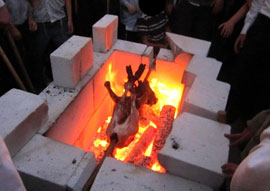
7. Propitiatory, substitutionary sacrifice. According to the divine instructions for the Passover ritual, the lamb was to be “roasted in fire” (Exodus 12:8). The command is precise and direct: "Do not eat it raw, nor boiled at all with water, but roasted in fire—its head with its legs and its entrails" (v. 9). One may still observe the roasting of the Passover lambs over the fire pits on top of Mr. Gerizim, as the Samaritans continue to observe this rite each spring. On a recent visit to the Samaritan Passover service, I observed the two sticks of wood placed crosswise in the carcass of the lamb, holding it open so that it may be thoroughly roasted, and I could not help but recognize the very shape of the cross upon which the Lamb of God hung. I envisioned the fires of divine wrath (Psalm 89:46; Zephaniah 1:18; Hebrews 12:25–29) that were poured out upon Jesus as he took upon himself the sins of the world and received the punishment we deserved (Isaiah 53:5–6). In my imagination, I could hear his plaintive cry at the hiding of the Father's face: "My God, my God, why have you forsaken me? (Matthew 27:46; Mark 15:34; citing Psalm 22:1). God was propitiating His own wrath against sin by means of the blood of His Son. Paul may have had this picture in mind when he wrote, Being justified freely by His grace through the redemption that is in Christ Jesus, whom God set forth to be a propitiation by His blood, through faith" (Romans 3:24).
The central meaning of this feast for Christians is encapsulated in the term by which the feast is named: "Passover," or, in Hebrew, pesach. The verb pasach, in the context of Exodus 12, means “to pass or spring over.” God announced to Moses, “I will pass through the land of Egypt on that night (Passover). Now the blood shall be a sign for you in the houses where you are. And when I see the blood, I will pass over [pasach] you, and the plague shall not be on you to destroy you when I strike the land of Egypt” (Exodus 12:12–13). Verse 23 elaborates the same point: “For the Lord will pass through to strike the Egyptians; and when He sees the blood on the lintel and on the two doorposts, the Lord will pass over [pasach] the door and not allow the destroyer to come into your houses to strike you.” This core meaning of Passover was to be passed on to successive generations after the time of the Exodus: “And it shall be, when your children say to you, 'What do you mean by this service?' that you shall say, 'Iris the Passover sacrifice of the Lord, who passed over [pasach] the houses of the children of Israel in Egypt when he struck the Egyptians and delivered our households."' (Exodus 12:27)
A Christian reading of this central focus of Passover finds here a prefiguration of the substitutionary sacrifice of Jesus. Just as Israelites in Egypt were spared and delivered from bondage as the Lord himself provided a substitute—the· Passover lamb—to protect them from the destroying angel, so all may be spared from eternal destruction and delivered from bondage to sin as the Lord Himself provided a substitute, Jesus the Lamb of God. Just as the Lord passed over (i.e., delivered) those who were covered by the blood of the Passover lamb, so Christians believe that He passes over (delivers) all those in bondage to sin who choose to be covered by the blood of Jesus, the Lamb of God. Paul summarizes: “In Him (Christ Jesus), we have redemption through His blood, the forgiveness of sins, according to the riches of His grace." (Ephesians 1:7)
8. A time of joy. The people of Israel came out of Egypt redeemed by the blood of the lamb, and as they experienced the deliverance from Pharaoh's armies in the parting of the Red Sea, they sang a great song of joy—the Song of Moses (Exodus 15). The Passover in each successive generation was to be a memorial of this time of joyous deliverance (Exodus 13:8–10). Later generations of Israelites in biblical times experienced such Passover joy. For example, in the time of Hezekiah, the feast of Passover and unleavened bread was kept “with great gladness. The whole congregation of Judah rejoiced. So there was great joy in Jerusalem” (2 Chronicles 30:21, 25, 26).
Christians look forward to a final joyous fulfillment of the Passover in the messianic kingdom, as Jesus promised at the Last (paschal) Supper before his death: “I will not drink of this fruit of the vine from now on until that day when I drink it new with you in My Father's kingdom” (Matthew 26:29). In every celebration of the Lord's Supper, Christians “proclaim the Lord's death till He comes” (1 Corinthians 11:26). And when he comes, in the Father's kingdom, on the “sea of glass,” reminiscent of the Red Sea of the Exodus, the redeemed will sing “the song of Moses” with its accompanying stanza “the song of the Lamb” (Revelation 15:3), and they will partake of that ultimate messianic Passover meal, the “marriage supper of the Lamb” (Revelation 19:19). Christians eagerly await that day!
1 Richard M. Davidson, “The Peace of Passover, ”Shabbat Shalom, June 1994, 17-18.
2 Biblical citations are from the NKJV unless otherwise indicated.
3 For support of this chronology of the last week of Jesus' life, see, e.g., F. D. Nichol, ed., The Seventh-day Adventist Bible Commentary, rev. ed. (Washington, DC: Review and Herald, 1979), 233.
4 For Jewish sources giving evidence of these two interpretations, see especially, Jack Finegan, Handbook of Biblical Chronology: Principles of Time Reckoning in the Ancient World and Problems of Chronology in the Bible, rev. ed. (Peabody, MA: Hendrickson, 1998), 12.
5John Durham aptly notes, "The penalty for the violation of this restriction, exclusion from the community of Israel, suggests a level of jeopardy far more serious than a need for haste in the preparation of a meal" (Exodus, Word Biblical Commentary, vol. 3 [Waco, TX: Word Books, 1987], 159).
6 Ibid.
7 Note, e.g., Ber.L7a;”leaven represents the evil impulse of the heart.” Cf. Gen. R.34:12. For additional post-biblical Jewish references, see Nahum Sarna, Exodus, The JPS Torah Commentary, vol. 2 (New York: Jewish Publication Society, 199l), 58, 245 (n. 44)
8 See George Balentine, “Death of Christ as a New Exodus,” Review and Expositor 59 (1962): 27-41.
Add comment