
The glaring sun cast long shadows in the desert of Beersheba—the silhouette of a woman holding a child against the barren sand. She ran as if in a trance from hilltop to hilltop, scanning the horizon and crying for help. Nothing, but hot wind and dust blown into her face was the response. Deadly fear overcame her as she recognized the emptiness and turned away from the limp body of the child. Suddenly, she heard an angel's voice say, "What is the matter with you, Hagar? Do not fear, for God has heard the voice of the lad where he is" (Genesis 27:177). Not Hagar’s loud weeping, but the whispering cry of the dying child reached the heavens.
Hundreds of years later, God's words sounded very similar: "I have surely seen the affliction of My people who are in Egypt and have given heed to their cry, for I am aware of their sufferings. So I have come down to deliver them" (Exodus 3:7–8). The biblical text suggests that it was the cry of the afflicted people that led to the exodus.
The Sabbath commandment of the Book of the Covenant, which links these two events through an interesting Hebrew wordplay, reads as follows: Six days you shall do your work, but on the seventh day you shall cease so that your ox and your donkey may rest, and the son of your maid servant and the stranger may be refreshed. (Exodus 23:12)
The unique value of this Sabbath commandment is suggested by two components: the motif of the God who hears the cry of the afflicted and specific linguistic terms that refer to Israel's patriarchal history. The last verb used in this text, "be refreshed, breathe," relates to the cognate noun “soul” (Hebrew nephesh), found only three verses above: "You shall not oppress a stranger, since you yourselves know the nephesh ["feelings, live, soul"] of a stranger, for you were strangers in the land of Egypt" (Exodus 23:9). The resonance between the verb and the noun highlights a similar experience: the soul of the stranger is exhausted, and it is the responsibility of the Israelite householder as one who knows about such weariness and depletion to provide distinct time for refreshment and recreation. Moreover, Israel’s concern for the oppressed is taken as the human analogue of God's compassionate listening to the cry of the suffering people. This motif is fundamental to the entire book of Exodus, even appearing as a trigger for the exodus event: "The Lord said, I have surely seen the affliction of My people who are in Egypt and have given heed to their cry" (Exodus 3:7). By including the stranger in the realm of Sabbath rest, Exodus 23:12 goes along with the Decalogue versions of Exodus 20:10 and Deuteronomy 5:14. Both mention the stranger as a partaker of the Sabbath rest. However, Exodus 23:12 employs the term "stranger" (Hebrew: ger) in an unusual way: unlike the Decalogue, which reads “your stranger,” Exodus 23:12 uses the definite article and reads “the stranger” (Hebrew: hager). Only here is the sound allusion to the name of the Egyptian maid servant, Hagar, obvious in the Hebrew text.
Another unusual expression in Exodus 23:12 is “the son of your maid servant." In the Decalogue, the servants of the Israelite household called to rest on the seventh day are the “male servant” and the “female servant.” Yet, the Sabbath commandment in Exodus 23:12 varies by the phrase “the son of your maid servant." Interestingly, the only other occurrences in the Pentateuch are found in the story of Hagar and Ishmael's expulsion from the household of Abraham, where Ishmael is twice called "son of the maid servant" (Genesis 21:10, 13). Even the idea of God hearing the cry of the afflicted appears in this narrative in the words, “God has heard the voice of the lad” (Genesis 21:17).
The Sabbath commandment in Exodus 23:12 prepares the reader for hearing the pun, first by providing the idea of God’s compassionate listening as context, and second by using unusual linguistic terms like “the son of your maid servant” (as an allusion to Ishmael, the son of Hagar) and "the stranger" (bager) instead of "your stranger" (as a sound allusion to the name of Hagar). If Exodus 23:12 had ended with “your stranger” (Hebrew: gerchah) like the Decalogue does, the wordplay on Hagar would not be obvious to the reader.
It is also interesting to note that only in Genesis 21, the Hebrew term for Hagar as "maid servant" is amah, just as Exodus 23:12 cites, “the son of your maid servant,” but in Genesis 16 and 25, Hagar is called shipchah (maid servant"). Also of interest is the fact that Genesis 21 does not refer to Ishmael by name. In this chapter, he is “the lad,” “her son,” or “son of the maid servant.” ' Yet, a clear reference is made to the significance of the name Ishmael by the words for God has heard the voice of the lad” (Genesis 21:17), "Ishmael" bearing the meaning God bears. It seems that by the omission of the name, but by pointing out its meaning, the text stresses the motif of God's compassionate listening to the cry of the one who is about to die. Yet, an even more subtle rhetoric of Hagar’s story is that she, the Egyptian maid servant, is never called a stranger; rather, Abraham sojourns in the land and calls himself "a stranger (ger) and a sojourner" (Gen. 23:4).
The conclusion seems to be: by alluding to the story of Hagar and Ishmael, the Sabbath commandment is linked to patriarchal times and founded in God's compassionate listening to the outcry of the oppressed. The human response then is to take responsibility for the same kinds of people, the servants and the socially marginal ones, whom God cared for, as He did for Hagar and Ishmael and the Israelite slaves in Egypt. The Sabbath commandment implies that man's role is not fulfilled by worshiping the God of heaven or by relating only to his own kind. The Sabbath calls for the care of hardworking animals and the outcast, the pariah of the community, not to gather strength for the following weekdays but to have the opportunity to "breathe" and to live. The verb used to describe the condition of the one who is likely the most rejected, “the son of your maid servant,” on the Sabbath day is “to be refreshed, to breathe." By applying this verb to Himself in another Sabbath text (Exodus 31:17), God expresses self-identification with the marginalized and most burdened members of society. The responsibility lies in the ceasing and resting of the householder. When he allows the servant and the stranger to breathe, to rest, and to live, he himself recognizes the value of equality: “I am a stranger and a sojourner among you” (Genesis 23:8).
The Hebrew Bible uses the term “son of the maid servant” also in the book of Psalms (Psalms 86:16; 116:2-16). The Psalmist alludes to both Genesis 27 and Exodus 23, calling himself "son of your maid servant," who cries out in distress and danger of life, and the Lord inclined His ear and loosed his bonds. The Psalm culminates in the words, "Return to your rest, O my soul [nephesh], for the LORD has dealt bountifully with you" (116:7). All significant characteristics of the Sabbath commandment are included in this Psalm: the motif of God’s compassionate listening and the linguistic elements of the Sabbath commandment, ”rest,” ”soul,” and “son of your maid servant.”
In his famous book on the Sabbath, Abraham Heschel mentions Philo's understanding of the Sabbath, which speaks of men's relaxation from continuous and unending toil in order to send them out renewed to their old activities. Heschel points out that this understanding is not in the spirit of the Bible but in the spirit of Aristotle, where relaxation is for the sake of activity, for the sake of the work days. The biblical meaning is the contrary: labor is the means toward an end, and the Sabbath's first intent is not for the purpose of recovering from weekday work; rather, the weekdays are for the sake of the Sabbath, and the Sabbath is for the sake of life (The Sabbath, 14).
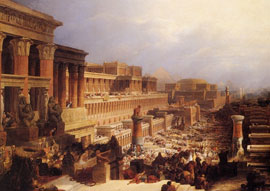
Image: "Departure of the Israelites", by David Roberts, 1829. Public Domain
Add comment