
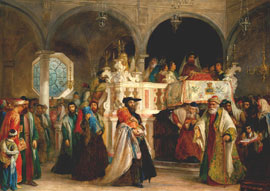
When the Bible is danced, sung, and rejoiced upon...
The park was jammed with thousands of Jewish celebrants—young and old, men and women, rabbis, city dignitaries, and representatives of the many different Jewish communities—all dancing together in giant circles with ecstatic joy, accompanied by exuberant singing and instrumental bands.
Dotting the throngs of dancers, there were scores of individuals hugging Torah scrolls as they danced, enthusiastically lifting them aloft at musical crescendos, and then hugging them once more. I was experiencing what I later learned is generally regarded as the crowning festival celebration of the year. For the first time, I was savoring Simchat Torah, “the rejoicing of the Torah!" Though the seven days of the Feast of Sukkot (Tishri 15–21) were over, I had arrived in Israel in time to witness the final climatic celebration of the eighth day. In modern Jewry, this day is technically regarded as a festival independent of Sukkot and called Shemini Atzeret, "eighth day of solemn assembly” [cf. Numbers 29:35]. In the Diaspora—outside Israel—Shemini Atzeret lasts two days [Tishri 22–23], and the second day is called Simchat Torah, while in Israel, Shemini Atzeret lasts only one day and thus also includes Simchat Torah. What I was viewing at the park actually came at the end of the Israeli one-day combined celebration of Shemini Atzeret and Simchat Torah; in the late afternoon and evening, Israelis have a final public “rejoicing of the Torah” celebration to coincide with the beginning of Simchat Torah outside of Israel.
Since that scene of ecstatic Bible revelry indelibly imprinted my memory a decade and a half ago, I have been back to Israel a number of times, with visits spanning the different seasons of the year. The dream I had thought was dashed forever—to be able to observe and celebrate the whole annual round of Jewish festivals in the Holy Land—has now become a reality. I have also been able to research more deeply the significance of these sacred times for both Jews and Christians.
All of the Jewish festivals have grown precious to me, but none has superseded the “rejoicing in the Torah,” Simchat Torah. Rabbi Hayim Halevy Donin has rightly called Simchat Torah “probably the most joyously celebrated festival day of the year.” 1 I can testify that he is also right when he says, “To see a Simchat Torah celebration in Jerusalem is to witness the heights to which religious ecstasy can rise.” 2
The major rituals of Simchat Torah revolve around the completion of the annual cycle of Torah readings and the beginning of the new annual cycle. It is preeminently a time of rejoicing in and honoring the Torah—God’s foundational revelation contained in the Five Books of Moses.
Certainly the most impressive tradition and the one most intimately identified with Simchat Torah is the ceremonial processional “circlings” (hakkafot) by worshipers carrying the Torah scrolls amid chanting, singing, and dancing. Seven “circlings” around the bimah (the raised “pulpit” where the Torah is publicly read) in the synagogue take place in the evening service, and another seven in the morning service. Although this practice on Simchat Torah was not introduced in Judaism until the late 16th century C.E., it is similar to the “circlings” of the second Temple altar with the palm and willow branches at Sukkot as described in the Mishnah and ultimately reminiscent of the seven circuits around Jericho by Joshua and the army of Israel (Joshua 6).
The “circlings” in honor of the Torah are popular, especially because they involve everyone, including women and children. The hakkafot is the only time in the year when women are allowed to join the men on the main level of the synagogue. The small children also follow the Torah scrolls in the procession, each carrying a miniature scroll or a decorative flag (reminiscent of the tribal banners of ancient Israel in the wilderness) topped with an apple hollowed out to hold a lighted candle (evoking the image of Torah as light). As the Torah scrolls pass by the celebrants, it is customary to kiss the scroll, or rather (out of respect for the holiness of the Torah) touch scarves or prayer shawls to the scroll and kiss them.
Between each of the seven circuits, the leader breaks out in joyous song and dance, and the entire congregation forms circles dancing around the Torah scrolls in the center. The ecstatic fervor honoring the Torah often rises in intensity to a frenzy of enthusiasm, and singing and dancing can go on for hours.
The celebration is even sometimes carried out outdoors. In Israel, the morning hakkafot includes a mass procession through the streets of Jerusalem as thousands of celebrants dance and sing their way 8–10 abreast to the Western Wall, led by Torah scrolls carried under protective canopies. The jubilant procession stretches as far as the eye can see!
The next most distinctive feature of Simchat Torah after the hakkafot is the aliyot—the “goings up” to the bimah (“pulpit”) to read the Torah. Simchat Torah is the time for every adult male worshiper to be able to publicly read the Torah. Some synagogues have aliyot to read portions of the Torah in the evening service (which makes this the only time in the year when the Torah is read in the synagogue at night), but the main part of the aliyot ritual occurs in the service the next morning. After the seventh “circling” of the morning service, all the Torah scrolls are returned to the Ark except three. From the first scroll, every adult Jewish male has an opportunity in turn to “go up” to read the Scripture portion found near the close of the Torah (i.e., Deuteronomy 33:1-26). Even the young children come up for a special collective aliyah with a prayer shawl canopy over their heads and receive a special blessing (from Genesis 48:16).
Then the “Bridegroom of the Torah” (Hatan Torah), a revered person in the community selected for this particular honor, is ceremoniously called up “by permission of the Great God” to read the final verses of the Torah, the description of the death of Moses in Deuteronomy 33:27–34:12. The annual reading cycle of the Torah has ended. The congregation rises and calls out (in Hebrew), “Be strong, be strong, and let us be strengthened!”
The first scroll is dressed and returned to the Ark, and the second scroll is opened to the book of Genesis. The honored “Bridegroom of Genesis” (Hatan Bereshit) is invited “by permission of One on High” to read from the beginning portion of the Torah: the Creation account of Genesis 1:1–2:31. The new cycle of Torah readings has commenced. The move from the end of the Torah to the beginning, from the death of Moses to the Creation account, embodies the truth that out of seeming death comes forth profound new life.
In some congregations, the entire Torah scroll is unrolled and held in a huge circle around the synagogue, with the end and beginning next to each other, ready to be read from the last panel of the parchment and then the first, while the whole congregation is literally encircled by the Torah.
The final reading from the third scroll is Numbers 29:35–30:1, which describes the instructions for sacrifices on this eighth day of solemn assembly. This is accompanied by the Haftorah reading from the first part of Joshua, which records the continuity of God’s people and leadership under Joshua after the completion of the Torah and the death of Moses, and the beginning of the fulfillment of the Torah promise to enter the land. Thus is embodied historically what is symbolized in the renewed cycle of Torah reading—from the death of Moses comes life in the land of promise.
After the aliyot, the worshipers proceed to the Kiddush (prayer of “sanctification” over the wine and bread) and to refreshments chosen from a multitude of culinary delicacies. The remainder of the day is spent visiting each other’s homes, with more refreshments and merriment at each. Oh, the joy of the Torah!
The attitude of reveling in the Torah is a dominant theme in the Torah Psalms of the Bible. 3
Although the festival of Simchat Torah is not mentioned in the Bible by that name (the origin and name of the festival may be traced to the Middle Ages, when the annual cycle of Torah reading became fixed throughout Jewry), its essential features may be deduced from three biblical passages connected with Sukkot. First, Leviticus 23:34–36 pinpoints the day and its general festal nature: “The fifteenth day of this seventh month shall be the Feast of Tabernacles [Sukkot] for seven days to the Lord... On the eighth day, you shall have a holy convocation. It is a sacred assembly, and you shall do no customary work on it.” Second, Deuteronomy 31:10–11 implies a focus of activity for Sukkot, which presumably included the eighth day: “At the end of every seven years, at the appointed time in the year of release, at the Feast of Tabernacles, when all Israel comes to appear before the Lord your God in the place which He chooses, you shall read this Torah before all Israel in their hearing.” Third, Leviticus 23:40 indicates the jubilant mood of Sukkot: “You shall rejoice before the Lord.” Putting together these three injunctions, the eighth day would be the natural climax of the special time of reading the Torah. The final portion of the Torah would presumably be read on the last (eighth) day of the feast, and it would provide the climax of rejoicing that was to characterize the entire feast. Thus, the understanding of Tishri 22 as the ultimate day of “rejoicing in the Torah”—Simchat Torah—is consistent with Scripture, and the historical development of this festival and its liturgy serves to highlight the importance of the Torah for ancient Israel.
It is not without significance that the two major Jewish pilgrimage festivals—Pesach (Passover) and Sukkot (Tabernacles)—both end in holidays celebrating Torah. This testifies to the high value that Judaism places in the Bible. Pesach is a seven-day festival, which culminates (fifty days later) in a one-day festival—Shavuot (Weeks, or Pentecost); likewise, Sukkot is a seven-day festival culminating in a one-day festival—Simchat Torah. Both of these one-day festivals are lacking in specific biblical details for celebration. In Judaism, Shavuot came to commemorate the divine revelation of Torah at Mount Sinai, and its mood became one of awe and gratitude to God for giving the Torah, demonstrated by serious study—remaining awake all night poring over the Torah.
Simchat Torah, by contrast, does not focus upon God’s revelation of Torah but upon the Torah itself as a “beloved companion” in daily Jewish life. Michael Strassfeld makes an apt comparison to the joy and intimacy of a wedding couple: “As with a bride and a groom dancing with each other at their wedding, on Simchat Torah we desire to hold the Torah in our arms and dance the night away.” 4 Strassfeld goes on to show how at Simchat Torah Jews learn to throw themselves completely into rejoicing with the Torah, drop their reserve and their defenses, and let go in the fullness of an unmitigated love relationship to a Torah of joy, a Torah without sense of burden or restrictions.
Thus, Jewish tradition has underscored the value of the Bible by emphasizing the need for deep Torah study (the theme of Shavuot) and the mood of rejoicing in the Torah (the theme of Simchat Torah).
Protestant Christianity, like the Karaite Jews, emphasizes the value of serious Bible study (the theme of Shavuot) with the dictum of sola Scriptura, the Bible and the Bible only, rejecting all external interpretive grids such as tradition or philosophy. But Christianity has nothing compared to Simchat Torah to highlight the mood of delight in Scripture, and thus Christians may well learn from the Jewish celebration of this feast how to rejoice unabashedly in the Bible.
1Hayim Donin, To Be A Jew: A Guide to Jewish Observance in Contemporary Life (New York: Basic Books, 1972), p. 257.
2Ibid.
3Psalms 1:1-2; 19:7, 10 (8, 11 Hebrew); 119:72, 77, 92, 97; cf. vss. 14, 16, 24, 47, 103, 111, 127.
4Michael Strassfeld, The Jewish Holidays: A Guide and Commentary (New York: Harper & Row, 1985), p. 155.
Image: The Feast of the Rejoicing of the Law at the Synagogue. Solomon Hart. Public Domain
Add comment