
The Jewish year is marked by eight festivals, beginning with Rosh Hashanah, the Jewish New Year, and ending with Shavuot, Pentecost, a commemoration of the granting of Torah to Israel. Reminding, beckoning, bringing joy, and bringing times of solemn reflection, these holidays help to give Israel her identity and remind her of her place in history.
Rosh Hashanah
Unlike Western New Year celebrations marked by the singing of Auld Lang Syne and wishes for a Happy New Year, Rosh Hashanah is the great and solemn day of judgment, the first of the ten days of repentance culminating in Yom Kippur. The typical greeting of the season is, “May you be inscribed in the book of life for a good year.” The sounding of the shofar, which can be heard coming from the Old City, calls people to examine their lives and behavior and to earnestly strive for self-improvement. A psychologically sound practice is to throw small stones into running water to symbolize the throwing away of acknowledged wrongdoings and weaknesses. The running water represents the washing away of those things and the opportunity for renewal.
Yom Kippur
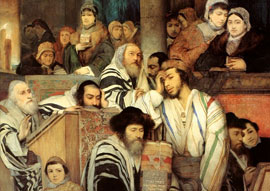
The fact that Yom Kippur is the most solemn day of the year is clearly seen in Jerusalem. Articles advising on how to prepare for and end the fast appear in local newspapers. The day begins at sunset, when even those who attend the synagogue on no other day are found in attendance. Everything closes in the preceding afternoon, with services continuing throughout the day. There is little traffic, and some streets are entirely closed off. Children take advantage of this quiet time to ride bicycles or skateboards on the otherwise empty streets. Pedestrians stroll along the roads and wish each other an “easy fast.” Many of those who are normally well-shod wear sneakers or other nonleather footwear as a sign of affliction, as commanded in Lev 23:27. Balancing the seriousness of the day, the Torah reading includes the story of the birth of Isaac (Yitzhak, a name that comes from the root meaning to laugh). There are positive feelings that all will eventually be well and that God will, as said in one of the prayers, remember us for life.
Sukkot
Sukkot, the Feast of Tabernacles, follows five days after Yom Kippur and is one of the three pilgrimage feasts—the others are Pessah (Passover) and Shavuot (Pentecost). Several days before the festival, makeshift shelters appear on balconies or in courtyards as families prepare to move out of their homes for the week-long festival. Sukkahs are also made in hotels and other public places.
The original connection with the land and its produce is still strong. Many are seen carrying lulav, bundles of the four species of plants that are harvested at this time, while the search for a perfect etrog, a type of citrus, is taken seriously. Thousands of Israelis join in the Feast of Tabernacles as they march through the streets of central Jerusalem, and Christians gather to demonstrate love and concern for Israel at the largest tourist event of the year.
Simchat Torah
Immediately following Sukkot, Simchat Torah, the Joy of Torah, marks the end of the Holy Day period that began with Rosh Hashanah. On this day, the Torah scrolls are taken out of the synagogues, held protectively in the arms, and, accompanied by dancing and singing companions, brought down to the Western Wall or Kotel for special services. The final portion of the Torah is read at this time, a new cycle is initiated, and the giving of Torah to God's people through Moses is celebrated.
Hanukkah
Although Hanukkah is not a religious festival per se, it is celebrated with enthusiasm. Jerusalem’s streets are decorated with lights in abstract, neutral designs, since they are also alight for Christmas celebrations held on December 25 by the Western Church, January 7 by the Eastern Orthodox Church, and January 19 by the Armenian Church.
The mouth-watering sights and smells of traditional jellied doughnuts waft from bakeries and cafeterias. Candle-lighting services are held in public squares in Jerusalem, and lighted menorahs, the eight-plus-servant branched candelabra, or hanukkiot, can be seen prominently displayed in homes. Special services are also held in synagogues during the eight-day festival. Hotels and restaurants invite guests to join in singing traditional songs and lighting candles in an amazing variety of hanukkiot.
Hanukkah is said to be particularly relevant to Christmas. Although not included in the Old Testament canon—it occurred too late for that—it is mentioned in the New Testament (John 10:22, 23). It is also said that without Hanukkah, there would be no Christmas, for if the Maccabbean revolt had failed, the Jewish people would not have survived as a nation.
Purim
Purim commemorates the heroism of Esther in rescuing the Jewish people from the murderous plot of Haman and is an opportunity for children to dress in fancy costumes. Biblical characters vie with fairy princesses and pirates in popularity. Special triangular pastries stuffed with raisins and apples are cooked and distributed. The book of Esther is read aloud in homes, synagogues, and public meetings. Children play an important and much-enjoyed role in making a loud noise that drowns out the name of Haman when it is read. As well as their voices, they use special noise-making toys and bang on drums, and a good time is had by all. Purim is a timely reminder that, in spite of plots to destroy God's people, even when tragedy and disaster seem inevitable, relief and deliverance will arise.
Pesach
Pesach, or Passover, occurs about the same time as Easter. The influence of many immigrants to Israel from the former Soviet Union is seen, for example, in the giving of colored eggs. Perhaps the most obvious indication that Pesach is approaching is the covering up or removal of all items containing leaven from supermarkets and other retail outlets. Entire shelves and bays are draped with signs warning of leaven products. Matza, a flat, crisp, unleavened bread, is eaten during the week. The observance of Pesach goes deeper than the acting out of rituals, for Pesach marks the very origin of the Jewish people as a free nation delivered from slavery by God.
The central theme of Pessah is the commandment to “remember deliverance from bondage in Egypt.” This exhortation “to remember” is linked with the Sabbath in Deut 5:6 and 15. As the story of the Exodus is recounted at the Passover Seder, those who are present participate not only in an intellectual experience but in a ceremonial recreation. The collective memory becomes a personal, existential experience.
Shavuot
Shavuot, or Pentecost, the commemoration of the granting of the Torah to Israel, is connected to Pessah by the counting of the Omer (sheaves of wheat). While Pessah is a reminder of the Jewish people becoming a physical nation, Shavuot shows the religious nature of the nation. Torah is understood to have been given not only to Moses and the Jewish people as precepts that guide life and bring peace, but to each individual. There is a custom of staying up the entire Shavuot night studying Torah. This demonstrates dedication to being “awake” to the importance of Torah and is evidence of its continuing relevance.
With Shavuot, the yearly cycle comes to an end, and we begin again with the soul-searching of Rosh Hashanah, which is only possible through the insights gained from the study of God's gift of His Word to us.
Image: Jews Praying in the Synagogue on Yom Kippur. Maurycy Gottlieb. Public Domain
Add comment