
Day of Atonement, Day of Forgiveness—why is it that Kippur is the most solemn and sacred day of Jewish festivals?
Yom Kippur was the most solemn and sacred day in the Israelite liturgy. The importance of the celebration of this day became so meaningful that in the first century it was simply called “the day” or “the great day.” However, the real meaning of the ceremonies performed on this day was for centuries a matter of controversy, due especially to the fact that the other rituals of the year that were related to those performed on the Day of Atonement were never well understood.
Fortunately, thanks to the intensive research performed mostly by Jewish theologians,1 "the spiritual significance of the priestly cult, as reflected in the laws of the Pentateuch, has been clarified to an increasing extent in recent years.” 2
The Paradox of the Sacrifice
One of the topics that had not been well understood was the nature of the defilement of the sanctuary to be cleansed on the Day of Atonement and the different role of the ritual of blood performed during the year and on the Day of Atonement. For instance, since in Leviticus 12:8, 16:16, the sacrifice for sin has an explicit purificatory value, many interpreters have tried to interpret unilaterally the whole system of sacrifices as performing an exclusive purificatory role. But what should we do then with the prescriptions for the officiant priests of washing everything holy touched by the blood and bathing themselves after having performed the ritual (Leviticus 6:27–28; 16:24, 26–28; Numbers 19:7–19)? As most modern Jewish interpreters have been demonstrating in the last two decades, all these laws reveal a profound inner coherence that modern man considers paradoxical.
Essentially, what does this paradox consist of? "the substitution of a victim and the transfer to it of the impurity and sins of the worshippers,” which “creates the apparent paradox of an impure victim serving as atonement, as the instrumentality for purification," How may we explain it? By the principle of substitutional interchange. The sinner brought his sin to receive, in exchange, the purity of the victim and of the sanctuary. More amazing still is the fact that “this apparent paradox is built into the entire system of Israelite purificatory rituals.”3
The Human and Divine Perspectives
a) The human perspective. In order to teach His creatures how to come near Him without irreparably damaging His holiness or being consumed by His glory, God required His people to pitch a tent in the midst of their tents (Exodus 25:8–9). Then He promised to free them from their sins by requiring them to bring their faults into His dwelling through a substitute animal (Leviticus 4:13–21; see 17:3–4). Actually, in the innocent victim, the sinner brought literally his “sin” (hattat = Leviticus 4:3; 5:6), his “guilt” (asham = Leviticus 5:15, 25, Hebrew [6:6, English]; see Isaiah 53:10). Some passages say literally, “You will make sin in the bull [that you offer] each day for the atonements” (Exodus 29:36). “It is a sin [offering]." (Exodus 29:14; Numbers 19:9). The sinner had to return (shub) to God his own contaminated life through the sacrifice of his substitute (Numbers 18:9). He did repreit in compensation for his fault, as his penal substitute. What happened once the victim was sacrificed? On the one hand, the sinner obtained the joy and peace of divine forgiveness (Leviticus 4:20, 26, 31, etc.). On the other hand, the sin remained in the sanctuary until the last liturgical month, when a special ritual was performed to take it out of the divine tent (Leviticus 16:16–18, 30).
b) The defilement of the sanctuary. It was obvious that by deciding to dwell among dirty people (Isaiah 6:5), the holiness of the divine dwelling could be touched (Leviticus 16:11; see Numbers 35:33–34). However, God did not deal indiscriminately with the sins of His people. He did not accept the human uncleanness in His sanctuary unless it was diminished by the minor contamination of a clean animal acquired by receiving the sinner’s uncleanness (Leviticus 4:5-7, 16–18; see Leviticus 6:27–28; 16:24, 26–28; Numbers 19:7, 19). This was the only contamination that the Lord could accept in His house without irreparably damaging His reputation as holy and righteous.
c) The divine perspective. According to the biblical account, our sins are more than social or political affairs, even more than a simple offense to God; they touch the good name of the Creator before the world and the creatures of the universe. This is why the defilement of the sanctuary is presented as affecting the name of Him Who dwells there (Leviticus 20:3; 1 Kings 8:29). Like a ruler deciding to forgive or condemn a betrayer of his country may compromise his reputation if he does not present the case adequately before his subjects, God also pledged or involved His name, His word, in the redemption of His people (Isaiah 42:21; 48:11; Jeremiah 14:20–21).
d) The final destiny of sins. The steps for the elimination of sin in the ritual of the sanctuary were recently well summarized by a Jewish scholar of the Shalom Hartman Institute in Jerusalem. “The contamination is transferred from the sinner to the animal (which is thereby substituted for him), and thence to the blood, and finally to the sanctuary.4 What then becomes of the impurity once it has been finally conveyed to God’s altar? "The residues of contamination, having been disowned, are heaped up at the altar and finally removed to Azazel by the yearly general cleansing of the sanctuary on the Day of Atonement.” 5 While during the year, the sins of the people were taken out of them and transferred into the sanctuary by the ritual of sacrifices, on the Day of Atonement, the principal purpose of the ritual of blood was to cleanse the sanctuary from all the sins it had accumulated (Leviticus 16:16–19).
Once the cleansing of the sanctuary from all the confessed sins on the Day of Atonement (Leviticus 16:20) was concluded, they were sent back to their first cause (see Genesis 3:14–15; Psalm 7:16). They were placed upon an animal that represented the originator and instigator of evil and, therefore, had nothing to do with the atonement. 6 The accuser of the people was then expelled to an uninhabited land (Leviticus 16:20–22).
The Day of Atonement as the Day of Judgment
If we take into account that the name of the Lord, which was within the temple, was cleared through the cleansing of the sanctuary only on the Day of Atonement and that it resulted in the cleansing of the people from all the sins of the year and the condemnation of the unconfessed sinners (Leviticus 16; 23:27–29), we may better understand why this day was as much reverenced by the Jews. It was also a day of fast, because on that day a remembrance of sins took place (Hebrew 10:3), and all the people were judged.
This notion of judgment represented by the ceremonies of the Day of Atonement could not be totally erased from the rest of the messages of the Bible or from Jewish tradition. In later times, for example, the people were called through the blast of trumpets at Rosh Hashanah to prepare themselves for the judgment, which would be sealed ten days later on the Day of Atonement. These days separating both feasts were called “ten days of penitence.” Satan, who was represented by the second goat on the Day of Atonement, was believed to be silenced on that day “in his intents of accusation, because (on the Day of Atonement) all the Israelites” were considered to be “as pure as the angels.” 7
In his vision of the judgment of Judah at the end of the first temple, Ezekiel saw a man clothed in linen (bad) as the High Priest on the Day of Atonement (Ezekiel 9:2; Leviticus 16:4, 23, 33), sealing the just for salvation and leaving without protection the rest of the people who were destroyed by the executioners (Ezekiel 9). Taking into account the Day of Atonement and this vision of Ezekiel, as well as other visions of the heavenly judgment, the Jews were taught to exclaim during the Day of Atonement, katvenu, that is, “inscribe us.” At the end of the Day of Atonement, however, when the doors were to be closed, they cried hatmenu, that is, “Seal us.”
“Who is a God like you,” said Micah, “who pardons [literally: “takes on him” or “assumes,” obviously, through the expiatory sacrifice] sin and passes over the remnant of his inheritance” (Micah 7:18)? Among the heathen nations surrounding Israel, no other kingdom had such a wonderful message. The gods of the nations were revengeful and often semi-demonic. The people had to appease them, even with human sacrifices. After dying, the Egyptians had to appear to prove their innocence—according to their beliefs—before a judgment represented by fierce animal gods.
Nothing like that happened in Israel, nor will it happen with us if we bring our sins to the Lord, annotating His judgment (Isaiah 1:16–19). The forgiveness of sin that God offers now delivers us from the anguish of having to justify ourselves before a court that has infallible records (Daniel 7:9–10).
Like Micah, who knew that in the final judgment the Lord “will again have compassion on us,” hurling “all our iniquities into the depths of the sea” (Micah 7:19–20), or, as on the Day of Atonement, into the wilderness (Leviticus 16:21–22), we have to fasten to God’s unalterable fidelity in fulfilling His promises to His people.
Conclusion
This message of judgment requires, as we could expect, a genuine answer from the worshiper, for it shows us that God looks and weighs from His heavenly sanctuary each life with unerring accuracy (Psalm 11:4-5). How much does the world need to know that, whether publicly or privately, everything we do is done before “the eyes of the Lord” (1 Kings 15:5, 11, 26, 34, etc.)? Trusting then in divine mercy, we will request God’s grace to live holy lives that glorify our Redeemer.
1 Among them we may especially mention Baruch A. Levine and Jacob Milgrom. A kind of compendium of climax of all that they have been publishing in these last years about the old worship may be found in their respective commentaries on Exodus, Leviticus, and Numbers.
2 Noam Zohar, “Repentance and Purification: The Significance and Semantics of hattat in the Pentateuch,” in Journal of Biblical Literature 107/4 (1988): 609.
3 Baruch A. Levine, In the Presence of the Lord: A Study of Cult and Some Cultic Terms in Ancient Israel (Leiden: Brill, 1974), p. 69.
4 Zohar, “Repentance and Purification,” p. 616.
5 Ibid., p. 615.
6 For the correct meaning of Leviticus 16:10, and the meaning of the term Azazel and the ritual of the second goat, see Alberto R. Treiyer, The Day of Atonement and the Heavenly Judgment: From Pentateuch to Revelation (Siloam Springs, AR: Creation Enterprises International, 1992), p. 45, and chapter four of the same book.
7 Seder Olam R., 6; Tanuma, ki tissa, 4.
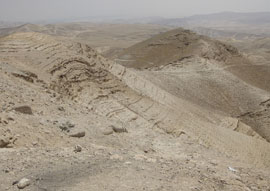
Image:Cliffs of Mount Azazel by D. Public Domain
Add comment