
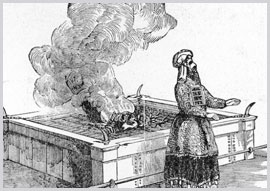
According to Leviticus 16, Kippur had cosmic implications. The people submitted “all the iniquities of the people” to divine judgment. The expression “all the iniquities and sins" runs as a leitmotiv in Leviticus 16 (verses 21, 22, and 30) and also appears in the psalm inspired by this great festival (Psalm 130:8). The Day of Atonement is the moment when the sins of all Israel receive atonement, or forgiveness. Forgiveness was ensured during the year through the “perpetual” sacrifice, but on the Day of Atonement, it needed the backup of other sacrifices. The expiation of sin was not an individual matter anymore.
The Day of Atonement was the only time when the totality of the people of Israel and the whole space of the sanctuary were totally “purified” (Leviticus 16:17, 33, 34). It was also the only time that the high priest could enter the Holy of Holies in the sanctuary and physically present himself to God (Exodus 30:6–10; Leviticus 16:2, 14). And it was the only time when the Great Pardon of God extended beyond the simple, individual pardon. Sin was not only forgiven but banished from the camp. The high priest chased “Azazel,” the incarnation of sin, into the desert (Leviticus 16:21).
But this ceremony enacts more than the judgment. The Day of Atonement points to Creation. The rhythm 7 is sounded through the seven occurrences of “all the iniquities and sins." Also, it is interesting that the time of the festival reveals the same quota of 7/10 as in the Creation story. In Genesis 1, creation takes place in 7 days and in 10 words. Similarly, the Day of Atonement takes place in the seventh month on the tenth day of the month. The cleansing of the sanctuary is, in fact, the sign of the total purification of the whole earth on the day of God’s judgment. Biblical theology understood the Israelite sanctuary as representative of the whole world that God created. The description of the construction of the sanctuary in Exodus 25–40 parallels the narration of the creation of the world in Genesis 1:1–2:4. Both occur in seven stages and both end with the same technical phrase: “finished the work” (Genesis 2:2; Exodus 40:33). The construction of the Temple of Solomon also takes place in seven stages and ends with the same words: “finished the work” (1 Kings 7:40, 51). The phrase appears only in these three passages of the Bible and clearly indicates the relationship between the sanctuary temple and creation. The psalms also attest to that connection: “He built the sanctuary like the high mountains, like the earth that He established forever” (see Psalm 78:69; cf. 134:3; 150:1, 6).
But this ceremony enacts more than the judgment. The Day of Atonement points to Creation. The rhythm 7 is sounded through the 7 occurrences of “all the iniquities and sins." Also, it is interesting that the time of the festival reveals the same quota of 7/10 as in the Creation story. In Genesis 1, creation takes place in 7 days and in 10 words. Similarly, the Day of Atonement takes place in the seventh month on the tenth day of the month. The cleansing of the sanctuary is, in fact, the sign of the total purification of the whole earth on the day of God’s judgment. Biblical theology understood the Israelite sanctuary as representative of the whole world that God created. The description of the construction of the sanctuary in Exodus 25–40 parallels the narration of the creation of the world in Genesis 1:1–2:4. Both occur in seven stages and both end with the same technical phrase: “finished the work” (Genesis 2:2; Exodus 40:33). The construction of the Temple of Solomon also takes place in seven stages and ends with the same words: “finished the work” (1 Kings 7:40, 51). The phrase appears only in these three passages of the Bible and clearly indicates the relationship between the sanctuary temple and creation. The psalms also attest to that connection: “He built the sanctuary like the high mountains, like the earth that He established forever” (see Psalm 78:69; cf. 134:3; 150:1, 6).
In a way, Kippur reminds us, then, of the weekly Sabbath, evoking, like that day, the creation of the world (Exodus 20:11; Genesis 2:1–3). Significantly, of all the festivals depicted in the book of Leviticus, we find the book setting only these two—the Sabbath and the Day of Atonement—apart as a day when the people are to “do no work,” as opposed to doing “no regular work” (Leviticus 23:3, 28, 35, etc.).
For the Israelites, Kippur symbolized the purification of the world, a true recreation. This is why Daniel uses the expression “evenings and mornings” (Daniel 8:14), a phrase that occurs strictly in the context of creation (Genesis 1:5, 8, 13, 19, 23, 31).
Jewish tradition also associated the idea of creation, like that of judgment, with the day of Kippur. The ancient Midrash, interpreting the first verses of Creation, declares: “There was an evening, and there was a morning, one day; this means that the Holy One, Blessed be He, gave them (Israel) one day, which is none other than the day of Kippur” (Midrash Rabbah, Genesis 4. 10).
The prayers recited on Yom Kippur remind the believer that the God who judges is also the Creator who forgives. “Blessed art thou, O Lord our God, King of the Universe, who opens the doors of Your grace and opens the eyes of those who wait for the forgiveness of Him who has created light and darkness and all things” (Yotser leyom Kippur). “How is the human to be just before his Creator when he stands naked before Him?” (Mosaph Leyom Kippur).
The prophecy of Daniel sees on the horizon of history a heavenly Kippur described in terms of judgment and creation. The Kippur the Israelites celebrated in the desert is but a rough draft of the heavenly Kippur. The two events belong to two totally different orders. And yet, to comprehend the divine Kippur, one must understand the earthly Kippur. Its spiritual message reminds us that history will come to an end and that the God-Judge will rise to seal the destiny of the human race and prepare for them a new kingdom.
We understand now the relevance of both judgment and creation during such moments in history. In fact, judgment and creation operate in the same way. Judgment elects a new people, torn from the grip of sin and suffering. They are a people set apart, separated from the others, but also a forgiven people. Creation fashions a new world—a purified planet released from the shadow of death. In this context, judgment is synonymous with creation, as both imply a radical separation.1 Yom Kippur is simultaneously the awareness of divine judgment and the hope of recreation.
On the one hand, awareness of the judgment of God invites us to repentance. Yom Kippur was the day for the Israelite to “deny himself” (Leviticus 16:29, 31) and to assume responsibility for his actions. God “created [the] inmost being” and weighs all actions (Psalm 139). But believing in divine judgment does not imply the mournful attitude of someone groveling in misery and sinfulness, permanently undergoing judgment. On the contrary, “be happy. Let your heart give you joy in the days of your youth. Follow the ways of your heart and whatever your eyes see, but know that for all these things God will bring you to judgment” (Ecclesiastes 11:9). Judgment does not exclude the enjoyment of life; rather, it implies it. Our awareness of judgment provides the frame in which we can best experience life.
The promise of re-creation also validates our hope. We can expect real change. True salvation is historical, not just spiritual. We cannot save ourselves in our present condition. Only God can, and to do so, He must transform the world—the essential meaning behind the festival of Kippur. An old story tells of ten rabbis, righteous and just, tortured to death by the Romans. The prayer book narrates that a voice then tore through the heavens and cried, “Is this then the reward of the just?” to which God answered, “Shut up! Or I destroy the world!” No other solution exists for the problem of evil. Salvation implies the destruction of the very cause of suffering and death. Not a mystical or psychological experience, salvation is an event of cosmic proportions that comes from beyond and is situated in history.
Judgment and re-creation are the two faces of Kippur. It is not surprising that the book of Revelation mentions them as the two vectors of faith during the last days. Entering into the cycle of Daniel 7, right before the coming of the Son of man—that is, during the celestial Kippur—the prophecies of Revelation 13 and 14 mention a messenger bearing precisely the dual message of judgment and creation: “He said in a loud voice, ‘Fear God and give him glory, because the hour of his judgment has come. Worship him who made the heavens, the earth, the sea, and the springs of water’” (Revelation 14:7).
According to the book of Revelation, which arises out of the book of Daniel, the last days will resound with new adoration, embracing the notions of judgment and creation.2
1Gordon J. Wenham, Genesis 1-15, Word Biblical Commentary, vol 1 (Waco, TX: Word, 1987), 18.
2See also Ecclesiastes 11:6-10 where “Judgment and Creation” are linked in a passage that speaks about the end. See Jacques B. Doukhan, All Is Vanity (Nampa, ID: Pacific Press Publishing Association, 2006), 115-117.
Image: Yom Kippur in the Jerusalem Temple. Henry Davenport Northrop. Public Domain.
Add comment