
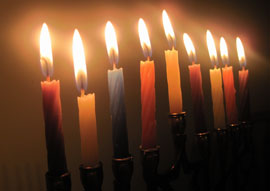
A new wave is moving through Christian communities; some Christians are engaging in the practice of Jewish festivals. The trend is significant enough to raise questions and reflection among both Christians and Jews: Should Christians “do” Jewish festivals?
To that question, yes and no answers are in order.
Yes, because doing the Jewish festivals may draw Christians closer to the Jews their tradition has taught them to despise. For instance, anti-Semitism was the main motivation for the repudiation of the Feast of Pessah, Passover, as the Nicene letter of Constantine testifies: “It appeared an unworthy thing that in the celebration of this most holy feast we should follow the practice of the Jews, who have impiously defiled their hands with enormous sin and are, therefore, deservedly afflicted with blindness of soul.”1
By engaging in Jewish festivals, Christians would, therefore, make a powerful statement against the anti-Semitic voice of the traditional church. Observance would provide a way of protesting injustice and repairing the breech.
Yes, because, by doing Jewish festivals, Christians will learn to rediscover emotional and aesthetic experiences they have forgotten to enjoy. Christian religion, especially within Protestant currents, has often reduced itself to a set of dry beliefs. Christians, so concerned with cognitive “truth,” have forgotten how to celebrate with the body and senses. In early Christian tradition, under the influence of the Gnostic heretic Marcion, human flesh and the concept of divine creation became suspect and were no longer influential in the act of worship. Christians were concerned primarily with the spiritual world and their salvation from this evil, material, and nonspiritual world. By doing Jewish festivals, Christians will discover the holiness of bread, which is a symbol of messianic sacrifice, and the mitsvah of laughter. Christians will live a more incarnate religion.
Yes, because, in doing Jewish festivals, Christians will bring into their religion the power of time and rhythm through the act of remembering. They will gain an understanding of the value of learning within the adventure of worship and prayer. Christian religion has often become subjective, individualistic, and sentimental, at times to the point of becoming anti-intellectual, mystical, and surreal. By participating in Jewish festivals, Christians will grow in their ability to become authentic human beings, in touch with the real world they are a part of. They will learn to live and wrestle with the world, to endure it, and to repair it through the art of tiqqun.
Yes, because Jewish festivals contain profound meanings that enlighten and enrich biblical and Christian truth. Some will even perceive in the beautiful rituals gems of mysterious prophecies that give greater significance to the gospel. Christians will better understand the messianic gestures of the Lord, their Messiah, when He partook of the matsah at Pessah. Sukkot will open new avenues into Christian hopes and expectations for the Kingdom of God. Kippur will teach them the force of teshuvah, the internal movement of returning to forgotten paths. Christians will have a better understanding of their own holy books—the Hebrew Scriptures and the New Testament—which will become more of a physical part of their tradition and their lives.
Thus, by doing Jewish festivals, Christians may become better Christians. And yet, the situation is not so simple. The celebration of Jewish festivals will not make Christians magically or automatically holier. For it is not the human act, as wonderfully correct as this may be, that makes humans holy, but the work of the Spirit from above. Besides, this idea, as beautiful as it may be, encounters serious problems that suggest a definite no to the question.
No, because Christians do not have a historical festival tradition. How, then, will they celebrate the festivals? Are they going to adopt Sefaradic or Ashkenazic rituals? On what grounds will they justify one practice over another? It will be tempting to engage in creating a new way—the biblical one—which, of course, will be the better and true way. There is no need to remind people that this attitude is pregnant with the old monster of anti-Semitism. The Christian engaged in the “more nearly true” Jewish festival will soon think himself or herself more Jewish than the Jews. Thus, there is a real danger of falling into the old temptation of replacement theology, not to mention the fact that without the support of a historic tradition, this enterprise will produce artificial, strange habits and distortions, which will ultimately make the sacred celebration of festivals ridiculous, uncomfortable, and at the edge of sacrilege.
No, because the scriptural way requires sacrifices and offerings that were supposed to take place in the temple in Jerusalem (Deut. 16:2). Pessah implies the slaughter and eating of a lamb (Exod. 12:3–10). Sukkot prescribes a burnt offering (Lev. 23:37). Kippur is built around several sacrifices of bulls, rams, and goats (Lev. 16). Likewise, Shavuot stipulates the sacrifice of seven lambs, a bull, and two rams (Lev. 23:18). From a biblical perspective, these sacrifices are not mere rituals or cultural expressions of piety; they are central to the very meaning of the festivals themselves. It is the lamb that gives Passover its meaning. The sacrifice of the lamb is designed to remind the one who offers the sacrifice of God’s passing over the blood of the slaughtered animal, thereby granting redemption (Exod. 12:13). This connection is so strong that Passover is actually identified with the lamb itself (2 Chron. 30:15). Pessah is the lamb. The same truth applies to Kippur, which concerns the work of atonement. Indeed, the whole mechanism of atonement revolves around sacrifice (e.g., Lev. 16:6, 11).
No, because, for Christians, sacrifices are loaded with specific meanings that point to the coming and function of the Messiah. The book of Hebrews clearly explains that they are the shadow of “things to come” (Heb. 10:1). A prophetic message was conveyed through the sacrifices concerning the process of salvation: God will come down and offer Himself as a sacrifice in order to atone for and redeem humanity. Now that the prophecy contained within the sacrifices has been fulfilled, sacrifices and related rituals, such as Jewish festivals, are no longer mandatory. The type has met the antitype. To engage in Jewish festivals with the idea that they are compulsory for our own salvation is to make the antitype, the Messiah, all together irrelevant.
No, because Jewish festivals are not like the weekly shabbat, which is an eternal sign that reminds us of the creation of the universe and is, therefore, always relevant and mandatory (Num. 28:1–10). Shabbat was given at the end of the creation week, when sacrifices were not yet a necessary factor in the equation of salvation because sin had not yet been committed. The shabbat, unlike Jewish festivals, was a part of the Ten Commandments and was given to all of humanity. In fact, it was given to Israel even before the gift of the Torah on Sinai (Exod. 16:23–28). Further, Lev. 23:3–4, which lists the Jewish festivals along with the shabbat, clearly suggests that there is a significant difference between the two “feasts.” In Lev. 23, the shabbat is mentioned at the beginning of the list (v. 3). Then the Jewish festivals are given under the designation “these are the feasts of the Lord” (v. 4). To equate the shabbat with the festivals may affect the true meaning of the shabbat, ultimately removing its mandatory character. For this reason, it is problematic to associate Jewish festivals with the Shabbat. Paradoxically, by elevating the Jewish festivals to the level of the shabbat, one may kill the shabbat itself.
What shall we do then? By valuing the richness of Jewish festivals but also being aware of the problems that are implied in doing them, Christians may find a proper way to engage with Jewish festivals.
Yes, and no. Christians should explore the possibility of celebrating the Jewish festivals. But this practice should be conducted with balanced wisdom, humility, openness, and a willingness to learn. A number of practical suggestions may help Christians find a meaningful expression of the festivals:
Relate to Jews. Jewish festivals will then become an occasion for Christians to become better acquainted with Jews and to engage in intelligent conversations to the benefit of both parties. Connecting with Jews will also safeguard Christians from the danger of anti-Semitism and the fallacy of replacement theology. As long as Christians need Jews, they will not be tempted to replace them.
Read the Bible. While Christians may not have the cultural background that Jews have in regard to the doing of Jewish festivals, they do have the Bible that should inform their reflection and orient their practice, thereby helping them to find a correct perspective. It is not forbidden to be creative, but this should be done under the guidance and control of biblical revelation. Relax and enjoy. Jewish festivals are not mandatory. They will supply the Christian with excellent material that will enrich their religious experience but not replace it. The sign should not prevail over the reality it points to. Besides, one of the main lessons Christians may learn from Jews is to enjoy the goodness of the festive moment and to not be tense and sad. Learn the joy of the feast. Learn to celebrate.
1Eusebius, Life of Constantine 3, 18-19, NPNF , I, p. 524.
Image: Yakov Chernin for Shalom L.C. Public Domain
Add comment