
"Those who forget history," wrote George Santanya, "are doomed to repeat it." However pithy the saying, one could be excused for wondering just how accurate it is. After all, we have thousands of years of recorded history to inform us of what racism, bigotry, greed, imperialism, and aggression lead to. That knowledge, however, hasn’t stopped the past century from being one of racism, bigotry, greed, imperialism, and aggression. Whether remembered or not, history is, it seems, doomed to be repeated.
All this, though, doesn’t mean we still can’t learn from history. Though certainly not in a Hegelian sense, Jews do believe that history has a divine purpose—that history is not just some uncontrolled outpouring of blind forces heading toward no good end. For Jews, historical events don’t occur at random, in isolation from each other; rather, history is the unfolding of a divine plan that, ultimately, leads to the redemption of the world. This is best seen in Daniel 7, when, after a parade of historical kingdoms, the world culminates with final redemption: “But the judgment shall sit, and they shall take away his dominion, to consume and to destroy it unto the end. And the kingdom and dominion, and the greatness of the kingdom under the whole heaven, shall be given to the people of the saints of the most High, whose kingdom is an everlasting kingdom, and all dominions shall serve and obey him” (Dan. 7:26, 27).
In this context, we can better understand the basic meaning of the Jewish festivals: however much they are “the jewels on the crown of Judaism,” they are also a powerful means of educating the Jew by helping him or her remember the past and God’s work in Jewish history. We can get so caught up in the humdrum hassle of the mundane; the festivals are a way of invigorating the soul and of sanctifying the life. They are also powerful tools to help us remember not just what God has done but also what He promises to do. In this article, we’ll take a quick look at the three pilgrim holidays that mark Jewish life and help us remember them.
Pesach, of course, commemorates the seminal event in all Jewish history: the redemption from bondage in Egypt. For here, in a real sense, the Jewish nation as a nation was born. Without the Exodus, there would be no Israel, and without Israel, there would be no Jewish people. Thus, though a reminder of Jewish origins, Passover should be even more so a reminder of the role of the Lord in creating this people in their special role.
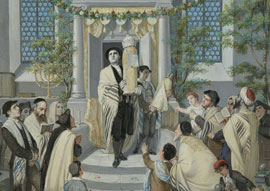
Shavuot, or Pentecost, comes with a number of different understandings. It is also known as Zamn Mattan Toratinu, or “Season of the Giving of Our Torah.” Indeed, in Jewish tradition, this commemorates the giving of the law at Sinai, another seminal event in the history of the Jews, which clearly shows the working of the Lord in Jewish history. The Jews didn’t make up the law; they didn’t get it from the nations around them. The giving of the law was a divine act of God on behalf of His people. Shavuot, of course, helps us to remember the law and the divine responsibility of living up to it before the world.
Sukkot, the Feast of Tabernacles, comes with a different spin: the Jew is reminded, by living in booths, of the transience, the frailty, and the uncertainty of this life. Sukkot, in a roundabout way, points to a time when all Israel, all God’s redeemed, will no longer face the uncertainties and insecurities of this existence but will live in the fullness and hope of the Messianic kingdom. Sukkot is a yearly reminder that, until then, we can trust little or nothing in this world. Our hope has to be in God and in God alone.
Whatever meanings and traditions are infused in these festivals, they all point to the sovereignty of God. The festivals are powerful but joyous reminders that we are not alone in this world, but that there is a loving and caring God who has powerfully intervened in the world, most dramatically through the history of Israel and the Jewish people. These festivals, along with the weekly Sabbath, not to mention the High Holy Days, all function together as a powerful reminder for the Jew to remember not only history but the God of history—the God who promises not only to redeem the past but the future as well. The festivals help us to remember that our lives, our hopes, our identities, and, most importantly, our futures are too important to be left to ourselves. What a fearsome thought! They then, however, point us to the One to whom we owe our lives, existence, and future hope.
Sure, we can learn from history, and the best lesson we can learn is never to forget the role and work of our God in that history.
Image: Daniel Oppenheim - Shavuot. Public Domain
Add comment