
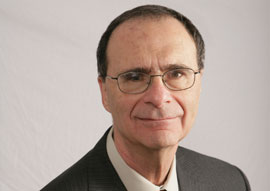
Dr. Hoffman is Professor of Liturgy and Director of the Synagogue 2000 Initiative for synagogue spirituality at Hebrew Union College—Jewish Institute of Religion and an ordained rabbi. He researches, writes, and lectures in the history of Jewish liturgy, ritual studies, contemporary worship, and modern Jewish spirituality.
Dr. Hoffman was recognized for his contributions to the field of liturgy with the North American Academy of Liturgy’s (NAAL’s) annual Berakah award. He became the first Jewish president of the interfaith scholarly organization, which is dedicated to liturgical research and dialogue.
Some of Dr. Hoffman’s recent scholarly works include: The Canonization of the Synagogue Service, Studies in Judaism and Christianity in Antiquity, 4 (Notre Dame, 1986); Covenant of Blood: Circumcision and Gender in Rabbinic Judaism (Chicago, 1995); and Minhag Ami: My People’s Prayer Book, vol. 1, The Sh’ma and Its Blessing (Jewish Lights Publishing, 1997). He has also co-edited the series Two Liturgical Traditions (Notre Dame: 1991–).
Shabbat Shalom: Are Jewish festivals still relevant today?
Hoffman: Expressions such as “I’m killing time" or “I had the time of my life!” betray the human need to structure life by a time line with ups and downs, highs and lows. If that line levels out, we become “dis-spirited”—the way a patient is pronounced dead when vital signs level out on a hospital monitor. Festivals remain relevant because they differentiate the merely “momentary” from the truly “momentous.”
Everyone arranges life with a calendar. The question is, which one? The holiest day on a corporate calendar might be the annual shareholder meeting, when the firm recollects its modest beginnings compared to current earnings. The Jewish calendar prefers a new year celebrated by wiping clean the slate of sin.
Religious festivals matter also because they have the potential to deepen us as human beings. The capacity for human emotion is learned; it is not innate. There are people, for instance, who love humanity in the abstract; born with reason, they have reasoned their way to the proposition that the world should be saved from tragedy. Yet, ironically enough, they dismiss the pain of individuals because reason alone cannot develop human empathy. That is where holy days come in; their accompanying rituals instruct us in empathy and make fully moral behavior possible. Every Yom Hasho’ah, for instance, I cry for nameless others as if they were my own.
Other holy days carry other emotions. I know how to celebrate freedom because at every Passover seder I rehearse the glorious fact that God took me out of Egypt. I experience the reality of sin and the greatness of forgiveness every Yom Kippur. And because I dress up in costume every Purim, I never lose the sense of childhood innocence. Observing Jewish practices makes me a profoundly deeper human being.
Shabbat Shalom: How should we keep festivals to make them meaningful?
Hoffman: Old rituals are newly reinterpreted, or old interpretations are given new rituals. Both processes may occur, but under different circumstances. In charismatic or hierarchical systems of authority, change comes from above: a Hasidic rebbe, say, announces a new practice, and people do it. But overall, Judaism has favored neither charisma nor hierarchy, so changes tend to occur from the bottom up—a community initiates a practice and others emulate it until it becomes common custom. Meaningfulness, then, requires a given community’s willingness to take responsibility for its own religious practice. Local rabbis, who constitute on-site religious leadership, become very important in the process.
The Jewish system of local adaptation and trust in the public leads arch-conservatives to reject all innovations just because they are innovations, thereby killing the very festivals they want to protect. Alternatively, ardent innovators who want to retain festivals at all costs may end up pandering to the public—like my child-centered culture here in America, which repackages deeply religious practices as pediatric kiddy-events. We also run the risk of commercialization, such as rampant Hanukkah gift-giving, at the expense of its symbolism of light. So we need both courage and caution: courage to welcome contemporary cultural expression into our rituals, but caution enough to do so with care.
I also think (admittedly controversially) that some festivals necessarily fall into at least temporary abeyance. Take, for example, Tisha B’av (the ninth day of the Hebrew month of Av), which is traditionally a day of mourning for the destruction of the Temple. For many modern Jews who do not regret the passing of animal sacrifice, a century and a half of attempted interpretation has failed. Tisha B’av may be successfully recovered some day, but until a new interpretation proves compelling, I do not lament its eclipse.
Shabbat Shalom: What is the most important festival in the Jewish yearly cycle?
Hoffman: Festival significance varies with time. Think of the Jewish year as an ellipse with two foci: Passover (in the spring) and the High Holy Days of Rosh Hashanah and Yom Kippur (in the fall). The former is particularistic: it affirms the formative event in Jewish peoplehood. The latter is universal; it celebrates creation and calls for moral renewal. Biblically, however, Rosh Hashanah was relatively insignificant, and Passover was just one of three pilgrimage festivals. I also think of a famous Jacob Riis photograph from the 1880s, depicting an immigrant living alone in a miniscule underground coal cellar. He sits proudly at a tiny, makeshift table, dressed in a suit, to welcome Shabbat. This man who worked ceaselessly all week long may have found Shabbat most important.
So your question should be reformulated as, “Important to whom?” or (the same thing), “Whose opinion wins?” Religious authorities determine “official meanings"—the"technically correct answers. But again, in Judaism, the experience of everyday people usually proves probative. Ordinary folk posit “public meanings” that persist regardless of what experts say. Rabbis would universally choose Shabbat over Hanukkah, for instance, but most people today think differently. Rabbis and the people struggle to arrive at common understandings, hoping God is patient with us both.
Shabbat Shalom: What do you think about Christians observing Jewish festivals?
Hoffman: Suppose we conceptualize time the way we do space. We reserve certain spaces as our homes and decorate them to express our values—books on the wall, perhaps, instead of stuffed animal heads. Festivals are to time what homes are to space—times, rather than spaces, that we call our own and outfit similarly.
Now the key word in your question is “observing.” Asking (about time) whether Christians should “observe” Jewish festivals is like inquiring (about space) whether Christians should “occupy” Jewish homes, and the answer in both cases is no. But Jews happily open their homes and their sacred moments to visitors. So change “observe” to “visit.” I share my spatial and temporal homes with prospective visitors. I like to visit Christians similarly.
Most at stake is Passover, when many Christians want to celebrate a seder as they believe Jesus did. Christians certainly have the right to observe the Thursday of Holy Week in a manner consonant with their understanding of Christian Scripture. But any seder Jesus had could hardly have looked like my own, which evolved only during the many centuries after Jesus died. I would object to Christians who “observe” that seder as their own. Christians should live their sacred story in authentically Christian ways, but they should not (even inadvertently) co-opt the festive celebration of their own Jewish story for Christian purposes.
Press the analogy with space a little further. Suppose I invited you to my home for a social gathering. You would, no doubt, honor my home rules—sitting on my sofa, say, but not retiring to my bedroom. So too, Christian guests at my seder arrive with full knowledge that they are visiting my home “time,” not theirs. They will quite properly see Christological significance in my seder—like the way my spatial home might remind them of the way they built their own. But they should not take over what I do as if it were theirs, not mine.
Shabbat Shalom: How do Jewish and Christian festivals differ (psychologically and theologically)?
Hoffman: Our festival theologies are remarkably similar. We both celebrate covenants with God—through Torah, for Jews; through Christ, for Christians.
We both anticipate an eschaton, promise deliverance from death, and use similar symbols—bread and wine, for example. In both cases, festivals celebrate a sacred story: for Christians, Jesus’ life, death, and resurrection; for Jews, the Exodus, Sinai, and the Land of Israel.
But some Jewish festivals are not self-evidently linked to the Jewish story, even though they are commanded in the Torah—Yom Kippur, for instance. The Jewish calendar is, therefore, more diffuse. The most important Christian festivals superimpose upon each other the single theological theme of the Christ event—even the Christian Sabbath is the Lord’s Day. So they achieve a singular focus more than Jewish festivals do. What Jews lack in focus, however, we gain in breadth. Yom Kippur is personal; Passover is communal. Our calendar is solar, but also lunar. Our holidays more easily evolve with time—Israel Independence Day and Yom Hasho’ah, for instance, easily become religious occasions no less than Hanukah once did.
Shabbat Shalom: What is the most important lesson in the Jewish festivals? To remember, to enjoy, or to hope?
Hoffman: The Bible commands enjoyment on some occasions, but overall, enjoyment is peripheral since some holy times are not joyful at all—they are tragic. Memory, however, matters supremely, as it does for Christians. Jewish memory is more historical, however (writer Isaac Bashevis Singer is reputed to have said, “We Jews have many failures; amnesia is not among them”). The Holocaust and the rise of a third Jewish community in Israel are sacred events in and of themselves, so that Jewish memory expands historically in ways that essential Christian memory does not.
But we both agree on what Christians call anamnesis and Jews call zekher: memory that is not reducible to ordinary secular recollection. Theological memory is inseparable from hope. We dare to hope only because we choose to remember.
Add comment