
Time and its holiness have been a central idea in Judaism since biblical times. From the beginning of their history, the Jews received the divine injunction to hallow time on a weekly, monthly, yearly, and life-time basis. These holy times mark the cadence of Jewish life even today. The beliefs and practices attached to these times speak of the innermost essence of the Jewish faith and hope.
The New Testament and Holy Times
Interestingly, but usually unobserved by many of its readers, the Jewish holy times provide much of the cadence of New Testament history and establish the basis of Christian beliefs. A good example of this relationship is found in the writings of the apostle John. For instance, in his Gospel, the report of Jesus’ public ministry follows a pattern built around His public activities in Jerusalem during festivals. Most of Jesus’ teachings in John’s Gospel are directly related to the religious beliefs and practices that were characteristic of these festive meetings. For instance, chapters 2:13–4:54 emphasize the purification of the Temple and the “firstfruits” of the spiritual harvest of Jesus’ ministry. This section follows Jesus’ first public appearance in Jerusalem at the Passover Feast and the harvesting of the firstfruits that followed it (cf. 2:13, 23; 4:34–38, 45, 54). Chapter 5 presents Jesus’ healing of an invalid man on the Sabbath under the context of an unspecified Jewish festival, while Chapter 6 reports Jesus’ miraculous feeding of the five thousand and his teachings about the bread of life in the setting of the Passover. In 7:1–10:21, the Feast of Tabernacles was the background for Jesus’ teachings concerning the living water, the light of the world, and the good shepherd, while 10:22–42 reports events that occurred during the Feast of Hanukkah. The final segment, 11:1–20:31, is directly related to the events that took place during Jesus’ last Passover Feast. His death is presented as a prophetic fulfillment of the spiritual truths symbolically represented by the Passover lamb. Chapter 21 serves as a conclusion to the apostle’s report.
The New Testament as a Historical Source
The New Testament is one of the oldest historical sources for Jewish traditions associated with these holidays. An example may be seen in the report of Pentecost in Acts 2.
In the Hebrew Bible, Pentecost is presented as an agricultural festival called the “Feast of Harvest” (Exod. 23:16). On the fiftieth day following Passover, the Israelites were to bring an offering of the first fruits of their crops to the sanctuary in praise to God for the harvest that was just beginning.1 According to Deut. 26, Pentecost should not only be a time of thanksgiving for the incoming harvest, but it should also be an appropriate time for a renewal of Israel’s covenant with God. When the Thanksgiving offering was presented in the Sanctuary, the one presenting it was to briefly recount Israel’s history from Abraham to himself, recognizing that all that he was and possessed was made possible only by God’s grace (Deut. 26:5–10).
This biblical aspect of Pentecost as a day for renewing Israel’s covenant with God became elaborated on in the Jewish religious traditions about this feast at the beginning of the Common Era. Pentecost was identified with the day when God established His covenant with Israel at Mount Sinai. The key to such precise identification was the etymological and phonetic connections between the Hebrew name of the feast, Shavuot (“Weeks”), the Hebrew number Shevah (“Seven”), and the word Shevu’ah (“oath”). Seven (Shevah) weeks from the day of Passover (a seven-time repetition of the original cycle of creation week), the people of Israel stood before Mount Sinai, pledged their allegiance through a solemn oath (Shevu’ah), and entered into a covenant with God in order to become His people. The characteristic elements of this ceremony were Tevilah (“immersion, baptism”) in water, identified by the rabbis as the meaning of the divine order found in Exod. 19:10, in which the Israelites were asked to “consecrate themselves” and “wash their clothes”; God’s glorious manifestation through thunder and lightning, a loud trumpet blast, earthquake, fire, smoke, and a thick cloud upon Mount Sinai (Exod. 19:16-19); the divine invitation to the covenant through the gift of God’s Law to His people (Exod. 20-23); application of the blood of the covenant upon the altar established at the foot of the mountain and upon the people at the moment they accepted God’s covenant and made an oath of faithfulness to Him (Exod. 24:3-8); the pouring out of the Spirit of God upon Moses and the seventy elders who went with him on the mountain, following the giving of the Law, and who had a vision of the God of Israel (Exod. 24:9-11; Num. 11:16-17).
Thus, Pentecost was seen as the day when God established Israel as His holy people, a holy nation, and a kingdom of priests (Exod. 19:5–6). The day was remembered as the one on which God established His Kahal (“Congregation”), a term translated Ekklesia in the Septuagint (cf. Deut. 4:10; 9:10; 18:16 LXX).
The Jewish interpretation of the Feast of Pentecost as the day of the “Covenant at Sinai” does not appear in the ancient Jewish writings of Flavius Josephus and Philo of Alexandria, contemporaries from the first century C.E. They are found only in the later rabbinic writings. However, these ideas are clearly spelled out in the New Testament presentation of that feast. In Acts 2, when the disciples received the Holy Spirit from God during Pentecost, Luke records similar manifestations to those at Sinai: Jews, coming from all the nations of the time, had a Tevilah/baptism that day as a form of reconsecration to God (Acts 2:41); there was a manifestation of the Divine Presence through signs of fire, powerful wind, and a great noise (Acts 2:2-3, 19-20); the divine invitation to the covenant through Jesus, God’s divine and resurrected Word, was extended to the people (Acts 2:11, 14-40); there was an emphasis on the death and resurrection of Jesus as the blood of the covenant that would purify the people from their sins (Acts 2:22-38); and the Holy Spirit was poured out upon God’s people (Acts 2:3-4, 17-18, 38). Thus, precisely fifty days after the death of Jesus at Passover, which was seen in the New Testament as a prophetic fulfillment of the Passover lamb symbolism, the “Day of the Kahal/Ekklesia was repeated with great power and divine manifestations upon all those who renewed their covenant with the God of Israel.
The New Testament presentations of the feasts clearly point to their Jewish roots, reminding us of the need to understand them in order to fully grasp and comprehend the New Testament message of faith and hope.
1 Cf.Exod 34:22; Lev 23:15-20; Num 28:26; Deut 8:8; 16:10; 26:1-11 for a description of this feast, also called the “Day of Firstfruits,” the “Feast of Weeks,” and in Hebrew, Hag Shavuot.
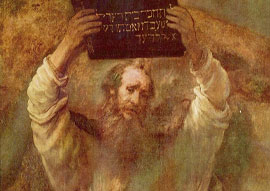
Image: "Moses with the Ten Commandments" by Rembrandt (1659). Public Domain
Add comment